On 27 April 2026, Apple introduced monthly subscriptions with a 12-month commitment — an annual subscription that customers pay for month by month while still committing to the full year. It is the most consequential change to App Store subscription mechanics in years, and most apps will treat it as a checkout option and ship it. That instinct is wrong. The monthly subscription with a 12-month commitment is not a cheaper monthly plan; it is a committed annual billed monthly — and where it sits on your paywall, and what it replaces, is an architecture decision rather than a pricing tactic. This playbook covers what Apple actually shipped, where the tier earns its place, and how to test it without burning your most valuable cohort.
What Apple actually shipped (and what it isn't)
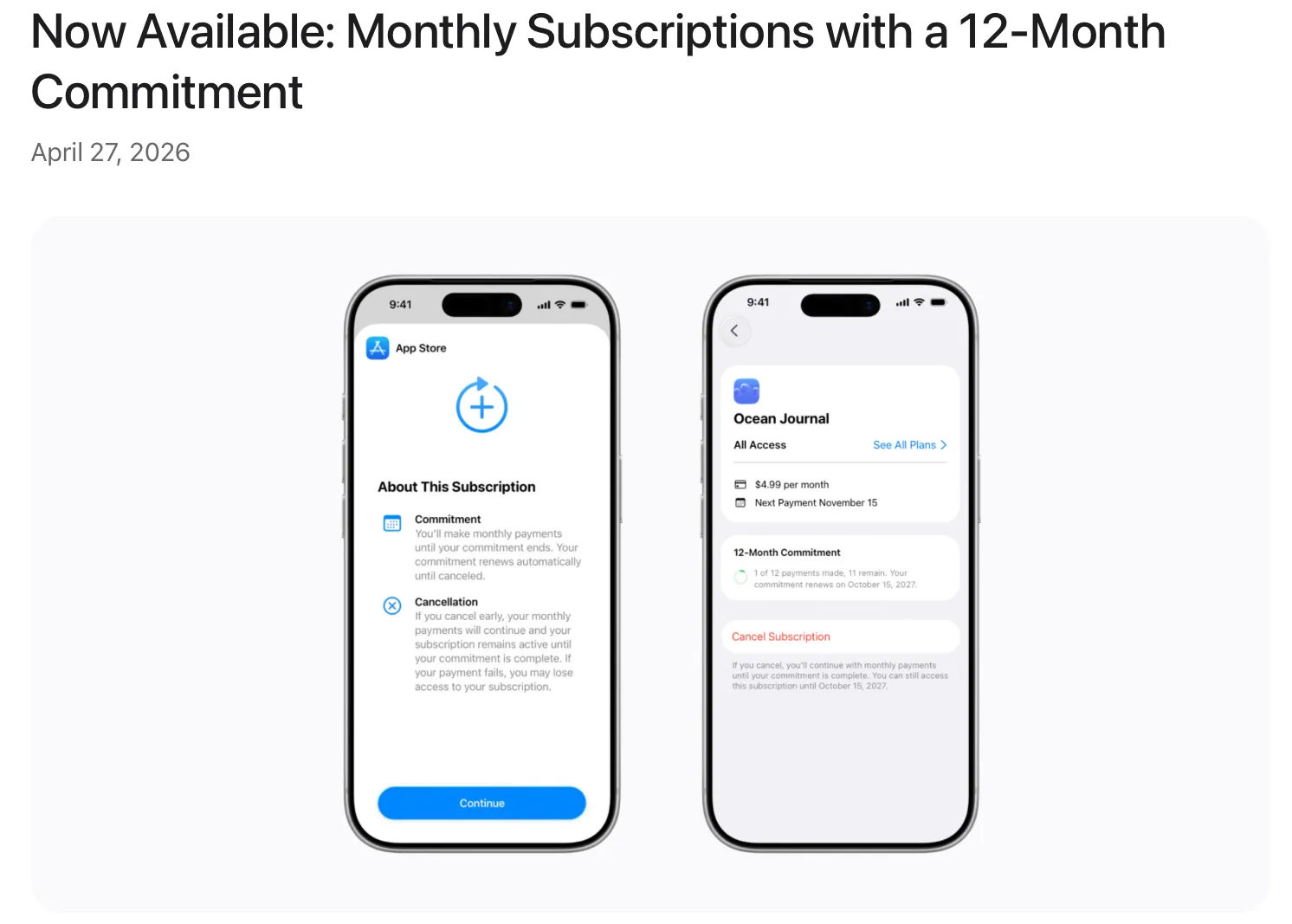
The mechanic matters more than the headline. Apple is modelling this as a single annual subscription product with multiple billing plans underneath it — a "1 Year Upfront" plan and a "Monthly With 12-Month Commitment" plan can sit under the same product. That is structurally similar to Google Play's installment base plan: one subscription concept, several purchasable configurations, each with its own offers and behaviour. It is a packaging shift, not just a new price point — and how it surfaces depends on your paywall and billing stack, not only on App Store Connect.
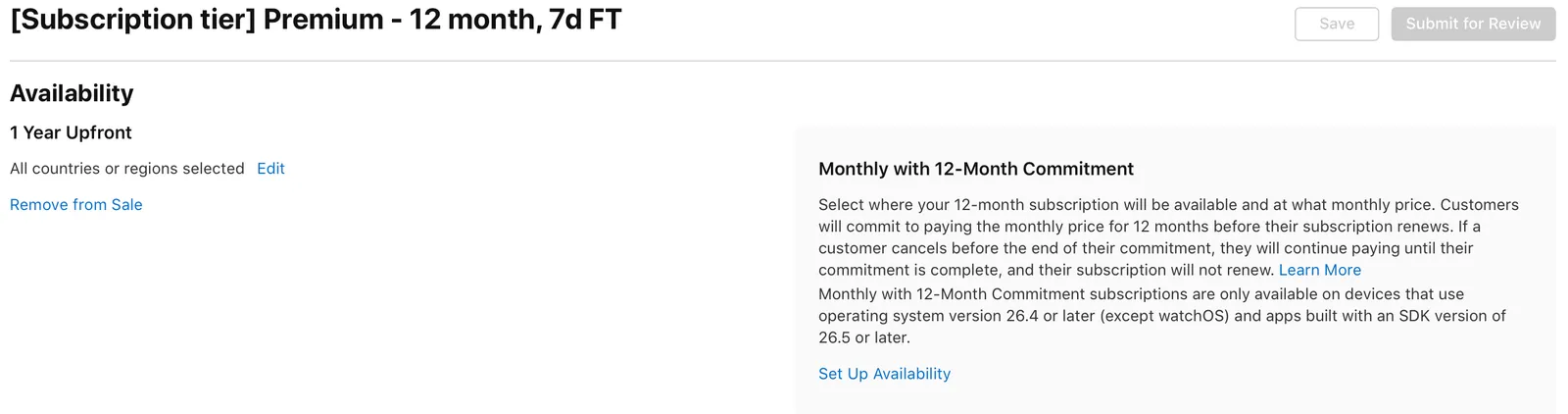
The constraints shape every test you might run. The plan launched everywhere except the United States and Singapore, available to customers on iOS 26.4 and later and rolling out with iOS 26.5. Apple has also fenced the pricing: according to reporting on Apple's developer documentation, the commitment total must be at least equal to the upfront annual price and no more than 1.5× that price — a deliberately narrow band that prevents both undercutting and predatory framing.
The customer experience is the part most teams skip before designing the paywall. Subscribers see completed and remaining payments inside their Apple Account, Apple sends renewal reminders by email and push, and cancelling early stops the next 12-month renewal but does not end the current payment obligation in most markets. A failed charge can suspend access until payment is recovered. In other words, this behaves more like an instalment plan than a flexible monthly subscription — which is why calling it "a cheaper monthly plan" on your paywall would be a mistake. It isn't one. It is a committed annual with monthly billing.
What this means for subscription apps
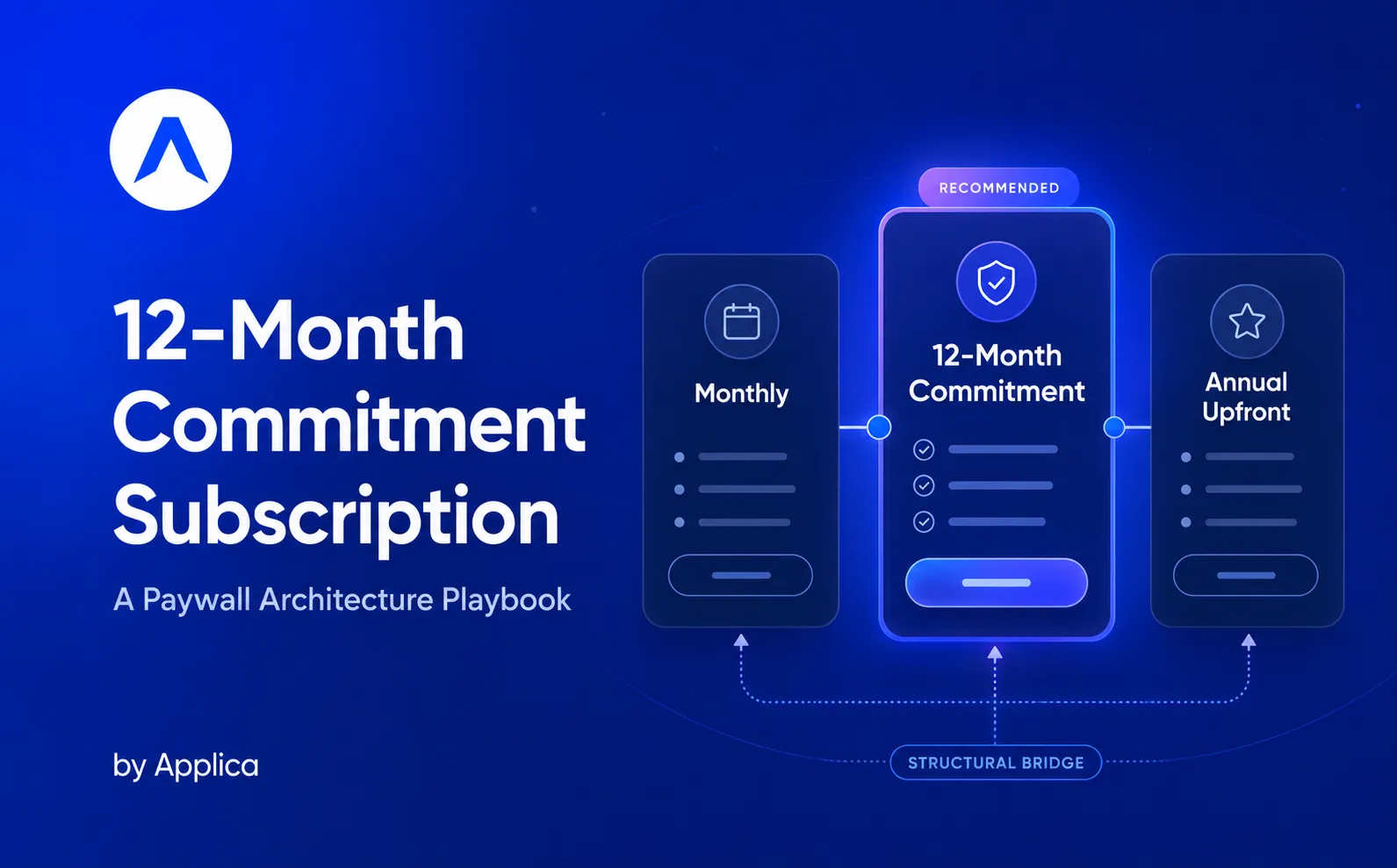
The strategic shift is easy to state and harder to operationalise: architecture matters more than pricing tactics here. Most subscription paywalls present a binary — monthly and annual. The new plan establishes a logical middle: closer to annual on commitment and unit economics, closer to monthly on perceived friction at checkout. That is not a discount feature; it is a structural option for resolving the tension every paywall navigates between high-conversion, low-lifetime-value (LTV) monthly plans and low-conversion, high-LTV annual plans.
What does the 12-month commitment tier actually cannibalise?
Every subscriber who picks the commitment plan came from somewhere. Some shift from the annual cohort — neutral in LTV, a downgrade only in cash collected upfront. Some shift from the monthly cohort — an upgrade in commitment. And some would not have subscribed at all — net new. The distribution across those three buckets decides whether the tier helps or hurts, and net revenue per visitor, not paywall conversion rate, is the metric that tells you the truth. A tier can lift selection rate while quietly pulling cash collection forward from your highest-value annual buyers — which is exactly the kind of effect that analytics alone won't catch and experimentation will.
The US exclusion deserves more weight than the coverage gives it. For most Tier-1-focused apps, the United States is the highest-average-revenue-per-user market and the most expensive to acquire in — and it is precisely the market you cannot test in. RevenueCat frames the launch the same way: in many markets the barrier is not that users dislike commitment, but that a $50–$60 upfront charge is a meaningful expense relative to local purchasing power. That reframes the rollout. This is not a universal monetisation shift — it is a regional pricing lever, available outside your most economically significant geography. It also lands in a market that is consolidating: RevenueCat's data shows the top quartile of subscription apps grew 80% year over year while the bottom quartile shrank 33%, so packaging decisions compound faster than they used to.
Three uses, and three traps
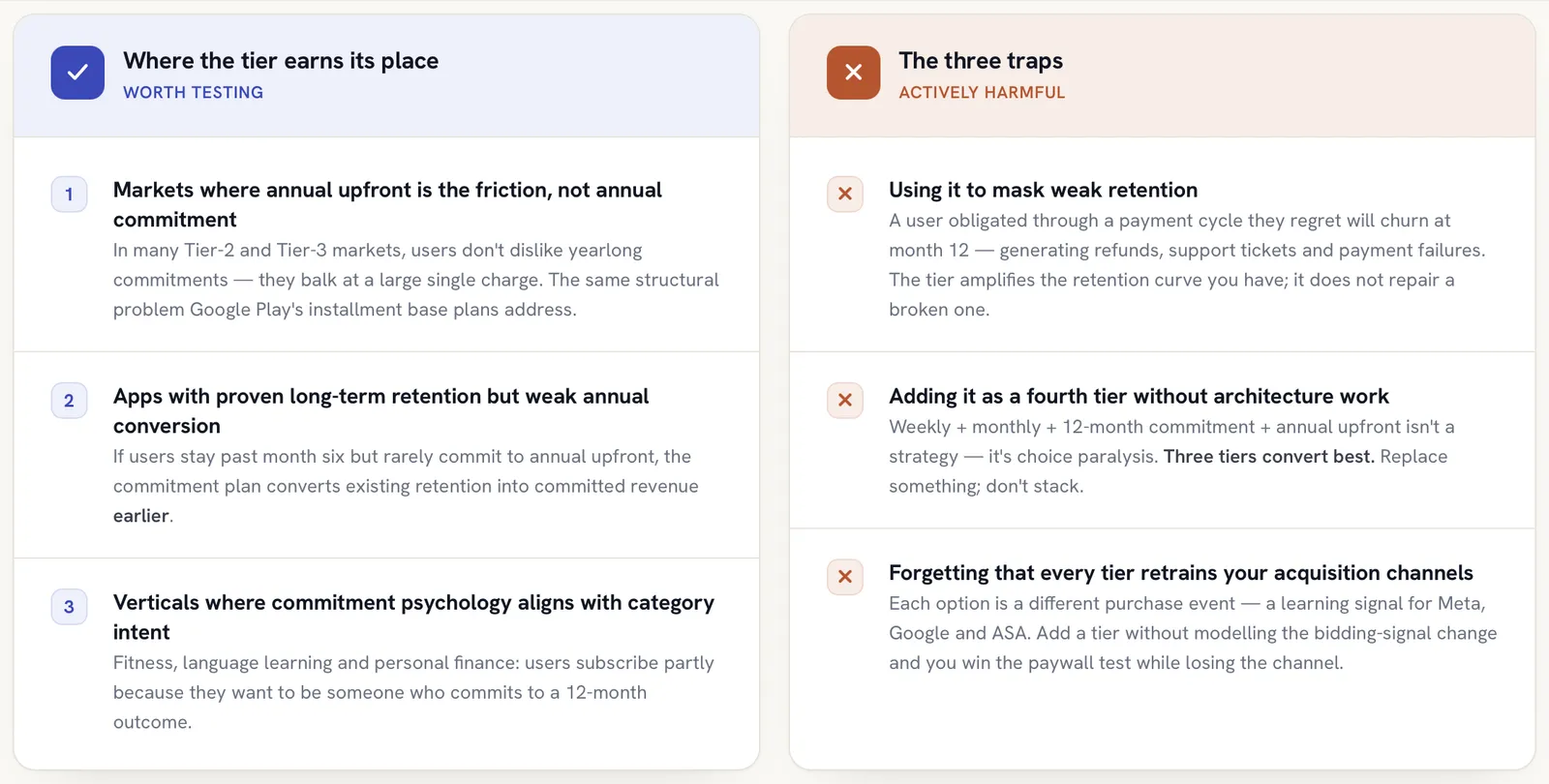
Not every app should ship this tier. At Applica Agency, our operating sequence is to ask whether the new mechanic resolves a problem the existing paywall actually has — and to refuse to ship it when it doesn't. Three situations make the tier worth testing, and three make it actively harmful.
Where the tier earns its place
- Markets where annual upfront is the friction, not annual commitment. In many Tier-2 and Tier-3 markets, users don't dislike yearlong commitments — they balk at a large single charge. This is the same structural problem Google Play's installment base plans address, and they are live in only four countries — Brazil, France, Italy, and Spain — a directional signal for where this Apple tier is likely to perform.
- Apps with proven long-term retention but weak annual conversion. If users stay past month six but rarely commit to annual upfront, the commitment plan converts existing retention into committed revenue earlier. RevenueCat's 2026 benchmarks show hard-paywall apps convert roughly five times better than freemium at Day 35 — a 10.7% median versus 2.1%, and apps with retention strong enough to run a hard paywall are exactly the ones with room to use this tier.
- Verticals where commitment psychology aligns with category intent. Fitness, language learning, and personal finance share a pattern: users subscribe partly because they want to be someone who commits to a 12-month outcome. For these categories the tier reinforces the value narrative. For utility and entertainment apps, where commitment psychology is weaker, it is harder to justify.
The three traps
- Using it to mask weak retention. RevenueCat is direct that the plan cannot compensate for poor engagement — a user obligated through a payment cycle they regret will churn at month 12 and generate refunds, support tickets, and payment failures along the way. The tier amplifies the retention curve you already have; it does not repair a broken one.
- Adding it as a fourth tier without architecture work. A paywall with weekly, monthly, 12-month commitment, and annual upfront is not a four-tier strategy — it is choice paralysis. The evidence on pricing-page structure is consistent: three tiers convert best, and four or more convert worse as the center-stage effect loses focus. Most apps adding the new tier should replace something, not stack.
- Forgetting that every tier retrains your acquisition channels. Each pricing option creates a different purchase event with a different value distribution, and that event becomes a learning signal for Meta, Google, and Apple Search Ads (ASA) optimisation. Add a tier without modelling the bidding-signal change and you can win the paywall test while losing the channel.
How to test it without burning the annual cohort
The temptation is to ship the tier as an A/B test variant and read paywall conversion in two weeks. That will mislead you twice over: payment-failure dynamics take longer than two weeks to surface, and the cohort-composition shift takes a full purchase cycle to measure. A disciplined sequence works better.
Start with markets where annual is structurally weak
The first question is not what the new paywall looks like but which market gets it first. Look at your pricing data: where is annual conversion well below your portfolio median, and where is monthly-to-annual upgrade poor despite healthy monthly retention? Those are the markets where upfront price is most likely the friction. If you don't yet localise pricing and paywall strategy by country, build that first — willingness to pay varies two to three times between markets, and the new tier only pays off on top of localisation you've already proven.
Choose the architecture — three-tier vs replacement
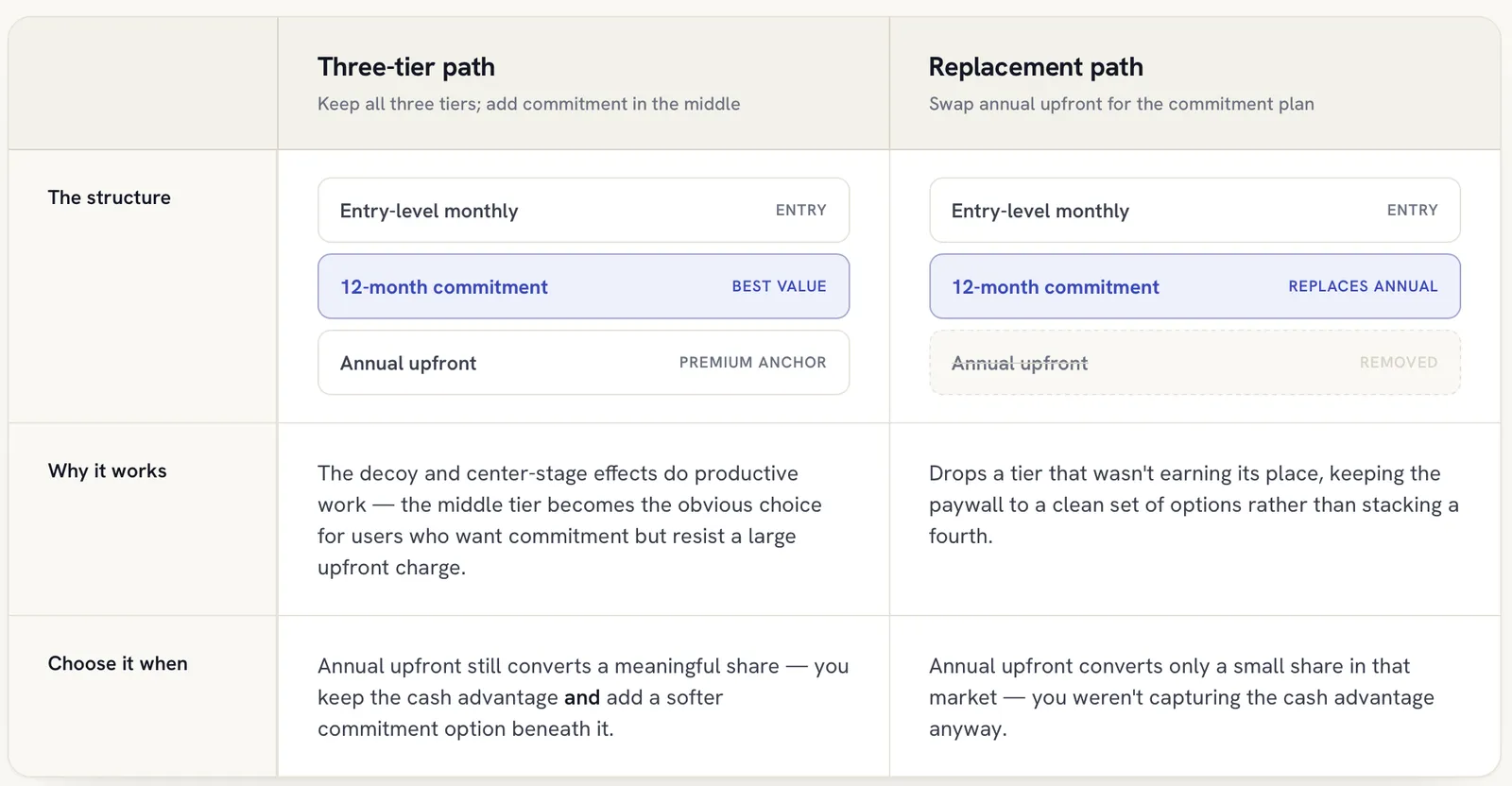
There are two viable architectures. In the three-tier path, you keep an entry-level monthly, position the 12-month commitment plan as the middle "best value" option, and retain annual upfront as the premium anchor — the configuration where the decoy and center-stage effects do productive work, making the middle tier the obvious choice for users who want commitment but resist a large upfront charge. In the replacement path, you swap annual upfront for the commitment plan entirely; this is appropriate only when annual upfront converts a small share of payers in that market, in which case you weren't capturing the cash advantage anyway. Tie the choice to your data, not your gut — the right answer in Brazil may be wrong in Germany.
How long should you test a new billing tier?
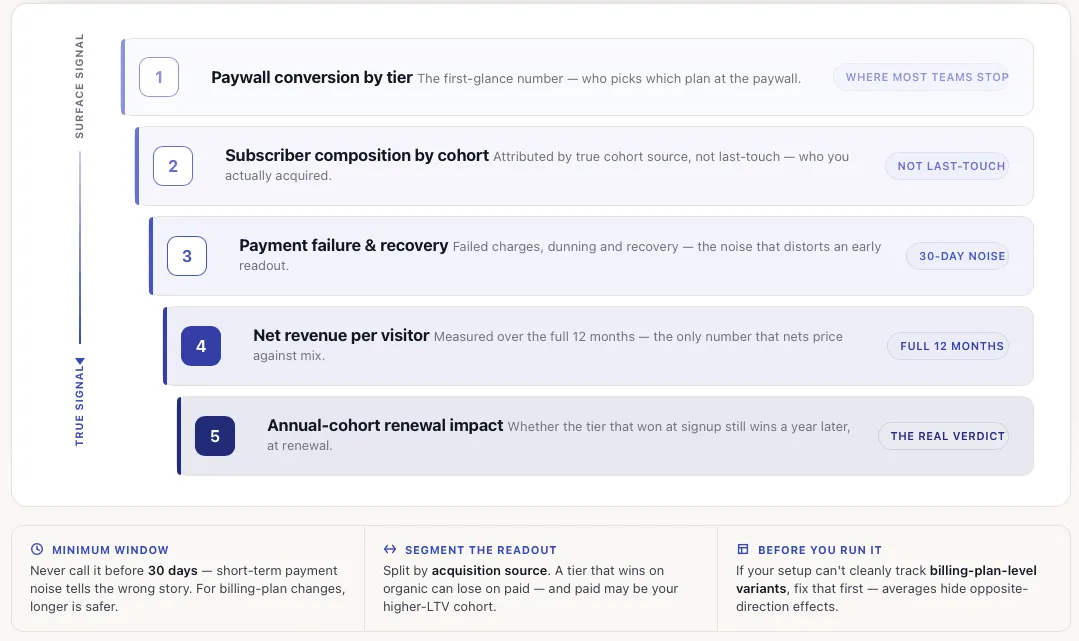
Longer than you want to, and measured on more than one number. Track at least five layers: paywall conversion by tier, subscriber composition by cohort attribution (not last-touch), payment failure and recovery, net revenue per visitor over the full 12 months, and annual-cohort renewal impact. Don't call the test before 30 days — short-term payment noise will tell the wrong story — and for billing-plan changes a longer window is safer. Then segment the readout by acquisition source, because a tier that wins on organic can lose on paid, and your paid cohort may be your higher-LTV one. Averages hide opposite-direction effects. If your testing setup can't cleanly track billing-plan-level variants, fix that before you run the experiment — it is the kind of structured A/B testing and data work that decides whether the readout means anything.
What actually moves ARPU on paywalls — and what doesn't
Here is the lesson from running paywall experiments across a subscription portfolio: format and pricing-tier decisions usually matter less than the value-perception decisions that move average revenue per user (ARPU). Most teams optimising paywalls reach for the visible levers — new tiers, new prices, new discount framing — when the higher-leverage lever is often invisible: aligning what the paywall communicates with what each user segment actually values.
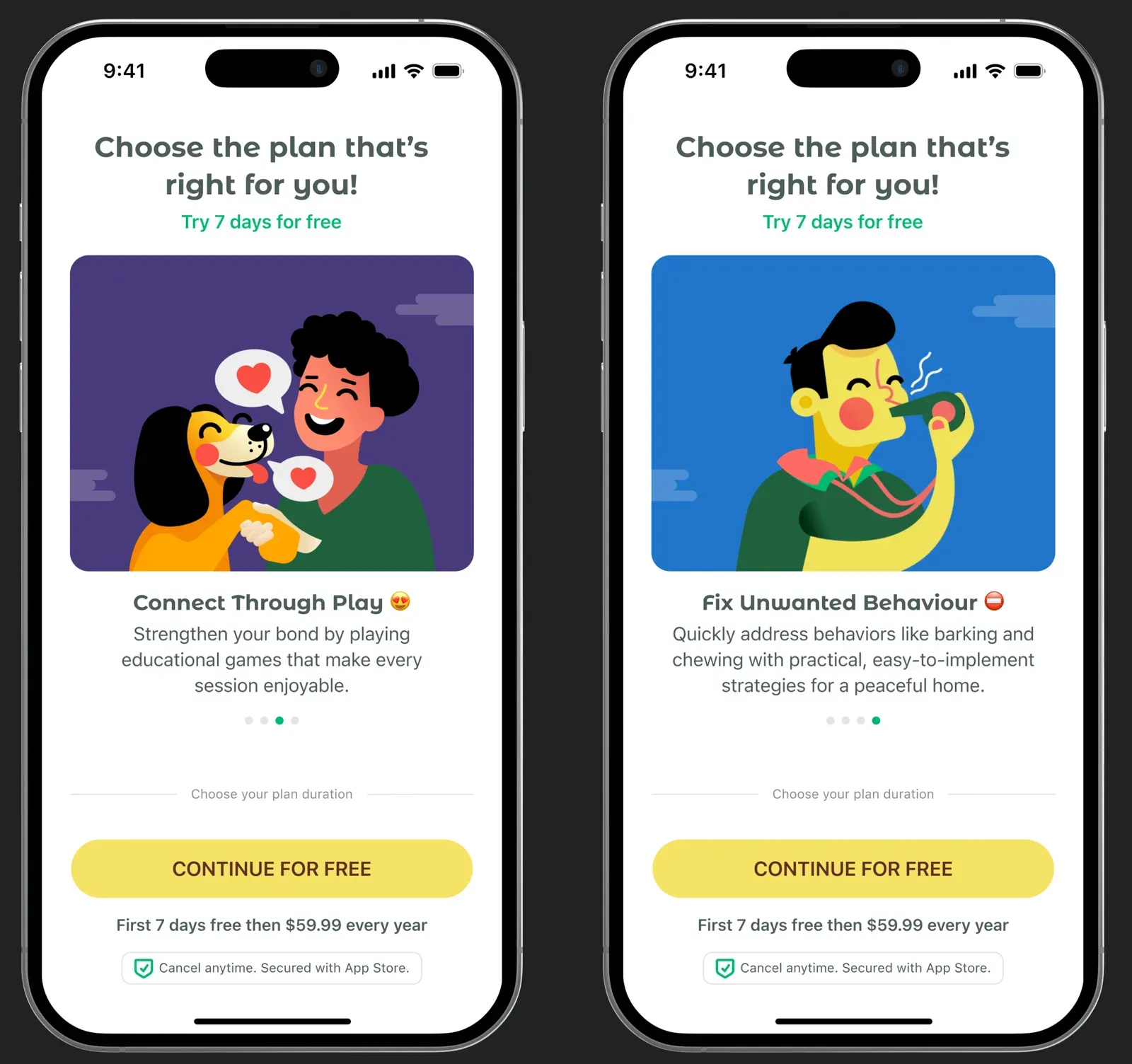
Dogo, a dog-training app, lifted ARPU by 13% — not by adding a pricing tier, but by rebuilding paywall messaging around three distinct owner segments surfaced through structured research. Results-oriented owners cared about training effectiveness, social owners about community, and support-seeking owners would pay a premium for expert guidance. Same pricing, segment-specific value communication, +13% ARPU. The takeaway for Apple's new tier is not that it doesn't matter — it does — but that it is one lever among many, and most apps will get more from value-communication work than from architecture work. If your paywall hasn't been tested on segment-specific messaging in the last 90 days, that is usually the higher-leverage place to start, and the commitment tier sits far more usefully on top of a paywall that already communicates well. Our mobile paywall design guidance goes deeper on building that foundation.
When to wait, and when to test now
Wait if your retention is unstable past Day 30 (the tier amplifies whatever your retention already is), your annual cohort is your highest-LTV segment and you haven't isolated why, you operate primarily in the US (you can't test it there, and US data won't transfer), or your testing setup can't track billing-plan-level variants cleanly.
Test now if you have proven annual-equivalent retention but weak annual upfront conversion in Tier-2/3 markets, you already localise pricing and paywall strategy by region, you can commit to a multi-week window with statistical discipline rather than ending on noise, and your paywall has already been optimised for segment-specific messaging. For most apps the right order is the same: fix paywall value communication first, localise pricing second, and test the commitment tier third — in the markets where it has the strongest structural reason to work. Out of order, the experiment produces noise; in order, it produces a regional ARPU lever.
Conclusion
Three things are worth holding onto. First, Apple's 12-month commitment subscription is a paywall architecture decision, not a checkout button — the question is where it sits and what it replaces. Second, it is a regional lever, not a universal default — the apps that benefit most operate where annual upfront pricing is the structural friction, not annual commitment itself. Third, it is an experiment, not a launch — the right test runs for weeks, segments the readout by acquisition source, and measures net revenue per visitor rather than paywall conversion alone.
If your paywall hasn't been tested in the last 90 days — or your pricing isn't yet localised to the markets where this tier is most relevant — that's where to start, before adding new architecture on top. If you want a partner to design the experiment, interpret the readout, and turn it into a roadmap, let's talk — Applica Agency builds conversion and monetisation systems for subscription teams across FinTech, EdTech, and WellTech.