Picture an event called trial_started. It fires reliably, the count looks healthy, and every week it feeds the trial-to-paid conversion number the team reviews. Except it fires on paywall view, not on trial activation — so the denominator is inflated with people who never started a trial, and conversion reads worse than it actually is. Nobody notices, because nothing looks broken. The chart is smooth, the number is plausible, and a quarter of pricing and onboarding decisions get made against a measurement that quietly means something other than its name.
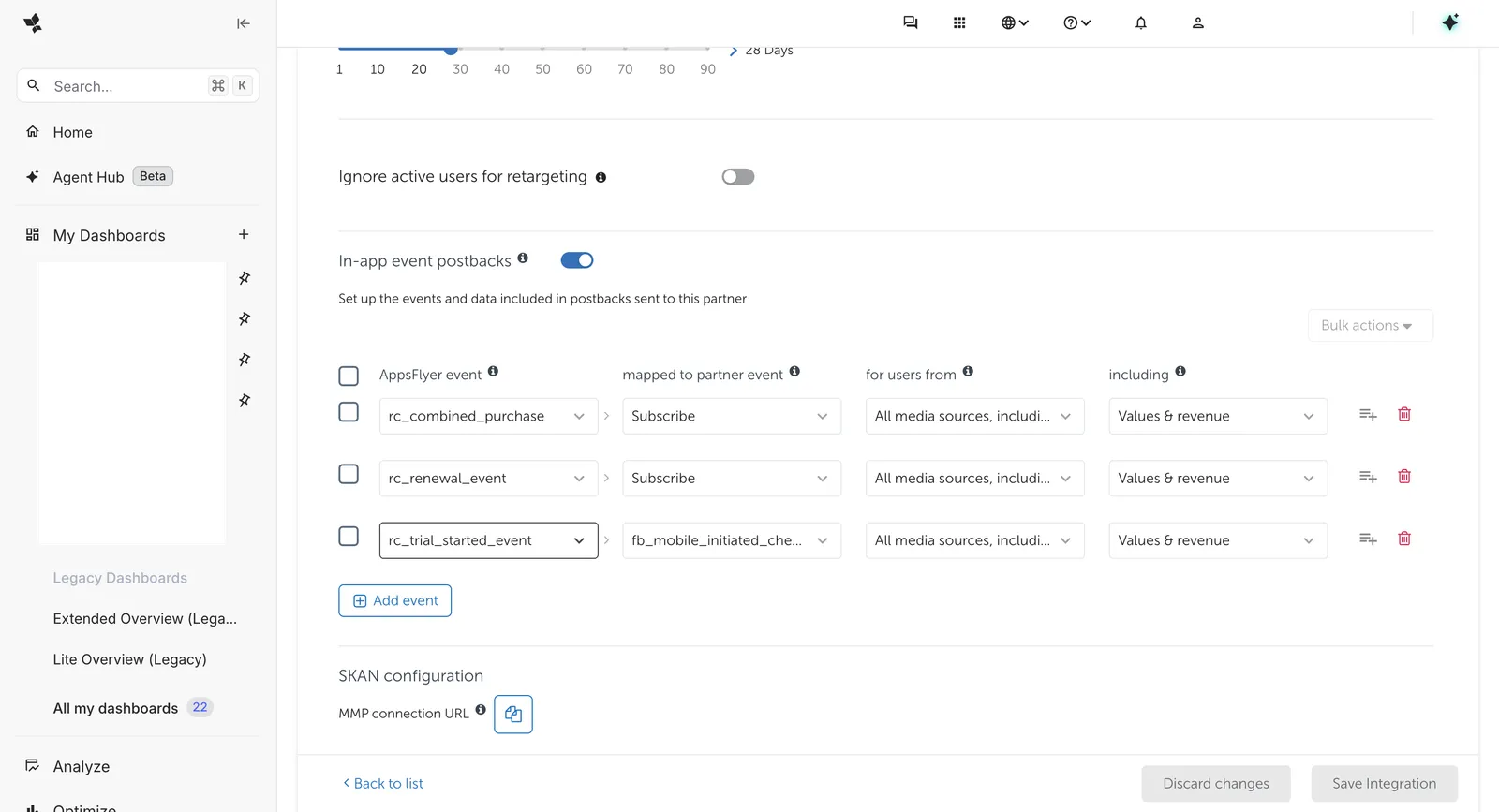
This is the failure mode senior teams almost never budget for. You already run Mixpanel, Amplitude, or RevenueCat; you already ship experiments on the data. The risk isn't that you're missing data — missing data announces itself. The risk is confidently wrong data: an event whose definition drifted away from its label and now passes every surface check while corrupting everything downstream. What follows is the structural reason event tracking accuracy degrades, why the error stays invisible, how it compounds through experiments and ad algorithms, and the diagnostic and operating discipline that catch it before it ships another decision.
What event tracking accuracy actually means — and why a plausible number is the trap
An event name is a promise. trial_started promises that a row in your warehouse corresponds to a human who began a trial. The implementation is the reality — the line of code that decides when the event actually fires. Event tracking accuracy is simply the distance between those two things, and the uncomfortable truth is that the distance is rarely zero and almost never measured.
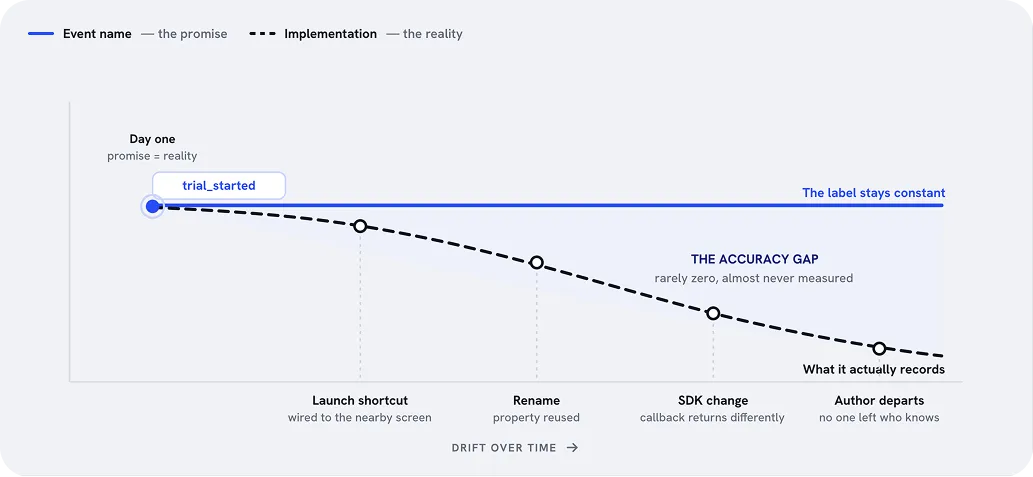
The gap opens quietly. A developer wires the event to the screen that usually precedes activation because it's faster to instrument. A property gets reused. A platform changes what a lifecycle callback returns. None of these throw an error. The event keeps firing, the dashboard keeps filling, and the promise and the reality drift apart while the label stays reassuringly constant.
Why are confidently wrong analytics events more dangerous than missing data?
Missing data is loud. A gap in a funnel, a column of nulls, a metric that flatlines at zero — these trigger an investigation within hours because something obviously isn't there. Confidently wrong data is silent. It produces a number in the expected range, moving in the expected direction, so it gets trusted and acted on.
The cost is real and easy to under-read. In one published analysis of client-side versus server-side tracking, a single tracking gap of roughly 400 users amounted to nearly $200,000 in misattributed revenue — not a missing chart, but a wrong one that looked fine. And because the error wears the costume of normal data, it tends to be diagnosed late: data-quality problems often look like a different problem first, so weeks or months of compounding decisions can accumulate before anyone traces the symptom back to its source. Not the absence of data, but the false confidence of it, is what makes this expensive.
How event definitions drift: 5 mechanisms
Drift isn't random. It arrives through a small set of recurring 5 mechanisms, and recognising them is most of the diagnosis.
- Implementation shortcuts at launch. Under deadline, an event gets bound to the nearest convenient trigger rather than the exact moment it names.
trial_startedon paywall view is the canonical case: close enough to ship, wrong enough to distort the denominator forever after. - Renamed or reused events. A team repurposes an existing event rather than defining a new one, or changes a name without versioning the definition behind it. Renaming events cleanly is genuinely hard and needs structured, peer-reviewed migration — done casually, it leaves the same label pointing at two different realities across time.
- SDK or platform changes. An analytics software development kit (SDK) upgrade or an operating-system change can alter what an event captures in ways that look like ordinary variation. The label is untouched; the payload underneath it is not.
- The original instrumentation author leaving. The person who knew that
activationactually meant "completed step three, not step two" moves on, and the tribal definition leaves with them. The event survives; its meaning becomes folklore. - Client-side versus server-side discrepancies. The same logical event fired from the app and from the backend rarely reconciles perfectly, which is why sensitive measures like revenue are better captured server-side. When a number is stitched from both sources without deduplication, its meaning depends on which path won.
A related driver sits underneath several of these: even the act of switching analytics tools or changing how you collect data introduces artificial drift that has nothing to do with user behaviour. The schema is where it concentrates — when event schemas change without proper versioning, analysis quietly corrupts, and the same action ends up named one way on web and another on mobile. The mechanism varies; the result is constant. The name holds still while the thing it measures moves.
Why the error is invisible: it passes every sniff test
The reason these errors survive review is that they satisfy every check a busy team actually runs. The event fires consistently, so monitoring stays green. The number falls in a believable range, so it doesn't trip anyone's intuition. It trends the way the team expects, so it confirms the prior rather than challenging it. A misdefined event is camouflaged precisely by looking like a well-defined one.
Worse, the breakage leaves no fingerprints. A misconfigured data layer can break tracking silently, without throwing a single visible error — events can even fire out of logical order, a "purchase" landing before the "begin checkout" that supposedly precedes it, and still populate the dashboard cleanly. The surface is intact; the meaning is hollow.
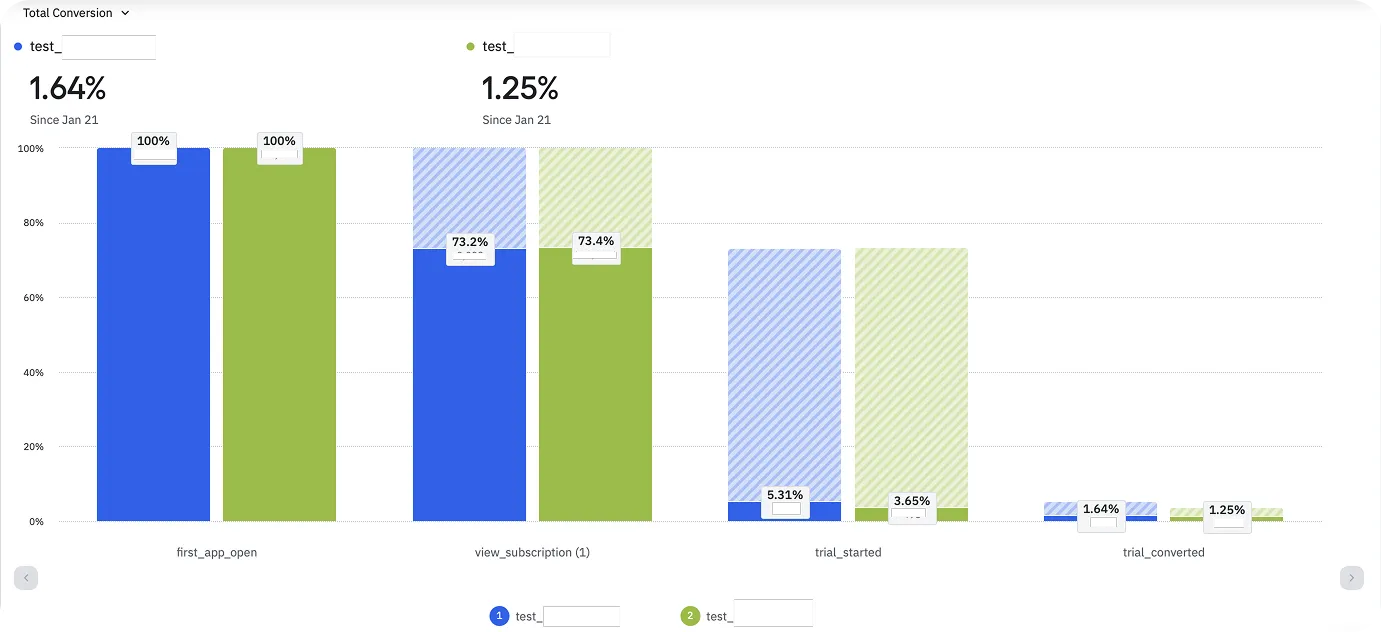
The review process compounds this. Most teams validate a metric by checking whether its magnitude is reasonable and its trend is sensible — both of which a drifted event satisfies effortlessly, because the drift is usually small enough to stay in range and stable enough to trend cleanly. A definition that is subtly wrong is harder to catch than one that is obviously broken, and a metric that confirms what the team already expected gets the least scrutiny of all.
This is why surface checks aren't enough and why the instinct to trust the dashboard is the vulnerability. Feeding decisions and downstream models poor-quality data produces poor results regardless of how confident the interface looks, and the only durable fix is at the source — the definition — not at the chart that renders it.
How the error compounds downstream
A misdefined event is rarely contained. It's an input to three systems that each amplify it.
Experiments read the wrong signal
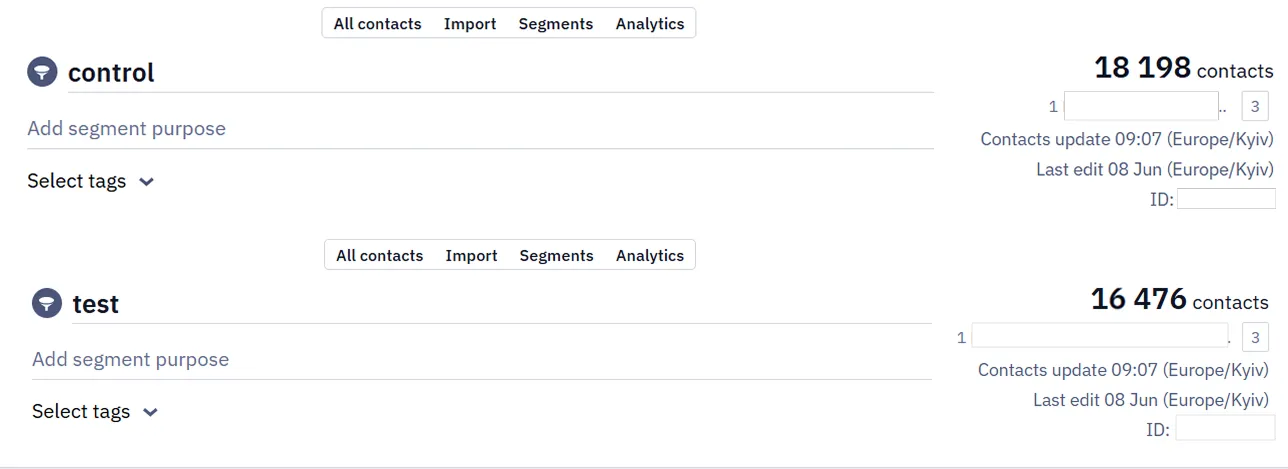
If your activation event measures the wrong moment, every experiment optimising activation is grading itself against a number that doesn't mean what the readout claims. Controlled experiments are only reliable and actionable when they sit on complete, accurate data; broken instrumentation underneath them turns a clean statistical result into a confident wrong answer. The recognised tripwire here is a sample ratio mismatch (SRM) — when observed traffic split diverges from the designed split — which the experimentation literature treats as a symptom of a wide range of underlying data-quality issues rather than a single diagnosis, much as a fever points to many possible illnesses. The deeper point is that reliable testing is downstream of reliable measurement, which is the whole case for treating end-to-end analytics as the foundation experiments are built on, and the reason an experiment can inherit a measurement error before the first variant ever ships. The failure is rarely dramatic. A variant wins, the team ships it, and the lift is even broadly real — but it's credited to the wrong mechanism, sized against a distorted baseline, and used to justify a roadmap built on a misreading. The experiment did its job; the measurement underneath it did not.
Cohorts are mis-segmented
Segmentation depends on what an event — and its properties — actually capture. A subtle but common version: segmenting by a user property versus an event property silently changes who lands in a cohort, because a user property reflects the most recent known state while an event property is fixed to the moment of the event. Define "activated users" against a drifted event and you build retention cohorts, lifecycle triggers, and the activation metric you treat as most predictive of retention on a population that isn't the one you named — an error that propagates straight into how you read results by traffic source and segment.
The paid algorithm optimises toward a misdefined event
The most expensive amplifier is the one outside your product. When you send an optimisation event to an ad platform, the algorithm can only optimise toward the signal it's fed — if purchase is actually firing on a low-intent action, the system dutifully learns to find more of the wrong people and spends real budget doing it. A drifted event doesn't just misreport history; it actively retrains your paid acquisition toward an outcome you never intended to buy.
How do you verify what an event actually measures?
Verification is a trace, not a glance. At Applica Agency, the first move when a number looks suspiciously clean is to follow the event from fire to definition: open the implementation, find the exact trigger, and confirm it matches the moment the name promises. The gap between intent and trigger is where most drift lives.
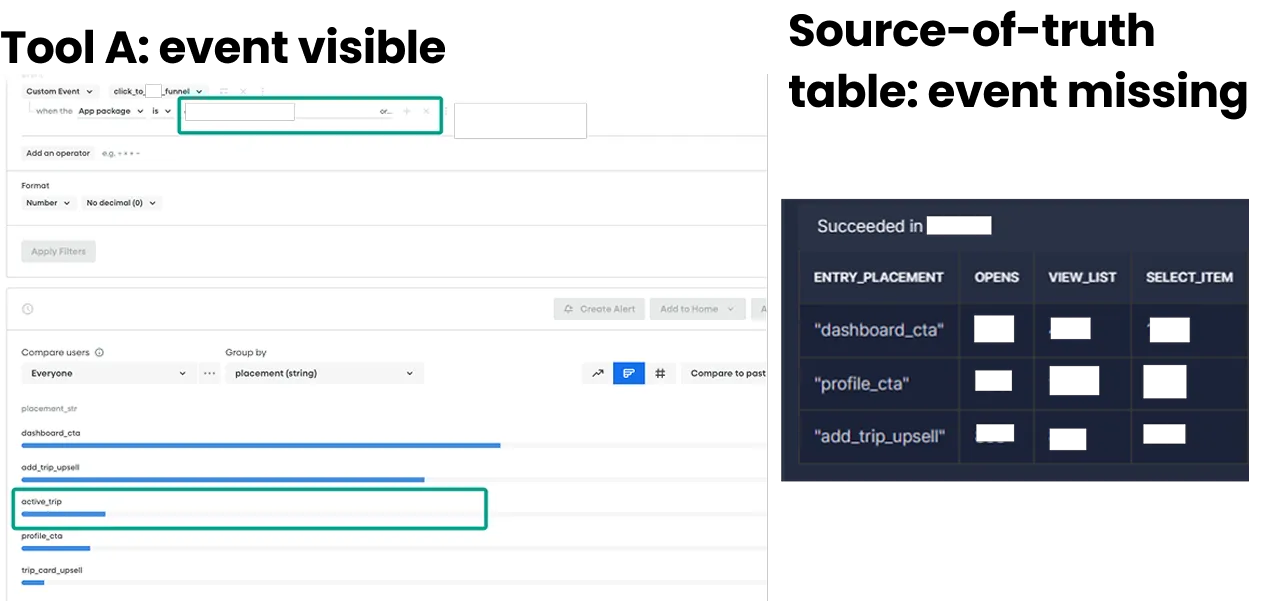
The second move is to reconcile against a source of truth. Match the event count against an independent record — server logs, billing, or a backend system — because server logs are the most direct account of what actually happened, and a discrepancy between the two is the fastest signal that a definition has slipped. This is also where the choice of attribution and measurement tooling matters, since client-side and server-side paths rarely agree by default. When your own systems disagree about the same metric, that's a related-but-distinct failure worth its own diagnosis — the problem of reconciling sources of truth when Mixpanel, RevenueCat, and Stripe contradict each other.
The third move is to check the event against raw user sessions. Replay or inspect a sample of real users and confirm the event fired when, and only when, it should have. A definition can survive every aggregate check and still fail the moment you watch a single user trip it at the wrong time. Verification is the act of looking at the moment, not the total.
The discipline most teams skip
Verification once is an audit. Verification on a cadence is a system, and the difference is what separates teams who get burned twice from teams who get burned once. At Applica Agency, our operating sequence treats the event taxonomy as infrastructure with four obligations.
- Documented definitions. Every event has a written definition — what it means, when it fires, what its properties carry — maintained as a versioned taxonomy with explicit lifecycle labels like proposed, active, and deprecated, so a name can never quietly point at two realities.
- Named ownership. Each event and each codebase source has an owner, and stakeholders are pulled into review whenever data they depend on is being modified. Definitions don't leave with the person who wrote them.
- Periodic re-validation. A tracking plan is a source of truth that decays without active maintenance built into the sprint cycle. Re-validation is scheduled, not triggered by the next crisis — the same logic behind reviewing the history of past experiments before trusting their lessons.
- Instrumentation review on a cadence. Changes to events go through review like code changes do, so drift is caught at the point of change rather than discovered months later in a misread funnel — and the core metrics worth tracking stay anchored to definitions everyone agrees on.
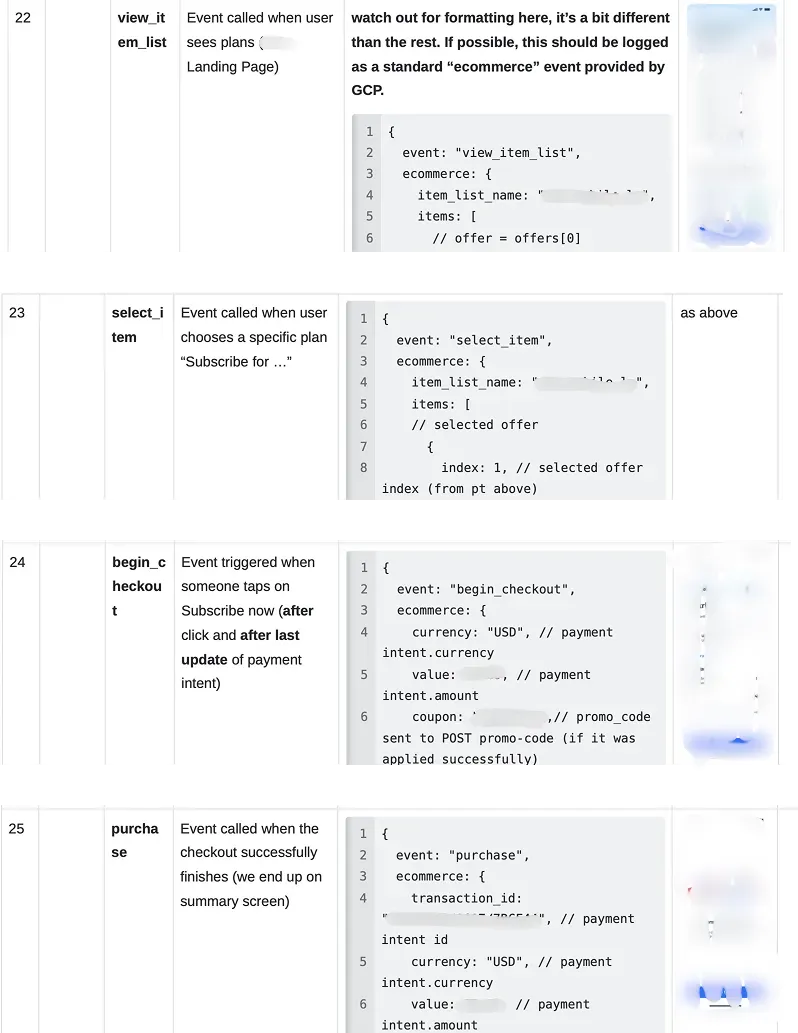
In one engagement, this discipline is exactly what surfaced a trial_started event firing on paywall view rather than activation — the trial-to-paid denominator had been inflated for months, making conversion look worse than it was and pointing the team at the wrong fixes. The instrumentation correction wasn't glamorous work, but it was the precondition for every decision after it to be made against reality instead of a plausible fiction.
Three takeaways
First, an event name is a promise and the implementation is the reality — event tracking accuracy is the distance between them, and that distance is almost never measured. Second, the dangerous errors are invisible by construction: they pass every sniff test, get trusted, and are inherited by experiments, cohorts, and ad algorithms before anyone questions them. Third, the fix is not a one-time audit but a discipline — documented, owned, versioned definitions, re-validated on a cadence.
If your team is shipping product, pricing, and acquisition decisions on dashboard reads you haven't traced back to their definitions, that's the place to start. Talk to Applica Agency about A/B testing and analytics diagnostic — we can validate what your events actually measure before the next decision inherits the error.
Frequently asked questions
What is event instrumentation drift?
Event instrumentation drift is the gradual divergence between what an analytics event is named and what its implementation actually records. It happens through launch shortcuts, renamed or reused events, SDK and platform changes, loss of the original author's knowledge, and client-side versus server-side discrepancies. The label stays constant while the underlying definition moves, so the data looks correct while quietly measuring something else.
How often should you re-validate event tracking?
Re-validation works best as a scheduled cadence rather than a reaction to a visible problem, because the most damaging errors never produce a visible problem. Building taxonomy maintenance into the regular sprint cycle, and routing every event change through review the way code changes are reviewed, catches drift at the moment of change instead of months later in a misread metric.
Can analytics tools flag a misdefined event automatically?
Tools can catch a lot — schema validation, naming-convention enforcement, version control, and sample-ratio-mismatch alerts will surface structural and statistical anomalies. What they cannot confirm on their own is semantic accuracy: whether an event that fires consistently and validates cleanly is firing at the moment its name promises. That last check requires tracing the event to its definition and watching it against real user sessions — judgement the tooling supports but doesn't replace.