A subscription team picks a no-code paywall tool with one expectation made explicit in the kickoff: engineering will finally be out of the paywall business. Marketing and growth will own the screen, iterate on copy and pricing in a visual editor, and ship without waiting on a release cycle. The first paywall goes live in a week, and the decision looks vindicated. Then the questions start arriving in the engineering channel. Why is the entitlement not unlocking for a cohort of returning users? Why does the revenue in the dashboard disagree with the figure finance is reading from the stores? Why did the latest operating system update break a purchase path that worked yesterday?
None of this means the tool was a bad choice. It means the team mistook the visual editor for the whole job. The no-code paywall tools that now sit under a large share of subscription revenue — Superwall, RevenueCat, Adapty, Purchasely — do remove code from one specific surface. They do not remove engineering from everything around it. RevenueCat's 2026 benchmark alone draws on more than 115,000 apps and over $16 billion in revenue across more than a billion transactions, so the expectations gap, multiplied across a portfolio at that scale, gets expensive fast. This piece is an honest map of where the engineering work lives, why it stays invisible until after you have committed, and a scoping framework for what to budget before you adopt.
What "no-code" paywall tools genuinely deliver
Start with what is real, because the value is real. The promise these tools make is narrow and they keep it well.
What does "no-code" actually mean for a paywall tool?
It means the paywall surface — the layout, copy, pricing display, and call-to-action — becomes editable without writing code and shippable without an app store release. RevenueCat's paywall product lets teams configure the entire paywall view remotely with no code changes or app updates, through a visual editor positioned for marketers and developers alike. Adapty makes the same offer — build native paywalls and ship them without app updates — and Superwall is built around exactly this loop, an open-source framework that lets you remotely configure every aspect of a paywall and iterate on the fly.
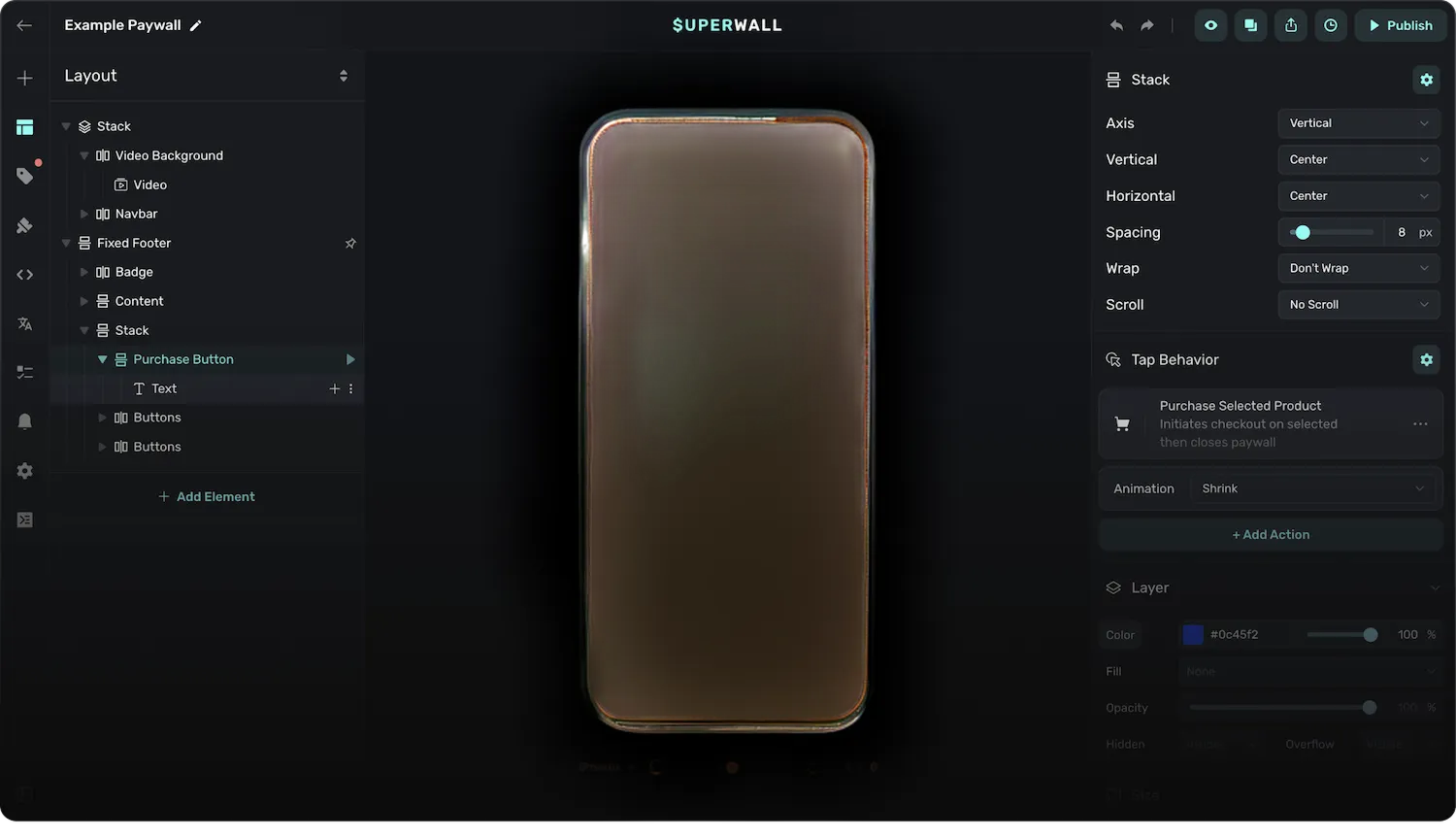
The mechanism underneath is remote configuration: the paywall definition lives on the vendor's servers, the app fetches it at runtime, and a change in the dashboard reaches users without a new binary. For a team that previously waited days for review to test a price point, that is a structural gain in testing velocity — the surface that carries the most monetisation leverage becomes the surface you can change fastest.
The value shows up in the numbers when the iteration is disciplined. In one Applica Agency engagement, a B2B client's app saw a 20% revenue uplift from structured paywall testing — the kind of gain that is only reachable when the paywall can be changed and measured quickly rather than once a quarter. That is the no-code promise delivering on its actual scope. The question this article raises is not whether that scope is valuable. It is what the tool quietly assumes you have already built around it. For teams weighing the landscape, our comparison of the major subscription paywall toolsand our reference on mobile paywall design best practices cover the surface itself in depth.
The hidden engineering layer
The visual editor is the part you see in the demo. It sits on top of a stack of engineering work that does not disappear because the editor exists — it gets relocated, from your paywall screen into the integration, the data layer, and the maintenance backlog. Five layers carry that work.
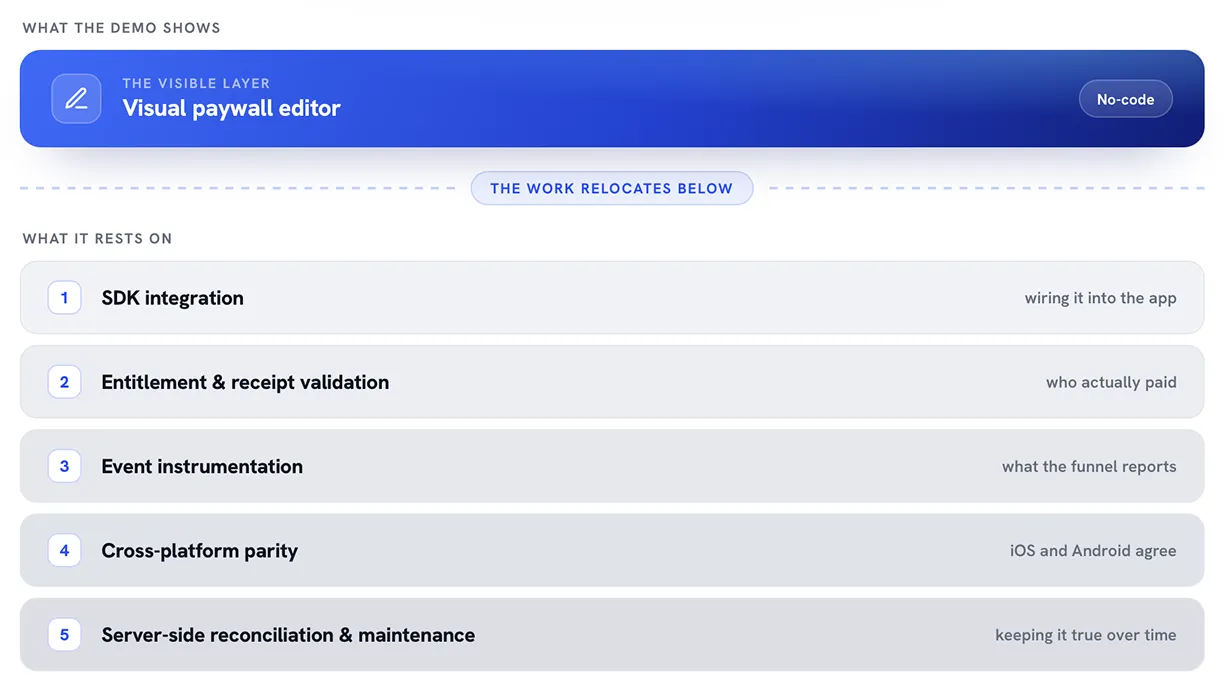
SDK integration is the first commitment, not a one-time task
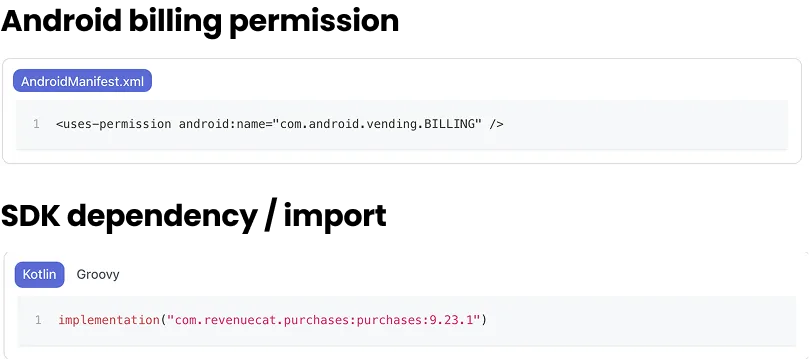
Every one of these tools ships as a software development kit (SDK) that an engineer installs, configures, and maintains. RevenueCat's own setup requires adding the SDK as a dependency, installing the dedicated paywall UI package, and configuring the shared instance on app launch, with minimum SDK versions that move over time. Superwall's Android integration is not only a dependency line — it also requires editing the application manifest to declare the billing permission and register the paywall activity. These are small tasks individually. Collectively they are the reason the paywall renders at all, and they are owned by engineering from day one and forever after.
Entitlement and receipt validation decide who gets access
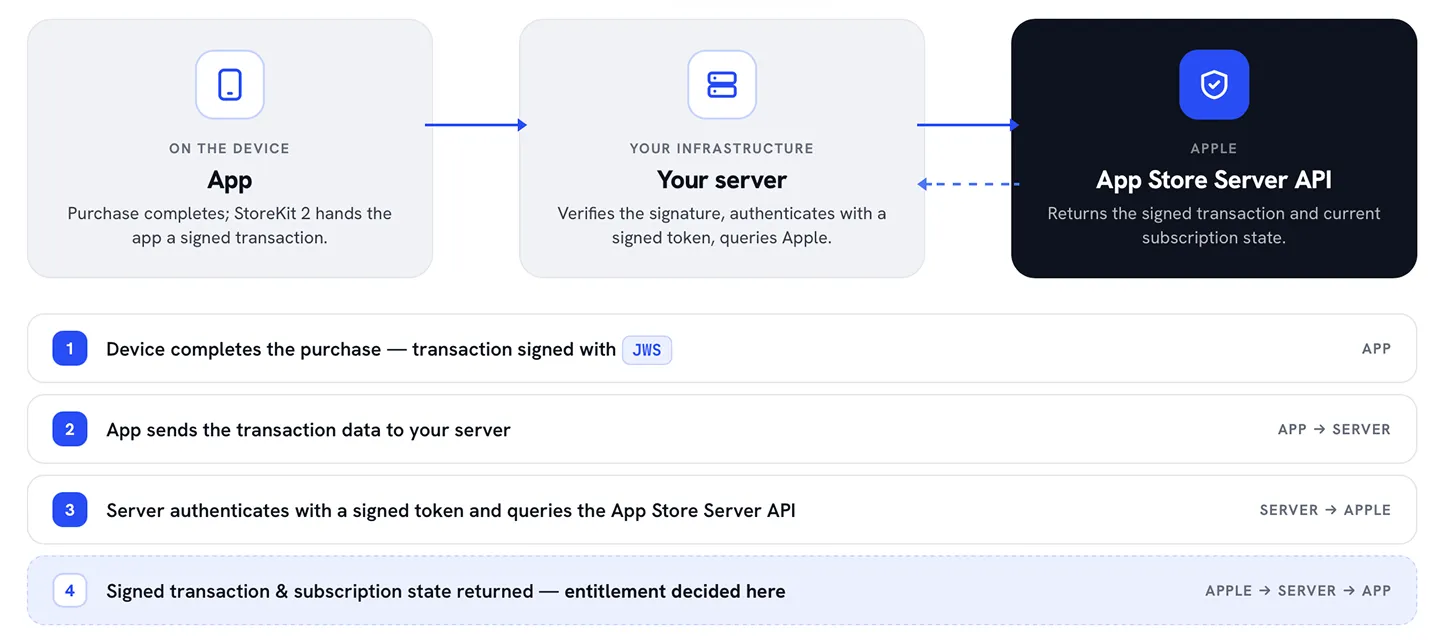
The editor changes what the paywall looks like. It does not decide who is entitled to the content behind it — and getting that decision wrong is how paying users lose access or non-payers slip through. On iOS, validating a purchase means working with StoreKit 2 and the App Store Server application programming interface (API): transactions are signed with JSON Web Signature so their authenticity can be verified, on the device and on your server. Doing it properly on the server side means authenticating with a signed token and querying Apple's App Store Server API for the current transaction and subscription state — work that has historically been one of the harder parts of integrating in-app purchases. The paywall tools abstract much of this; Adapty, for instance, states plainly that it handles the purchase flow, receipt validation, and subscription management behind the scenes because integrating with the store APIs directly is very time-consuming. That is precisely the point: the work is time-consuming enough that the tool sells itself on absorbing it — which means it is real work, now living inside infrastructure your team still has to configure correctly and reconcile against.
How accurate is the event data these tools emit?
Paywall iteration is only as trustworthy as the events that measure it, and the events are not automatically clean. Instrumentation accuracy depends on details that rarely surface in evaluation. Superwall's webhook documentation, for example, notes that the originalAppUserId field — the value that ties a subscription event back to a specific user — requires SDK version 4.5.2 or later; events generated by users still running older versions of the SDK can arrive without it. A cohort on an outdated app version can therefore produce events that silently fail to join to user identity, skewing exactly the conversion readouts the paywall programme depends on. This is the engineering discipline behind reliable experimentation, and it is the subject of a companion piece on how the events you trust are often not measuring what you think they are. For the foundational version of this problem, our guideline on instrumenting in-app experiments covers what clean event data requires.
Cross-platform parity and the maintenance treadmill
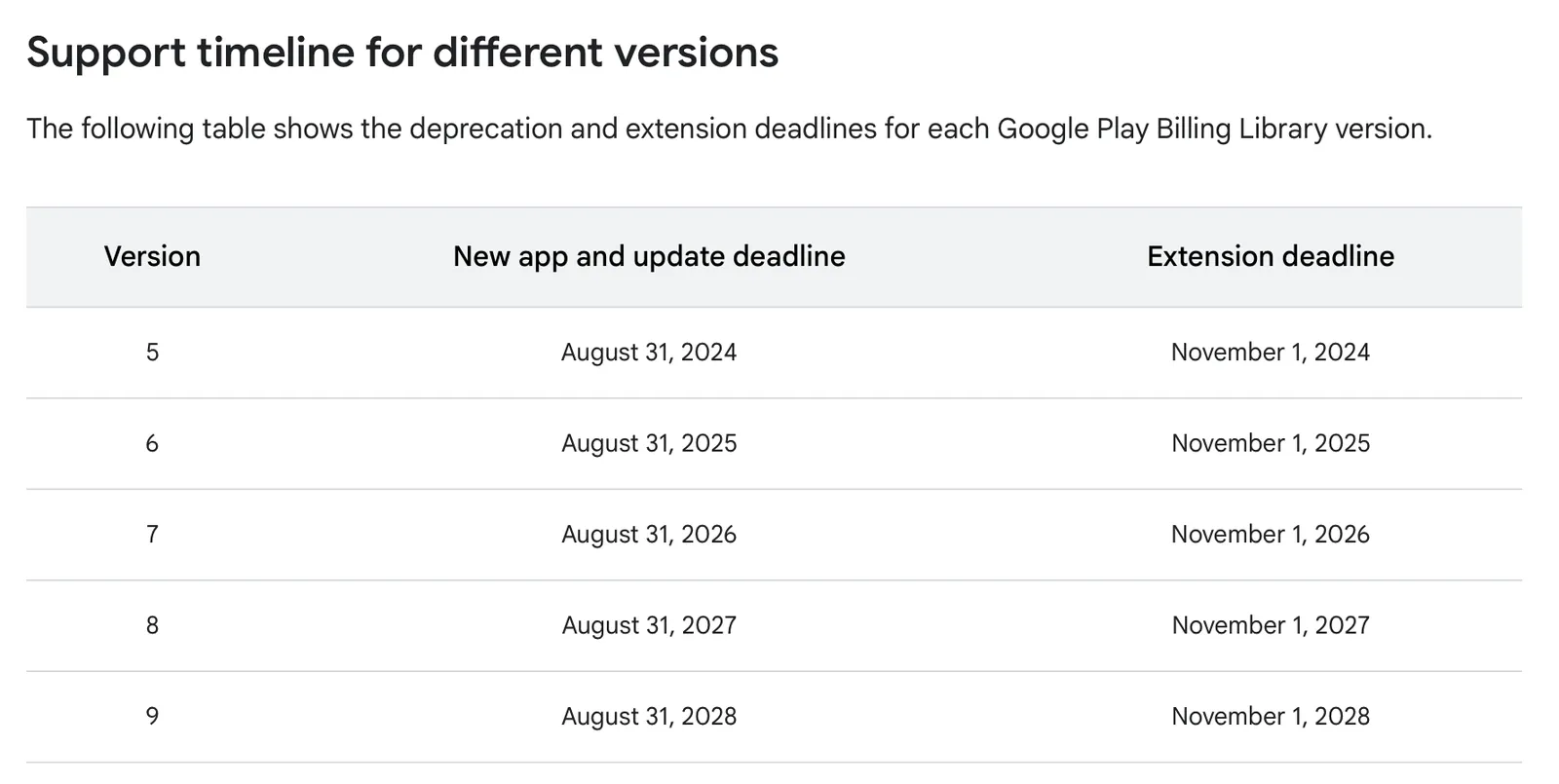
A paywall that works identically on iOS and Android is not a default — it is an ongoing engineering commitment, because the two store APIs evolve on their own schedules and break in their own ways. Google Play is explicit about the cadence: the Play Billing Library follows a two-year deprecation cycle, and Google made version 7 mandatory for app updates and new listings as of 31 August 2025, with behavioural changes that force code edits — the subscription proration model was renamed and reworked in that migration. Earlier versions removed methods teams had been relying on, with query and purchase methods deprecated and then removed across releases. None of this is optional maintenance. An app that falls behind the supported window cannot ship updates — which means the recurring upgrade load is a tax the paywall tool does not pay for you, no matter how no-code the editor is.
Server-side reconciliation: when the numbers disagree
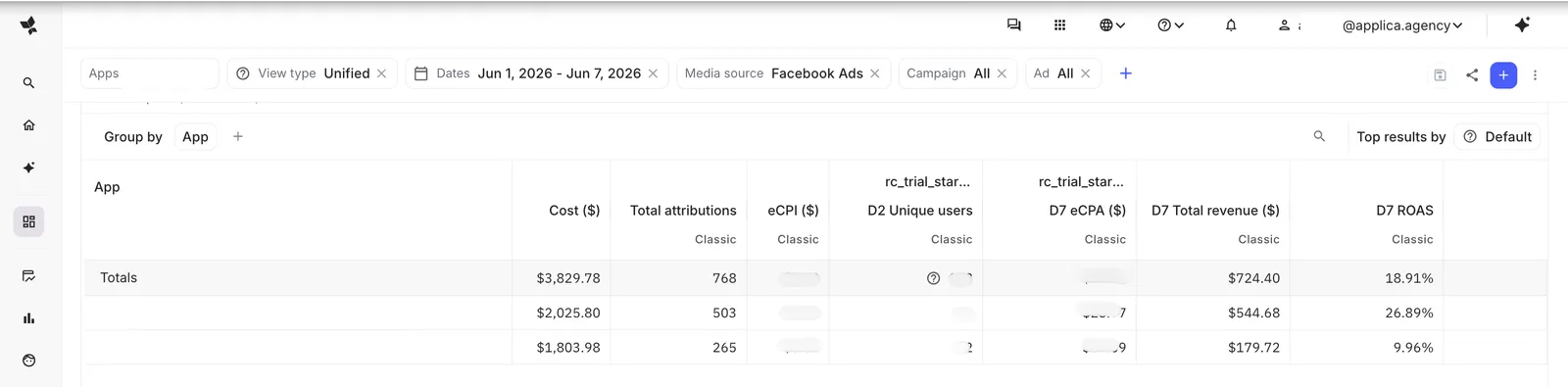
The paywall tool reports what reaches its own SDK and interface. The app store reports what it processed. The payment system reports what it settled. These three rarely agree to the cent, and reconciling them is server-side engineering, not dashboard configuration. Payment failures alone are a first-class, frequent event — Superwall's own event schema treats a billing issue as a distinct event type with its own failure reasons, and billing errors are not evenly distributed across platforms. RevenueCat's benchmark data has reported materially higher billing-error rates on Google Play than on the App Store — in the region of 28% versus 15% — which means an Android-heavy app carries more reconciliation burden than an iOS-only one. Deciding which source is authoritative for which question, and building the logic that resolves the discrepancies, is engineering work that scales with revenue — and it is the focus of our companion piece on reconciling your sources of truth when the dashboards disagree.
Why the gap is invisible at evaluation time
If this engineering layer is real, why does it consistently surprise teams? Because the evaluation moment is structured to hide it.
A sales demo shows the editor, because the editor is the differentiated, impressive part of the product. It does not show the integration backlog, the validation logic, or the maintenance calendar, because those are not the vendor's job to scope — they are yours. The cost profile compounds the problem: the work is front-loaded (the integration weeks you pay before the first paywall ships) and recurring (the maintenance you pay indefinitely), while the demo only ever shows the steady state in between, where the editor is the whole experience.
Testing infrastructure is a third invisible cost. Running a credible paywall programme means more than flipping variants on — it means sized experiments, clean assignment, and a documented history you can learn from, which is the difference between a programme that compounds and one that produces noise. Our framework for reviewing your experiment history covers what that discipline requires, and the segmentation problem — why the same paywall can win on one traffic source and lose on another — is its own engineering and analysis commitment. None of these appear in a thirty-minute walkthrough of a drag-and-drop builder.
The realistic operating model: collaboration, not replacement
The honest version of the no-code promise is not "engineering exits the paywall." It is "the boundary moves." Growth and monetisation own the surface — the copy, the pricing structure, the experiment design, the iteration cadence — and they no longer need a developer to change a headline. Engineering owns the integration and the data layer underneath — the SDK lifecycle, the validation logic, the instrumentation that keeps events trustworthy, and the reconciliation that keeps the numbers honest.
This is the operating model that holds up, and it is the one Applica runs inside subscription engagements: a diagnostic phase that reads where the constraint sits, a prioritisation framework that turns a long hypothesis backlog into a sequenced roadmap, and a disciplined testing programme on top of infrastructure that can be trusted. The no-code tool accelerates the iteration half of that loop. It does not remove the half that makes the iteration mean anything. Teams that internalise this run structured paywall experimentation as a genuine partnership between two functions — not as a handoff that leaves one of them holding an unscoped backlog.
A scoping framework: what to budget for
Before adopting a no-code paywall tool, scope the three engineering commitments. Each one is a real line item, and naming them up front is the difference between a clean adoption and a surprised engineering team a month in.
| Commitment | What it covers | Shape of the cost |
|---|---|---|
| 1. Initial integration | SDK installation and configuration, entitlement and receipt validation, store setup on iOS and Android, first event instrumentation | Front-loaded; measured in engineering-weeks before the first paywall ships |
| 2. Instrumentation ownership | A named owner accountable for the accuracy of paywall events, identity stitching, and the analytics the programme reads | Continuous; small but non-zero, and it never reaches zero |
| 3. Ongoing maintenance | SDK and operating-system upgrades, store-API deprecation cycles, cross-platform parity, server-side reconciliation as volume grows | Recurring; scales with platforms supported and revenue processed |
The numbers vary by app, but the structure does not. A team that budgets only for commitment one — treating integration as the whole cost — is the team that discovers commitments two and three the hard way. Scope all three, and the no-code tool delivers exactly what it promises without the unpleasant surprises.
Frequently asked questions
Superwall vs RevenueCat: which one needs more engineering?
Both require SDK integration, validation logic, and instrumentation — neither is code-free below the editor. The practical difference is scope of responsibility. RevenueCat is oriented around subscription management and the entitlement layer; Superwall is oriented around paywall presentation and remote configuration, and is commonly paired with a subscription-management layer such as RevenueCat, with the two SDKs sharing a user identity. Running them together means integrating and maintaining two SDKs rather than one — more capability, and more engineering surface to own.
Can a non-technical team run paywalls entirely on their own?
For iteration, yes — once the integration exists, a growth or monetisation team can change copy, pricing, and layout and run experiments without engineering involvement, which is the genuine no-code win. For the build and the upkeep, no. The initial integration, the validation logic, and the ongoing maintenance across operating-system and store-API changes all require engineering. The tool moves the boundary; it does not erase the side engineering owns.
How much ongoing maintenance do paywall SDKs actually require?
More than the steady-state demo suggests, and on a schedule you do not control. Google Play's two-year Billing Library deprecation cycle alone guarantees a recurring upgrade obligation, and Apple's platform evolves on its own cadence. Budget maintenance as a standing commitment that scales with the number of platforms you support, not as a one-off integration cost.
Three things to hold onto
The no-code part of these tools is real, and the value is real — but it is narrow. It covers the paywall surface and the speed of changing it, which is exactly the leverage point most teams need unblocked.
The engineering did not disappear. It moved — into SDK integration, entitlement validation, instrumentation accuracy, cross-platform parity, and server-side reconciliation — and most of it stays invisible until after the tool is live, because the demo only ever shows the editor.
So scope the three commitments before you adopt: the integration you pay up front, the instrumentation someone has to own, and the maintenance that never stops. If your paywall tool is already shipping numbers your team cannot fully trust, the data and instrumentation layer underneath is where the real work sits — and Applica Agency's A/B Testing & Data Analysis engagements are built to make that layer trustworthy, so the iteration on top of it means something.