
The challenge
Alux is a subscription app for wealth and personal growth, built for founders and senior professionals — a time-poor, outcome-driven audience that is skeptical of generic self-improvement and wants clarity and leverage, not motivation. Historically almost every user arrived pre-sold from Alux's YouTube audience, warm traffic that already trusted the brand. The mandate was to design an onboarding that could stand on its own for users arriving cold — the prerequisite for moving beyond YouTube into paid acquisition.
The default first experience was holding activation back.
New users were funneled into a multi-day intro series the app called "Foundation Week." Its completion rate was about a third lower than the rest, and it kept users coming back at roughly half the rate by Day 7 — the content meant to welcome people was quietly pushing them out.
The first 48 hours decide everything.
There's a steep drop-off between a user's first and second day, then it stabilizes. Users who finish even one piece of content almost always keep going, so the whole game is getting them to that first completion.
The product has to sell itself now.
Almost everyone arrived already convinced by Alux's YouTube channel. To grow through paid ads, the onboarding has to build and prove the product's value to people who show up cold — it can't lean on that warm-up anymore.
Client feedback
Applica brought a structured, evidence-based approach to our onboarding. They challenged how we communicated value before the paywall and turned those insights into a testable flow that improved both install-to-paid conversion and Day-1 retention.

Manuela Florea
Head of Product at Alux
What we did
We rebuilt the path from install to first content completion as one coordinated system. The throughline: onboarding is top-of-funnel leverage that moves conversion and retention together — value built before the paywall lifts trial starts, and the same screens lift retention. Three themes.
1. Rebuild the value proposition around the user's own words
1.1 Voice-of-customer copy. We analyzed anonymized, aggregated onboarding responses to identify the language users consistently used to describe their goals, then wrote the new value proposition in those words — rather than in generic marketing copy. The data confirmed financial outcomes dominate this audience's intent, so the whole flow speaks in those terms.
1.2 Wealth-stage and goal personalization. The user self-segments by wealth stage and selects a primary goal early; both drive the content, copy, and framing that follow.
1.3 Affinity and block-level validation. A light inspiration/philosophy step and short validation screens close each block with proof tied to the user's own selections.
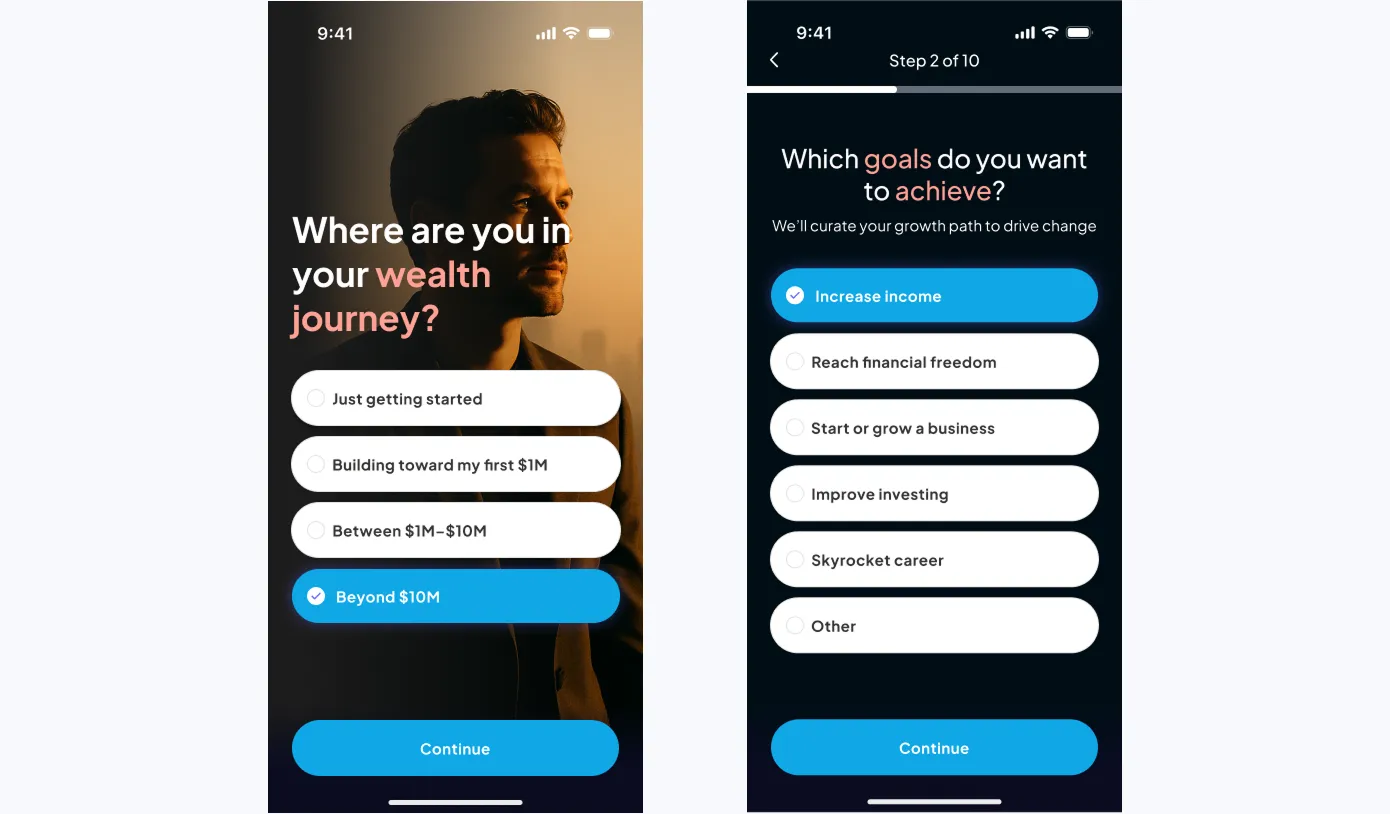
Reasoning & learning: a cold, skeptical, outcome-driven audience needs the product to mirror its actual ambition, in its own language, before any ask. The strongest value-prop copy is usually already sitting in your users' own words — mine it before you write.
2. Manufacture commitment before the paywall
2.1 Time and streak commitments. A daily-time goal and a streak the user explicitly accepts — commitment mechanics the app didn't have before.
2.2 Goal commitment with a target date. The user re-states a chosen goal and commits to achieving it by a date, adding urgency.
2.3 Relatability statements. Short "do you relate?" statements that reflect the mindset the product is built for, so the user sees themselves in it before the ask.
2.4 A "building your growth path" moment. A personalization-build screen with two embedded micro-questions that keeps anticipation high right before the paywall and adds two more small commitments. The projection charts are placed immediately after these screens, where they land hardest.
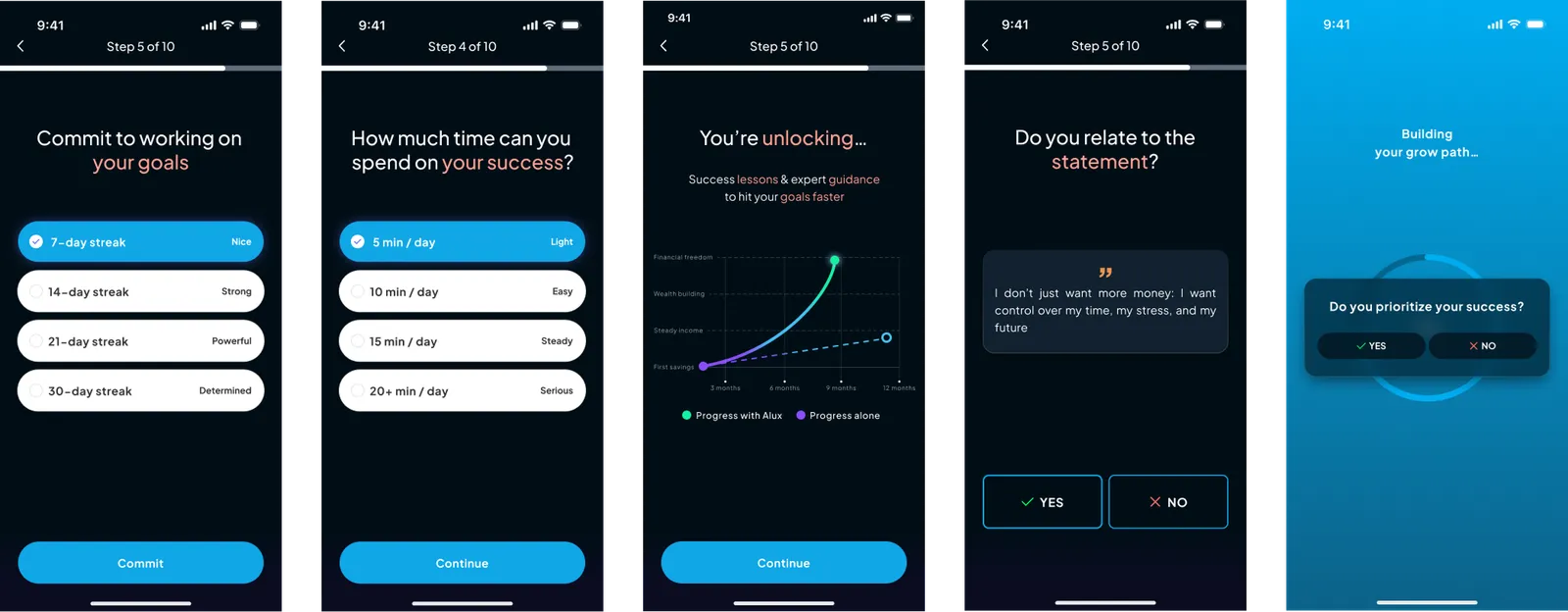
Reasoning & learning: asking the user to choose, state, and commit makes them more likely to start the trial and to come back — the highest-leverage retention work sits at the top of the funnel, not after the paywall. Commitment a user verbalizes is commitment they keep.
3. Land the first session, and earn the return
3.1 A personalized first homepage. The first screen inside the app leads with one highlighted "Session of the Day," plus a short, goal-matched "Selected For You" list (each piece tagged by topic and length) — focused enough to prompt a first play, with a few options so users pick one rather than bounce.
3.2 "Continue listening" home-screen widget. When the user leaves mid-session, the unfinished piece reappears as a live widget on their phone's home and lock screen (an iOS Live Activity), giving them a one-tap reason to come back the next day.
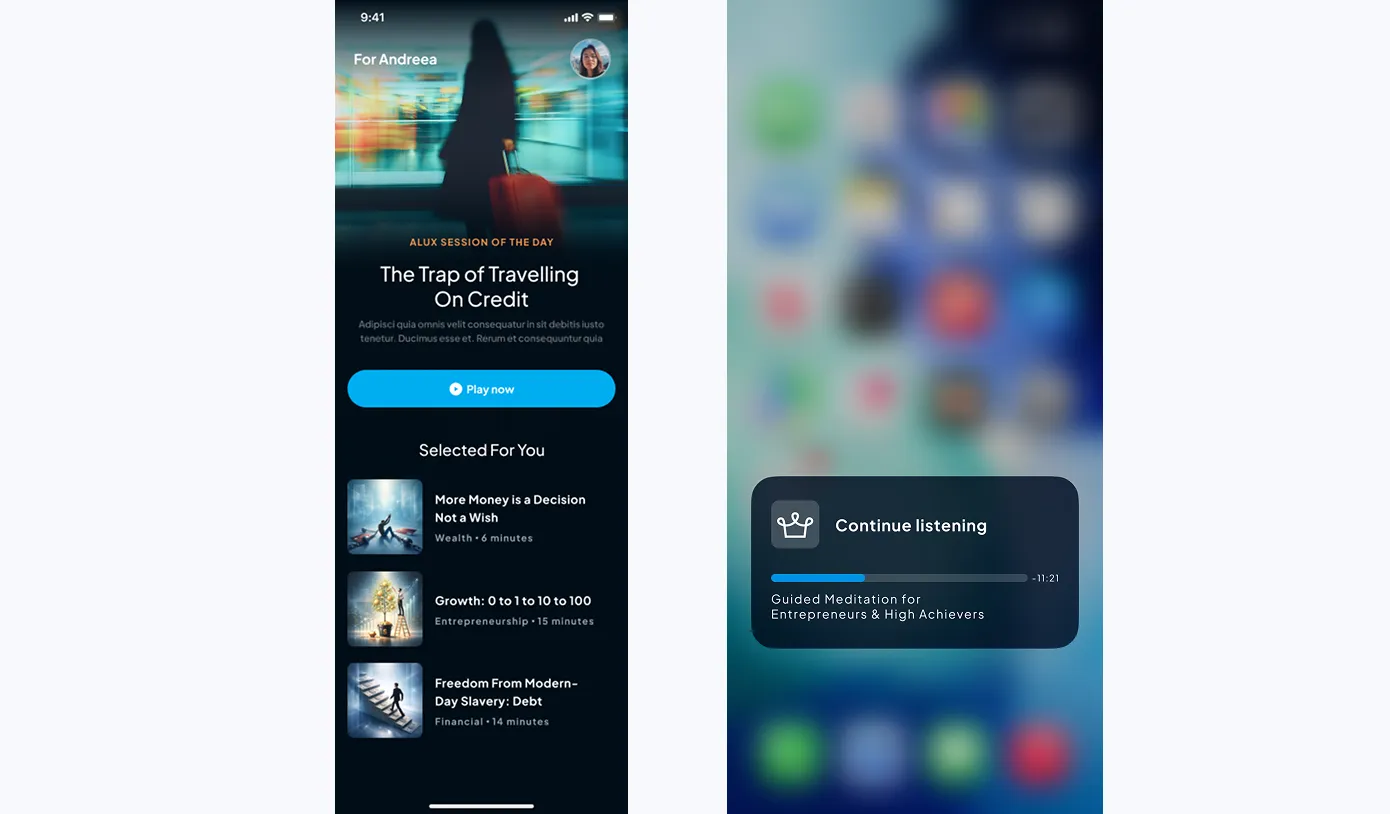
Reasoning & learning: finishing one piece predicts near-total continuation, so the first session is built to carry the user through a single complete piece straight away; the home-screen widget then gives them a concrete reason to return — the next-day return the retention lift reflects. Engineer the first session toward one completion and one reason to come back.
Results
| Metric | Definition | Change |
|---|---|---|
| Install → Paid conversion | Share of new installs who become paying within the trial window — Paying / New Installs | +26% |
| Day-1 retention | Share of new users returning on Day 1 | +22% |
| Day-7 retention | Share of new users returning on Day 7 | +11% |
Both results come from a 50/50 A/B test — run over 62 days across iOS and Android (n ≈ 1,134 per arm), with pricing and the paywall held constant — and cleared our pre-registered 90% significance threshold.
On attribution. This was an A/B test, so the conversion lift is attributable to the new onboarding flow as a whole. Because it shipped as a single bundled variant, we can't isolate the contribution of any single screen — that would require follow-on isolation tests. Price and the paywall remained unchanged, removing price as an explanation and pointing to the activation work. On this sample, the conversion lift is directionally clear, but its precise size carries some uncertainty; the Day-1 retention gain rests on more data and is the firmer result.
Key learnings
- The default isn't neutral. The most-consumed first content was the single biggest activation drag — auditing what you push by default outperformed adding anything new.
- Your best value-prop copy is already in your users' words. First-party goal data, categorized and handed to the writer, beats generic marketing language for a skeptical audience.
- Build commitment before the ask. Choosing, stating, and committing in onboarding lifts both trial starts and retention — the leverage is at the top of the funnel.
- Hold the paywall to earn the attribution. Keeping price and paywall constant is what lets a conversion lift be credibly credited to activation, not pricing.
Conclusion
Alux now has an onboarding that proves the product's value before the ask, rather than relying on the trust users already bring with them — 26% more install-to-paid at the same price, with first-day retention up 22%. The gain came from rebuilding the activation experience, not from changing what it charges. It was built with cold audiences in mind, giving Alux a stronger foundation to take into paid acquisition — and it sets up the next problem worth solving: mid-funnel churn past Week 1.
+26%
Install → paid conversion
+22%
Day-1 retention — from an A/B test