

The challenge
Dwellspring is a premium sleep-sounds app whose users arrive almost entirely from one place: the founder's 12 Hour Sound Machines for Sleep podcast. That defined every constraint of the project.
- No paid acquisition. Every user came organically from the podcast — warm, trusting traffic, but listeners who came for free sleep audio and weren't actively looking for an app to pay for.
- A free alternative competing with the product. The podcast delivers the core job (long sleep sounds) for free. The app had to justify a subscription against the client's own free channel.
- Tiny sample sizes, no room for iterative testing. With only a few hundred new users a week, we couldn't run powered A/B tests and wait. Whatever we shipped had to be close to a guaranteed improvement.
- No measurement foundation. When we started, the analytics weren't in place to tell whether anything was working. Setting them up (RevenueCat + Mixpanel) became the first piece of work — it doesn't appear in the results, but nothing below would have been measurable without it.
Client feedback
Applica's project management was structured and consistent throughout the engagement.

Brandon Reede
Founder & CEO at Dwellspring
What we did
We treated this as a single coordinated system, organized into three thematic blocks. Each block lists the moves that shipped, with the reasoning behind them.
1. Research — understanding a podcast-shaped audience
1.1 Sean Ellis + MaxDiff surveys. We ran a product/market-fit survey (Sean Ellis method) alongside a MaxDiff feature-preference survey to understand who these podcast listeners actually are and what they value, which differs meaningfully from a generic sleep-app user.
1.2 Pre-paywall differentiation screen. Research informed a founder-voiced moment placed before the paywall — a short pause that reframes the app as an upgrade to the podcast experience rather than a paid version of something listeners already get free.
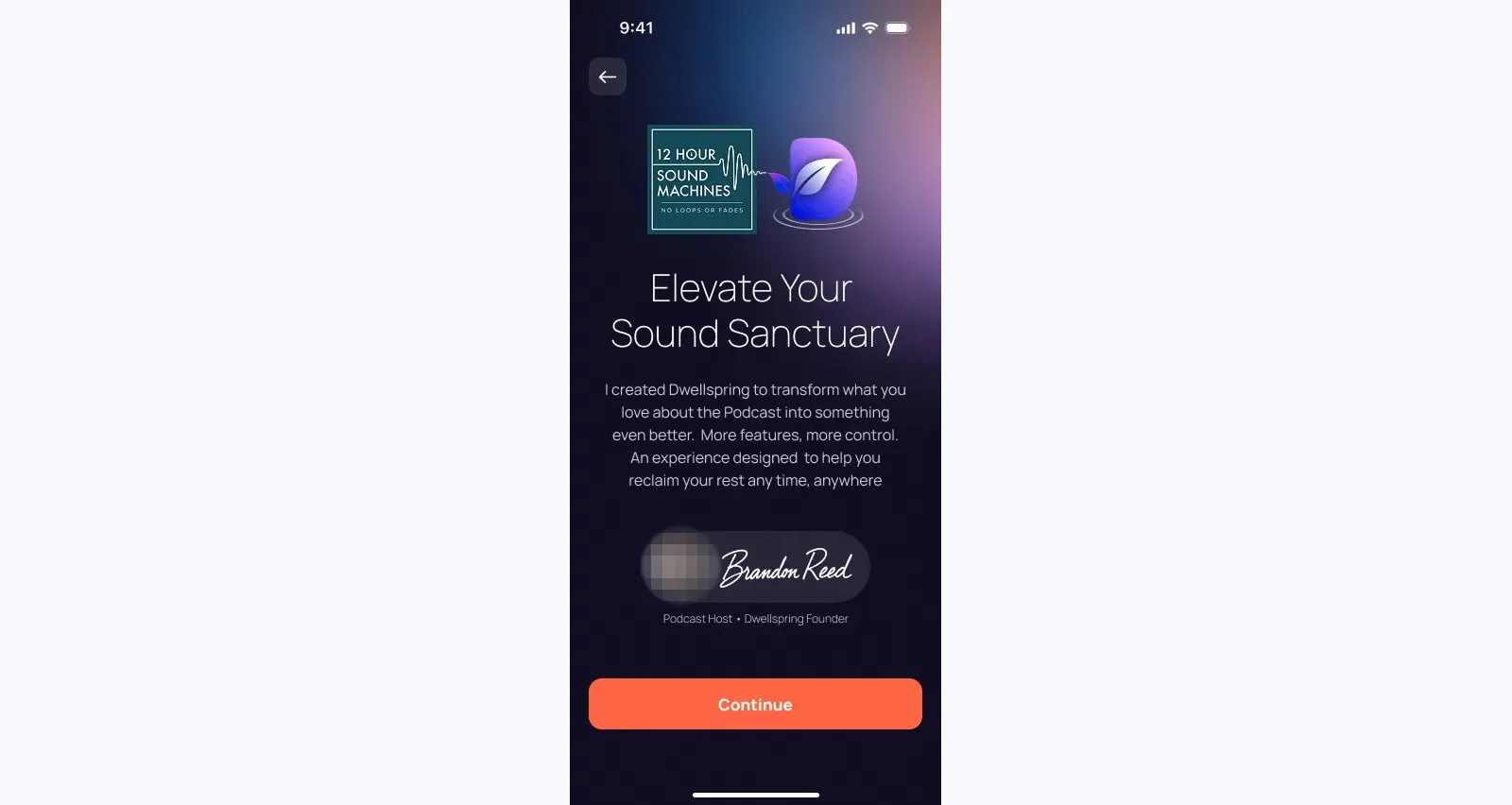
Reasoning & learning: when your main acquisition channel is also your biggest free competitor, the onboarding's first job is to draw the line between the two — before the ask, not after.
2. Onboarding — built from scratch, audio-first
2.1 Audio-first from the splash screen. An ambient soundscape begins playing the moment the app opens and loops seamlessly throughout the flow, so the user feels the core value within seconds rather than reading about it.
2.2 Contextual age framing. The age question is reframed as scientific calibration ("As we age, our sleep needs change") rather than data collection — turning a friction screen into a credibility moment.
2.3 Before/after transformation screen. A visual contrast (racing thoughts → deep rest; distraction → flow; panic → grounded) makes the promise concrete before the user is asked to commit to a trial.
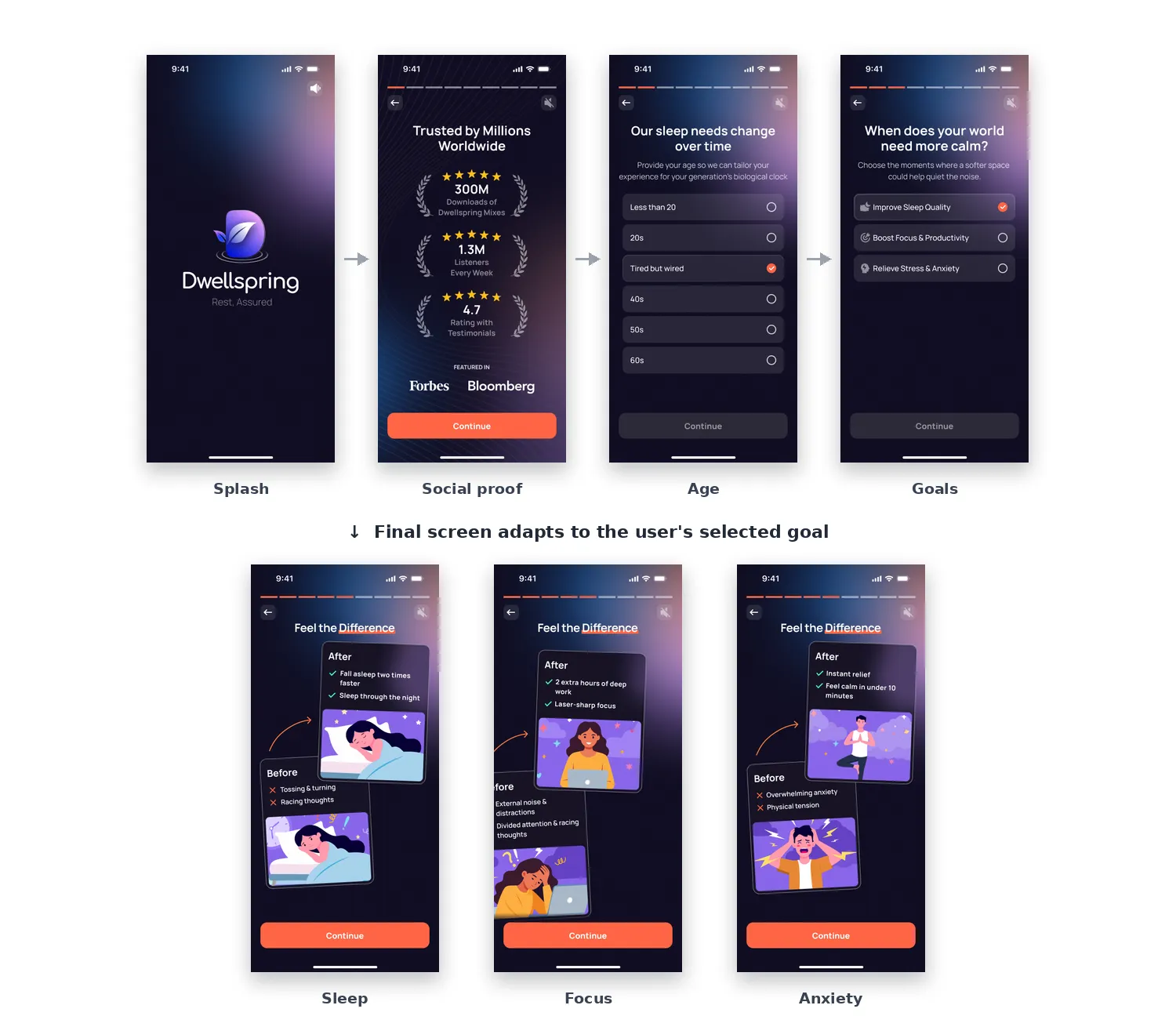
Reasoning & learning: because access sits behind a hard paywall, the decision to try happens before product use — so onboarding has to deliver emotional proof of value up front. The job isn't fewer taps; it's making the value felt before the ask.
3. Paywall — three coordinated changes
3.1 Made the paywall hard. Every new user is routed to a trial decision rather than sampling the app and slipping away. A soft paywall let warm podcast listeners try a little and leave without ever committing; a hard paywall asks for the decision while intent is highest.
3.2 Simplified to a single plan. The paywall now leads with one annual plan and the free trial front and center ("7 Days For Free"), backed by social proof and ratings; the monthly option sits behind a "View all plans" link. We replaced "shop for the best deal" with "start your free trial."
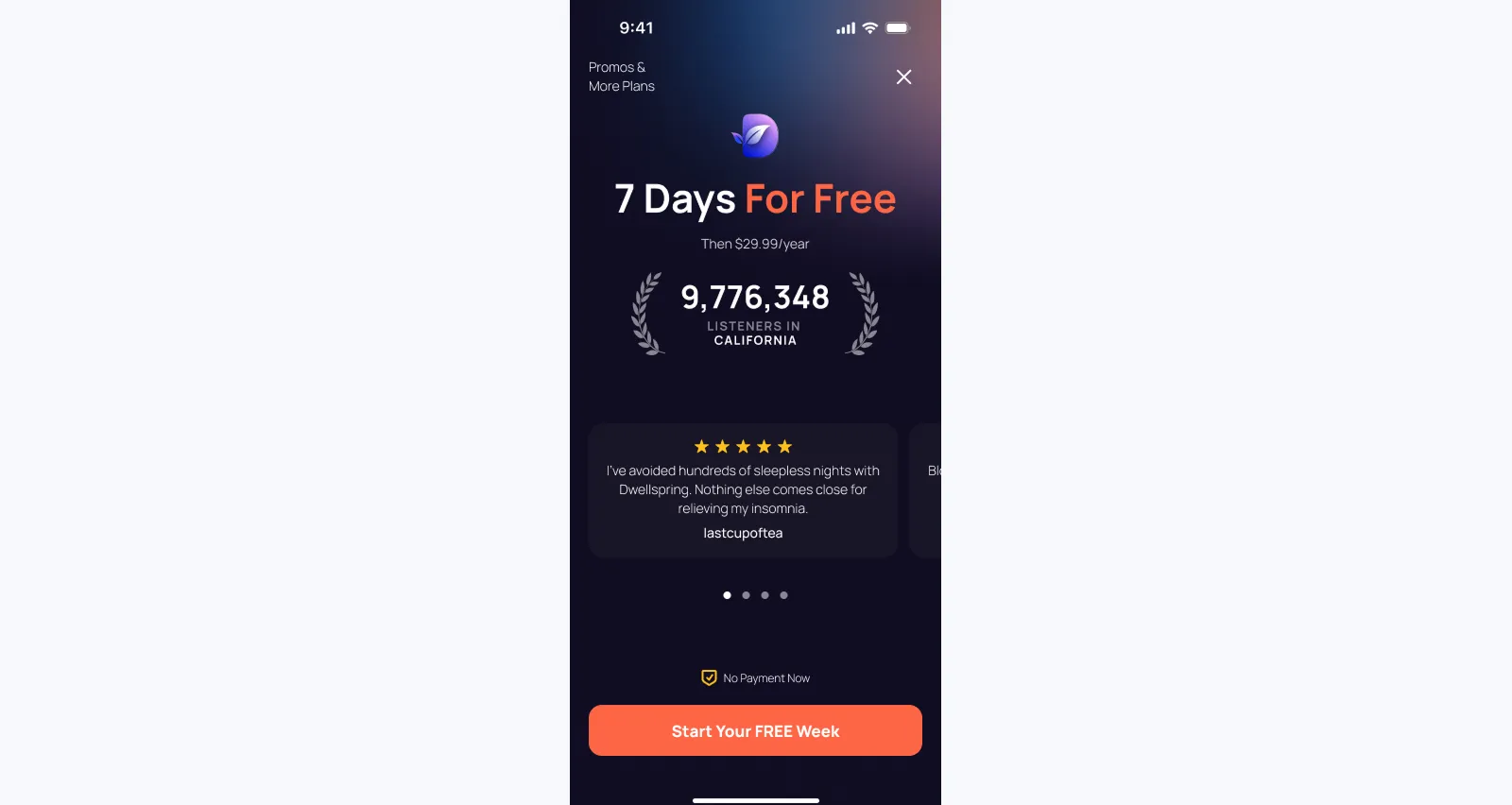
3.3 Longer trial instead of discount, on exit-intent. When a user tries to leave the paywall, instead of dropping the price we offer to extend the free trial from 7 to 14 days at the same price. This is the exit-intent path — it reaches users who hesitate at the main paywall, not every new user.
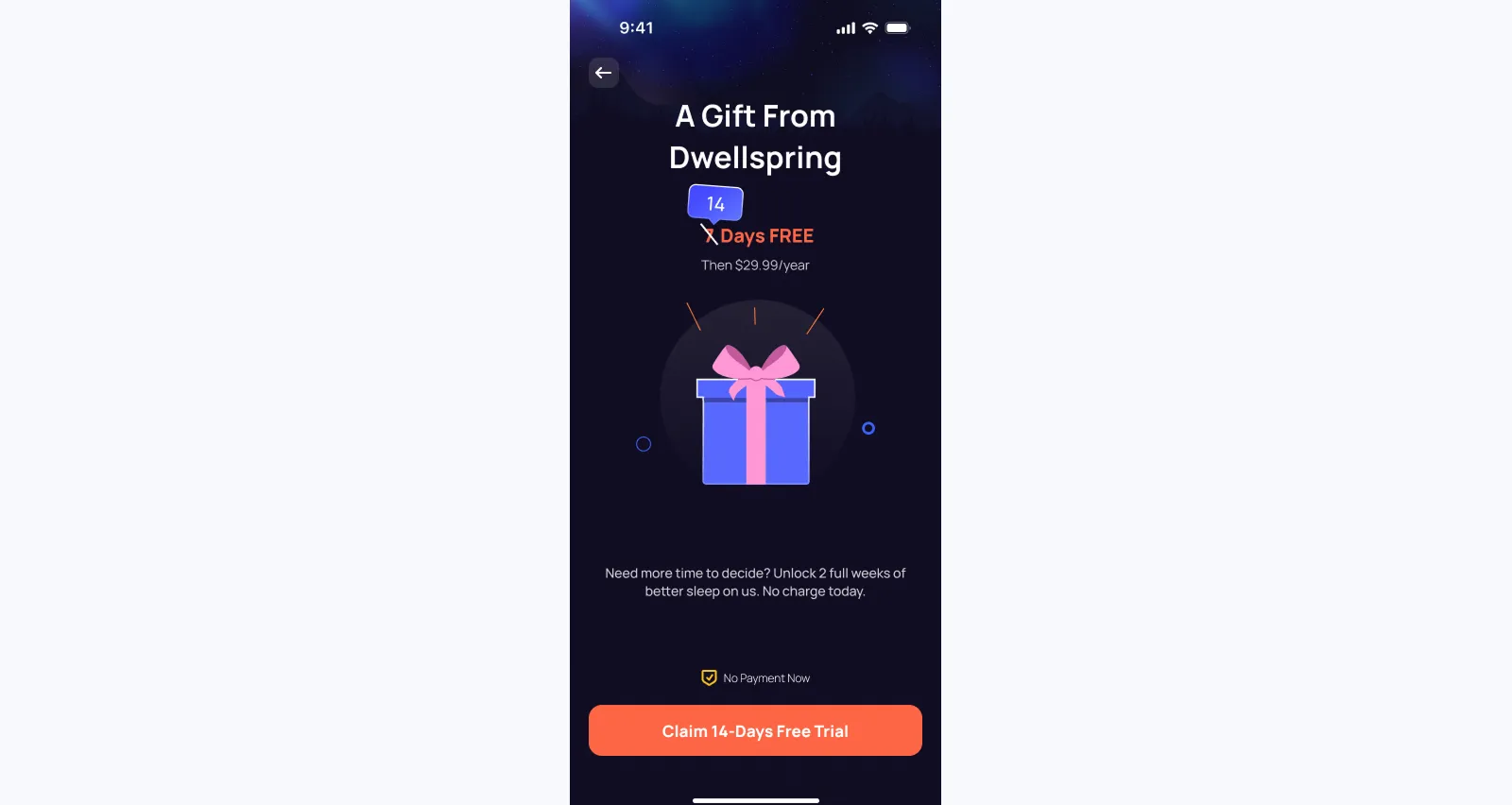
Reasoning & learning: the three changes serve one strategy — simplify the decision, force it while intent is high, and replace money incentives with time incentives. For a sleep app, value is habit-based; it takes several nights to build a routine that justifies the cost. A longer trial gives hesitant users runway to form that habit, while a discount does two harmful things: it anchors the relationship on price, and it self-selects price-sensitive users who churn (in our qualitative sample, every discount converter later canceled). Tradeoff we accepted: a longer trial delays cash collection — a deliberate cost in exchange for higher-quality, habit-formed conversions.
Results
+40% realized LTV per customer · conversion nearly tripled (~2.7×)
| Metric | Definition | Change |
|---|---|---|
| Realized LTV / customer (30-day) | Avg. revenue per new customer in their first 30 days — Realized 30-day Revenue / New Customers | +40% |
| Install → Paid conversion | Share of new users who become paying within 7 days — Paying Customers (7-day) / New Customers | ~2.7× (nearly tripled) |
How to read the windows. "Before" is the pre-optimization era (soft paywall, $59.99) — Aug 31 – Nov 16 2025. "Now" is the period after the final paywall rollout — Apr 12 – May 10 2026. Figures are volume-weighted across each window and pulled from RevenueCat. The +40% reflects the sustained level across 5+ post-rollout weeks — LTV peaked higher in a single week, but we report the level that has held, not the high point. Two anomalous baseline spike weeks and any post-May-10 weeks are excluded; both exclusions make the reported deltas more conservative, not less.
![🖼️ *[Chart — conversion uplift, indexed / relative. Re-export; the original shows absolute rates.]*](/_astro/image.CHrkvxY7_HG2Rt.webp?dpl=dpl_Bfjuws1MTmEJfWYWL6mrcL7bHZ9y)
Honest note — the interim dip. Between the two windows, performance dipped during an interim experiment that underperformed. We diagnosed it, rolled back to control, and verified the funnel was healthy again — after which it recovered and exceeded its prior best, where it has held since. (A higher interim price likely also weighed on results during that window, but couldn't be cleanly isolated.) We show the clean before/after rather than the noisy interim — the dip is here for honesty, not as a feature.
On attribution. Because organic volume was too low for powered A/B tests, the changes above shipped as a coordinated bundle — we can't isolate the exact contribution of any single screen. What we can show is a matched-window step change that has persisted for over a month.
Key learnings
- Organic ≠ paid. Wins on a warm podcast audience are a starting point, not a guarantee — the same funnel will need re-validation when paid traffic arrives.
- Time beats discount. Extending the trial protected the full price point and addressed the real blocker (habit formation), where a discount would have lowered LTV and attracted churners.
- Simplify the decision, not just the screen count. The biggest paywall gains came from removing the cognitivetask (comparing plans), not from cosmetic cleanup.
- Sustained > spiky. On low volume, a result that holds for weeks is more trustworthy than any single strong week.
Conclusion
Dwellspring now has a fundamentally stronger commercial position: a funnel that generates 40% more revenue per user than when the project began, at a lower price than where we started, with conversion nearly tripled on the same warm organic audience. The improvement didn't come from charging more or discounting — it came from rebuilding how the product proves its value before asking for the commitment. That's the prerequisite for the next chapter: turning on paid acquisition with a funnel ready to absorb it.