A subscription team decides to clean up its plan mix. Weekly plans are removed, the paywall pushes annual, and the monetisation dashboard improves almost immediately — higher average order value, healthier realised revenue per subscriber. Three weeks later, the head of growth flags something unrelated: Meta cost-per-click (CPC) has pushed up and stayed unsettled for weeks, delivery has turned erratic, and the same campaigns that were stable a month ago are now stuck. Two teams, two dashboards, two stories — and nobody connects them.
They are the same story. The pricing change and the CPC change were a single event, separated only by the org chart. When you change what a user can buy, you change the conversion the paid algorithm is optimising toward — and the algorithm relearns from a thinner, slower signal. This piece traces the mechanism behind that, maps the other pricing moves that behave the same way, and lays out a cross-team operating sequence to model and monitor the interaction before it costs you a quarter of acquisition efficiency.
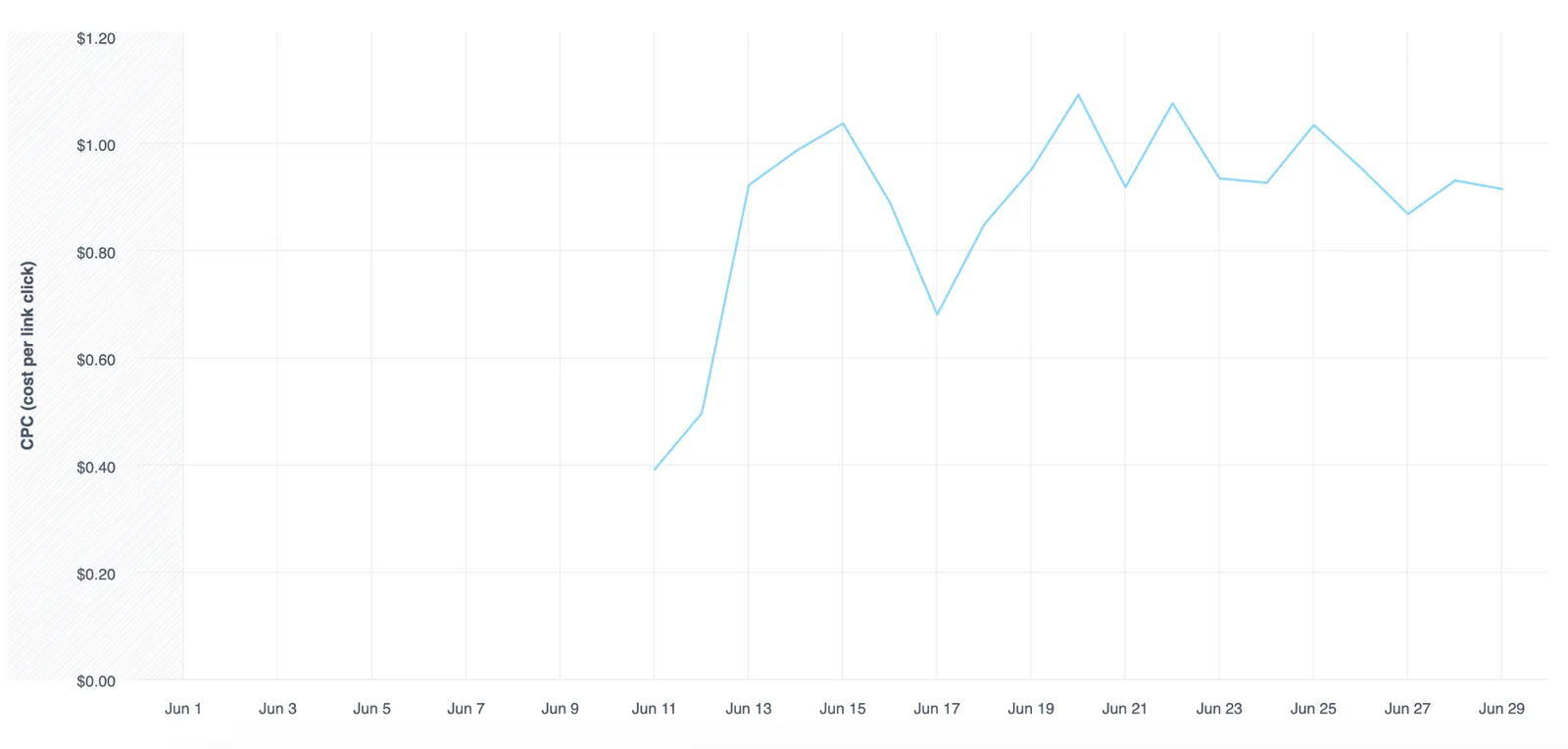
Removing weekly plans, and a Meta CPC that pushed up and stayed unsettled for weeks
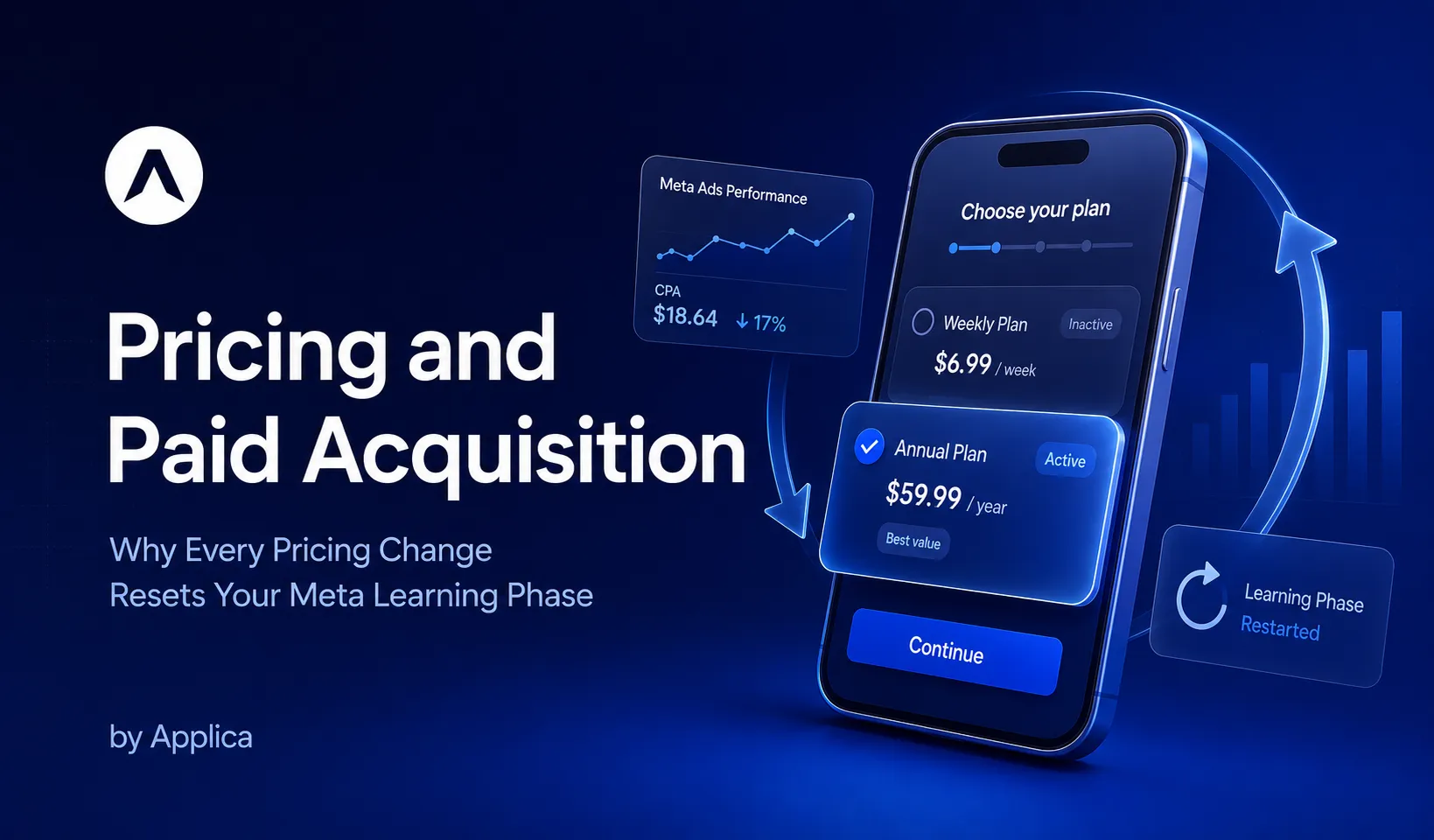
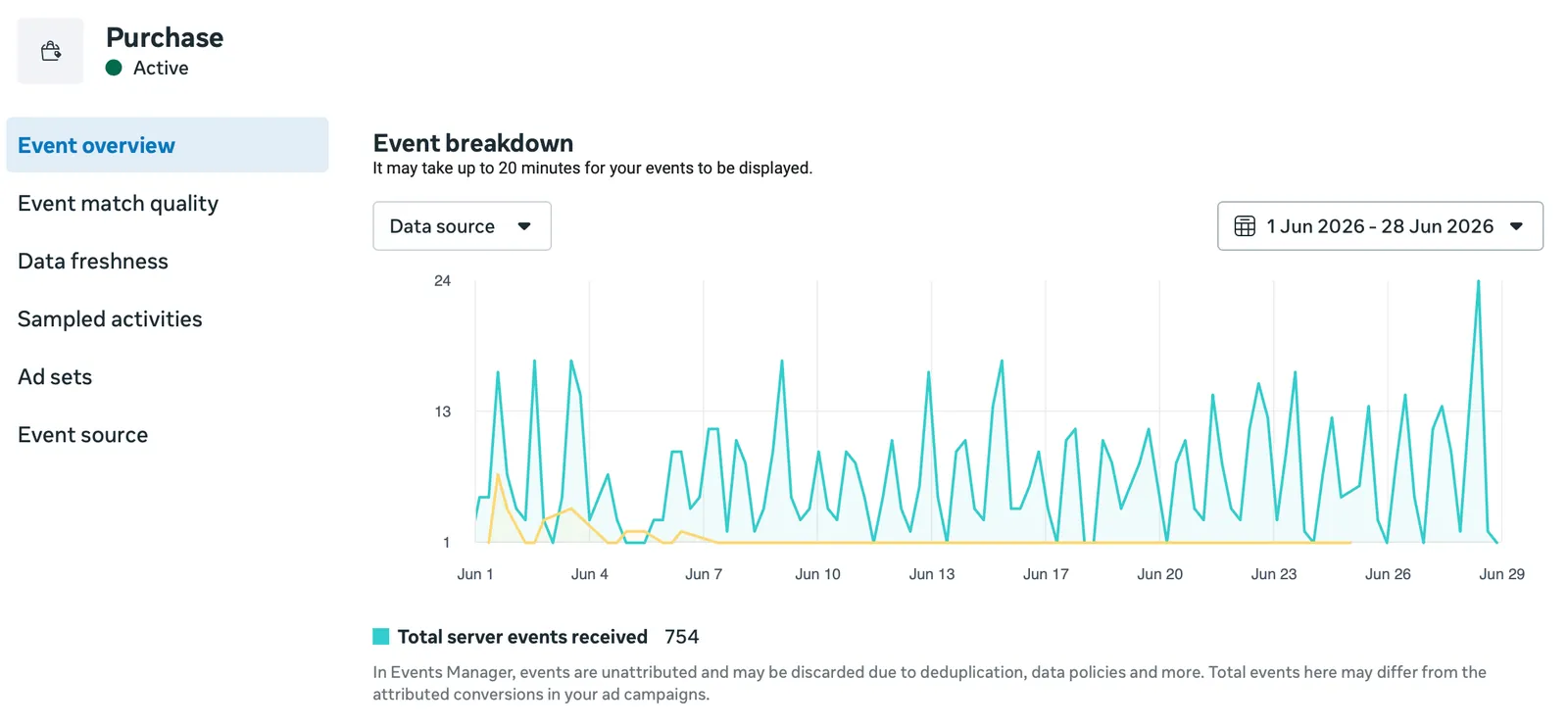
In one subscription engagement, after weekly plans were removed to push annual pricing, Meta CPC pushed up and stayed unsettled for weeks — the pricing decision and the acquisition cost were not separate events. Trial starts thinned out alongside it, and the cost stayed elevated well after the change. Nothing was wrong with the creative, the audiences, or the budget. The thing that changed was the purchase the pixel had been trained on.
The decision itself was defensible on its own terms. Annual plans pay back high acquisition costs faster and tend to lift realised lifetime value (LTV), which is exactly why publishers have spent years pushing users toward annual commitments. And the broader market is restless about plan duration: RevenueCat's 2026 State of Subscription Apps finds annual's share of subscription durations has fallen from 41.4% to 33.6% year over year, with weekly, monthly, and annual now each capturing roughly a third overall. Plan-mix changes are common, reasonable, and frequent.
What makes the case instructive is not that the pricing decision was wrong. It is that the team measured it as a monetisation decision only. The acquisition side of the ledger degraded quietly, in a dashboard owned by a different team, on a timeline nobody had modelled.
Why does changing your pricing change your Meta ad costs?
The short answer: the paid algorithm does not optimise toward revenue in the abstract. It optimises toward a specific event you defined, using the signal that event generates. Change the event or its economics, and you have changed the algorithm's training data mid-flight.
The pixel optimises toward an event — and you just changed it
A Meta campaign optimised for purchases is learning a model of who fires that purchase event. That model is fragile to definitional change. Editing the optimisation event is one of the changes that resets an ad set's learning phase outright, alongside large budget swings and audience changes. When you remove weekly plans, the composition of the purchase event shifts hard — fewer, higher-commitment, slower-arriving conversions — and the model that was tuned to the old event mix is now optimising against a moving target.
The reset is not a punishment. It is the system doing exactly what it was built to do: re-deriving its delivery decisions from the new signal. The cost is the relearning period, and that cost lands on acquisition efficiency, not on the monetisation report.
Fewer, rarer purchases means relearning from a thinner signal
Meta's learning phase needs roughly 50 optimisation events per ad set per 7-day window to stabilise delivery. The problem with pushing annual is structural: annual buyers are rarer than weekly buyers, so the same ad spend now produces fewer conversion events. When the chosen conversion event happens too infrequently, the algorithm never gathers enough data to exit learning, and the ad set can sit in "Learning Limited" indefinitely — which is where erratic, drifting costs come from.

Signal concentration is the lever that usually fixes this. When a brand consolidates fragmented ad sets so each one has a realistic path to 50 weekly events, delivery stabilises and CPA settles. Removing weekly plans does the opposite by accident: it thins the event stream the model depends on. And raw count is not the whole story — signal quality and consistency matter as much as volume, so a noisier, slower event stream degrades the model even before it falls below the threshold.
Value optimisation re-weights toward a different buyer
If you run value optimisation (VO) rather than simple conversion optimisation, the interaction is sharper. VO requires purchase values passed with every event and a minimum of roughly 30–50 weekly purchases before it can learn reliably. Crucially, VO learns from whatever signal you feed it — if your events skew toward low-value, one-off purchases, it optimises toward those; change the value distribution and it re-weights toward a different buyer profile entirely.
Two further mechanics compound this. These strategies depend on the purchase value firing with every event, and browser-only pixel tracking misses 20–40% of conversions without a Conversions API (CAPI) implementation — so a value signal that was already partial gets re-derived from partial data. And VO only counts revenue inside your attribution window; when you swap frequent weekly value for lumpy annual value that may land outside the window, the signal the model sees can shrink even as your realised revenue grows.
The broader principle — every pricing decision is also a paid-acquisition decision
Here is the structural claim, stated plainly: every pricing decision is also a paid-acquisition decision. Pricing does not merely set what a user pays. It defines the event, the frequency, and the value distribution that your paid channel learns from — which means a pricing change is a change to the training data of a live optimisation system you are paying for by the click.
Why this stays invisible
The interaction hides because each team reads a dashboard that shows only half of it. The monetisation view shows average order value and realised revenue improving. The acquisition view shows CPC and customer acquisition cost (CAC) rising. Neither view contains the other's variable, so neither team sees a single cause with two effects. The result is a textbook confounded read: the pricing team attributes the revenue lift to the pricing change (correct) and the growth team attributes the cost rise to auction competition or creative fatigue (usually wrong). The actual cause sits in the gap between the two dashboards.
4 pricing moves which retrain your paid channel
Removing weekly plans is the cleanest example, but it is not the only one. At least 4 common pricing moves rewrite the conversion signal — each through a different mechanism, listed below.
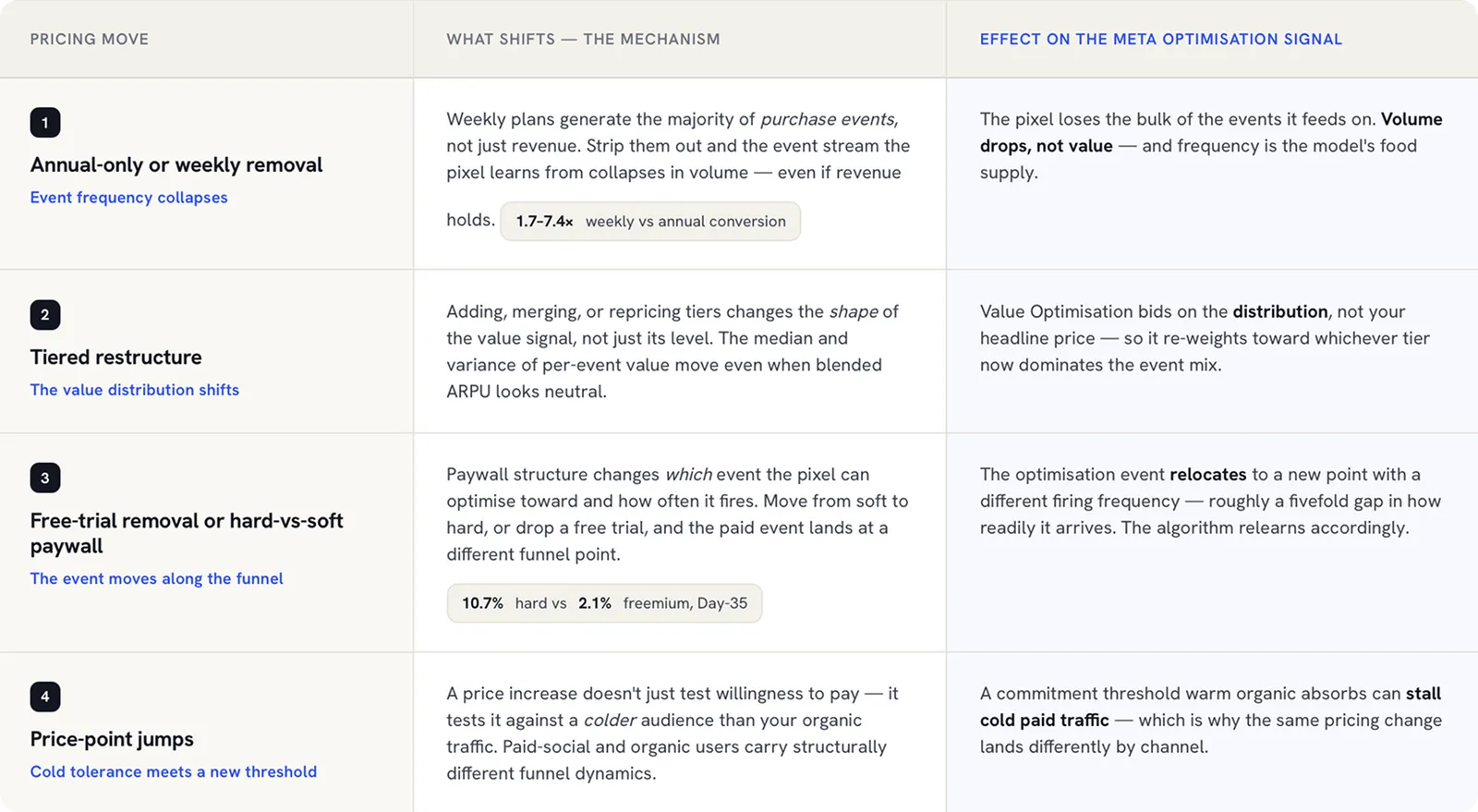
Annual-only or weekly removal — event frequency collapses
This is the anchor case generalised. Weekly plans convert 1.7–7.4× better than annual across price tiers and now generate the majority of app revenue, which means they also generate the majority of purchase events. Strip them out and the event stream the pixel learns from collapses in volume, even if revenue holds. The frequency drop is not incidental to the model — it is the model's food supply.
Tiered restructure — the value distribution shifts
Adding, merging, or repricing tiers changes the shape of the value signal, not just its level. Because pricing behaves as a dynamic lever rather than a fixed setting, a restructure that looks neutral on blended ARPU can move the median and variance of per-event value — and VO bids on that distribution, not on your headline price. The model re-weights toward whichever tier now dominates the event mix.
Free-trial removal or hard-versus-soft paywall — the event moves up or down the funnel
Changing paywall structure changes which event the pixel can optimise toward and how often it fires. Hard paywalls convert at a median Day-35 trial-to-paid rate of 10.7% versus 2.1% for freemium — a roughly fivefold gap in how readily the paid event arrives. Move from soft to hard, or remove a free trial, and you have moved the optimisation event to a different point in the funnel with a different firing frequency. The algorithm relearns accordingly.
Price-point jumps — cold paid-social tolerance meets a new threshold
A price increase does not just test willingness to pay; it tests it against a colder audience than your organic traffic. Paid-social and organic users carry structurally different funnel dynamics, and a commitment threshold that warm organic absorbs can stall cold paid traffic — which is why the same pricing change can land differently by channel. The channel-level divergence is large enough to deserve its own treatment, which we cover in our companion piece on why the same paywall wins on organic and loses on Meta, and it sits inside the broader 2026 performance-marketing channel landscapeevery UA team is already navigating.
How do you evaluate a pricing change for paid-channel impact?
You evaluate it the way you would evaluate any change to a live model's training data: name the signal, model the shift, estimate the relearning cost before you ship. The diagnostic is three questions, not a new tool.
First, name the event the pixel currently optimises toward and how often it fires per ad set per week. Second, model how the pricing change alters that event's frequency and value distribution — will it push you below the ~50-event threshold, change the value the model sees, or move the event up or down the funnel? Third, estimate the relearning cost: how many weeks of elevated, erratic CPC the channel will absorb while it re-derives delivery, and whether the monetisation gain clears that bill.
What to model before you ship
Three inputs decide whether a pricing change is paid-channel-safe. The event-frequency floor — does the new plan mix still clear the learning threshold at current spend? The value signal — does VO still receive a clean, complete value per event, ideally via CAPI rather than browser pixel alone? The attribution-window fit — does the value arrive inside the window the model counts, or does annual value land too late to register? Each of these is downstream of an LTV model that actually drives UA and product decisions rather than just filling a dashboard.
The coordination gap — pricing owns the change, growth owns the pixel
The reason this interaction is so consistently missed is organisational, not analytical. Pricing and packaging usually sit with product or monetisation. The pixel, the bidding strategy, and the conversion event configuration sit with growth or UA. The decision to remove weekly plans is made, reasonably, inside the first team's remit — and its largest cost lands inside the second team's remit, on a delay, attributed to something else.
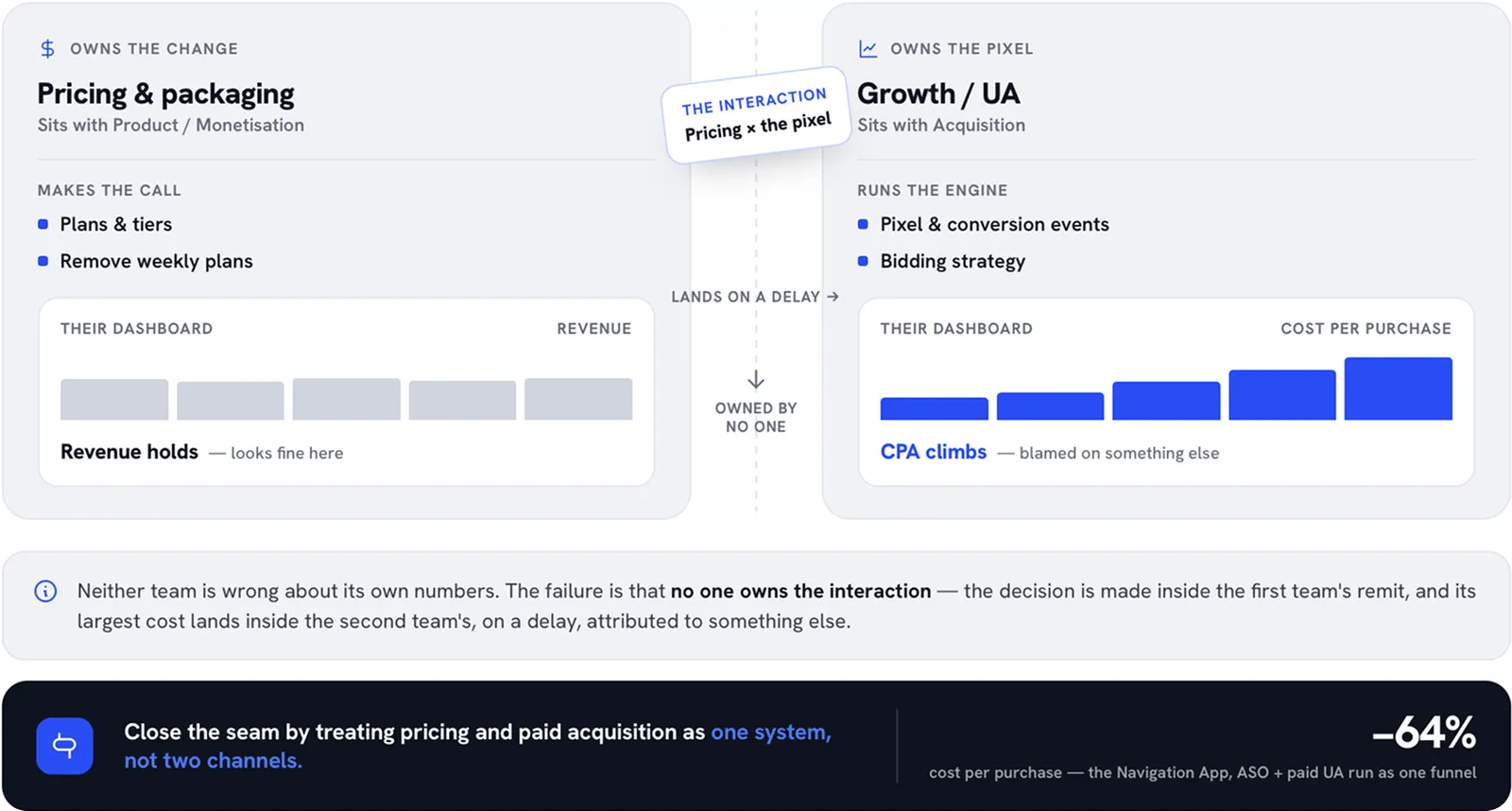
Neither team is wrong about its own numbers. The failure is that no one owns the interaction. This is the same operating-system gap that shows up wherever acquisition source is treated as an afterthought rather than a first-class segmentation signal — the teams that close it treat their channels as one system rather than two. The Navigation App, a product at the intersection of navigation and Health & Fitness, cut cost per purchase by 64% precisely by treating App Store Optimisation and paid UA as one funnel instead of two channels owned separately. The same logic applies one layer up: pricing and paid acquisition are one system, and the win comes from operating them that way.
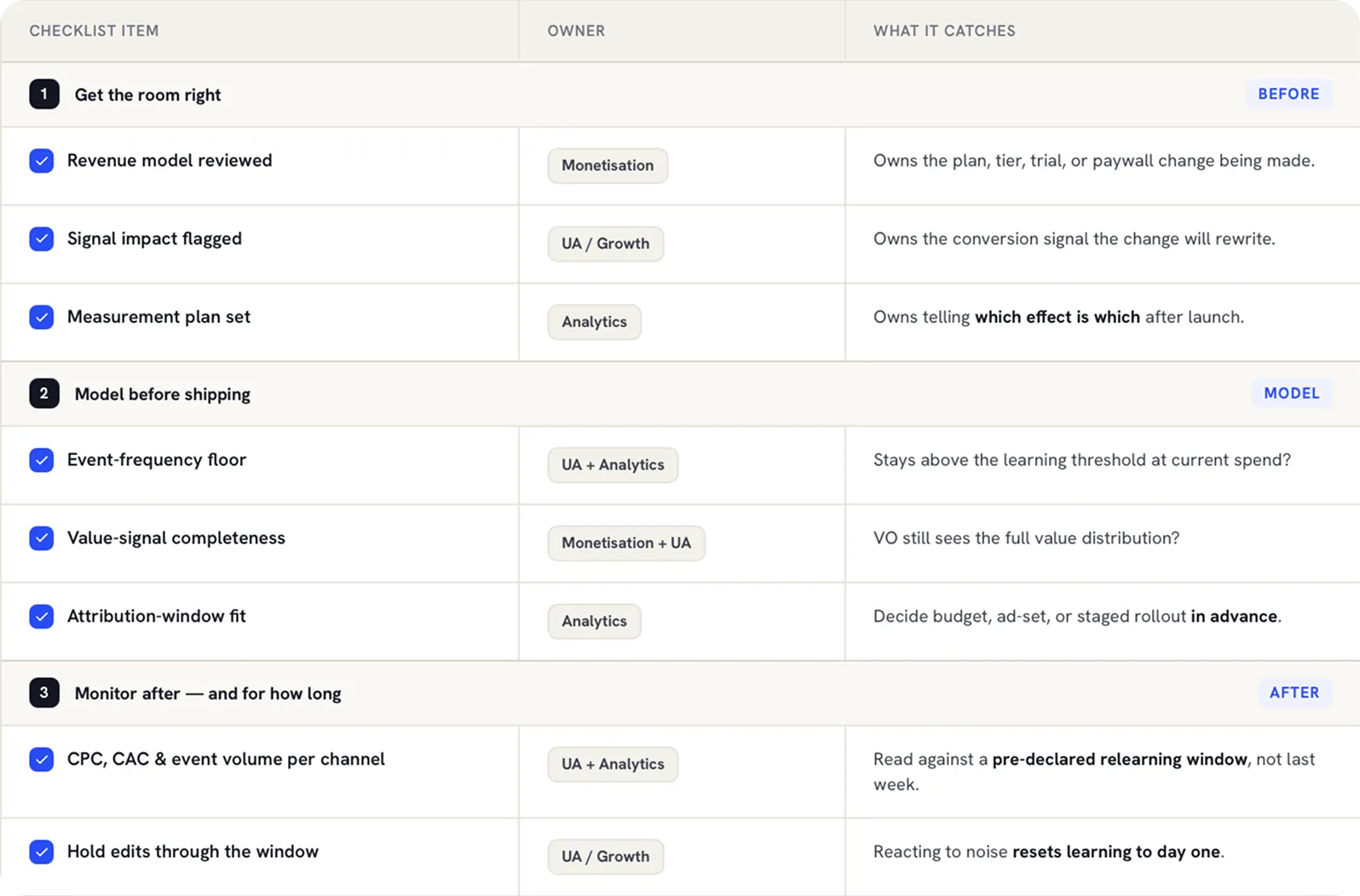
A framework for cross-team pricing decisions
The fix is not a clever bid setting. It is putting the interaction inside someone's remit before the change ships. Three moves operationalise it.
Who needs to be in the room
A pricing change that touches plan duration, tier structure, trial, or paywall type is a monetisation, UA, and analytics decision jointly — so all three are in the room before it ships, not after the CPC moves. Monetisation owns the revenue model; UA owns the signal the change will rewrite; analytics owns the measurement that tells you which effect is which.
What to model before shipping
Before launch, model the event-frequency floor, the value-signal completeness, and the attribution-window fit — the same three inputs from the diagnostic above, now as a pre-ship gate rather than a post-mortem. If the new plan mix drops the ad set below its learning threshold at current spend, you decide in advance whether to lift budget, concentrate ad sets, or stage the rollout — instead of discovering it three weeks in.
What to monitor after — and for how long
Post-launch, watch CPC, CAC, and event volume per channel against a pre-declared relearning window, not against last week. The channel will be noisy while it re-derives delivery, and reacting to that noise with more edits only resets the learning phase back to day one. Hold the line for the modelled window, because the timeline mechanics of when an optimisation change actually pays back are their own discipline — one we unpack in our piece on realistic ROI timelines for product optimisation. Reading the channel's recovery curve correctly is what separates a planned cost from a panic.
FAQ
Does this apply if I'm not using value optimisation? Yes. Even on simple conversion optimisation, the learning phase still depends on event frequency, so any pricing move that thins the purchase stream — annual-only, free-trial removal, a hard-paywall switch — can push an ad set into Learning Limited. Value optimisation makes the effect sharper, not unique to it.
How long does the paid channel take to re-stabilise after a pricing change? It depends on whether the new event mix clears the ~50-event-per-week threshold at your spend. Ad sets that comfortably clear it can re-stabilise within one to two weeks; ad sets that now sit below it may not stabilise until you concentrate the signal or raise budget. Model the floor before you ship rather than waiting to find out.
Should I never push annual, then? No — annual plans remain a legitimate lever for faster acquisition-cost payback. The point is that the pricing decision should be made with its paid-channel cost modelled and budgeted, by the teams who own both sides, rather than as a monetisation-only call whose acquisition bill arrives later under a different name. This pattern shows up most often in WellTech and Health & Fitness, where annual adoption runs highest, but the mechanism is cross-vertical.
Three things to take away
The pricing change is the acquisition change. When you alter what a user can buy, you alter the event, frequency, and value signal your paid algorithm is trained on — they are one decision, not two.
The cost is the relearning period, not just the new price. The paid channel will re-derive delivery from a thinner or redefined signal, and that transition shows up as elevated, erratic CPC and CAC on a delay.
The fix is operational, not tactical. Put monetisation, UA, and analytics in the room before the change ships, model the event-frequency floor and value signal, and monitor recovery against a pre-declared window.
If your pricing and paid-acquisition teams are making decisions on separate dashboards while the interaction between them moves your CAC, that gap is exactly where a structured cross-functional operating cadence pays for itself — let's talk: Applica Agency Performance Marketing. And if cutting the cost side is the immediate priority, start with the levers in how to reduce user acquisition costs for mobile apps, then bring the pricing team into the paid acquisition conversation before the next plan change.