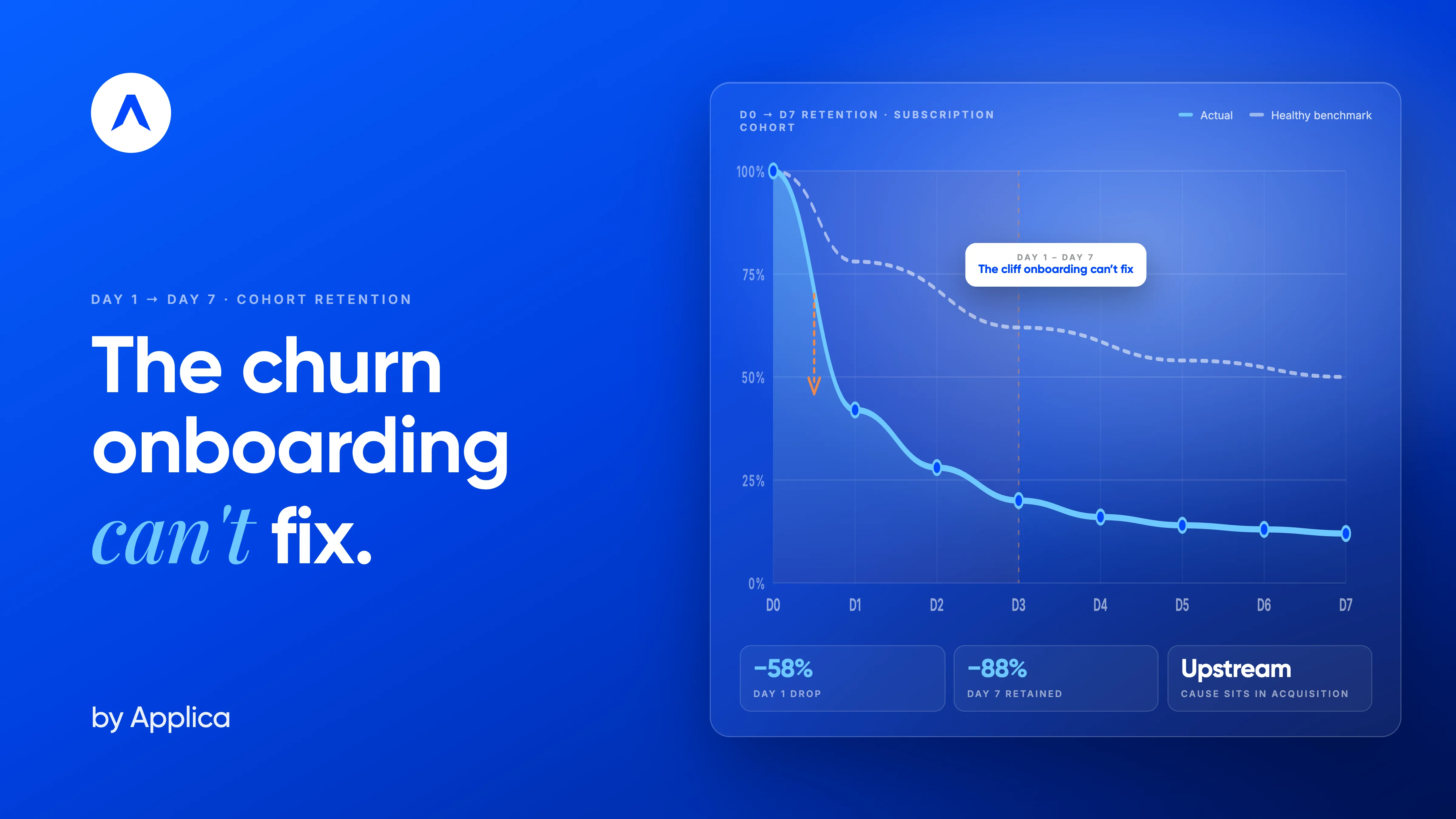
A subscription team does everything the playbook asks. Onboarding has been redesigned and tested. The paywall has been through three rounds of experiments. Pricing has been modelled, restructured, and re-modelled. And still, the cohort curve bends the wrong way in the first week — Day-1 to Day-7 (D1–D7) churn that refuses to move no matter which surface gets optimised next. The reflex is to tune those surfaces harder, because they are the ones the team owns and can measure.
That reflex is usually misplaced. Across consumer apps, retention falls off a cliff almost immediately: roughly three-quarters of users are gone within the first three days of install, and more than 90% churn within the first 30 days. When that decay survives competent onboarding, a tested paywall, and sensible pricing, the cause is rarely sitting on any of those surfaces. It sits upstream of all of them — in who the acquisition message recruited in the first place. Your churn problem is frequently a casting problem, not an onboarding problem, and this piece lays out how to diagnose it and the two structural ways to fix it.
Why competent teams keep misdiagnosing early churn?
The surfaces a growth team optimises are the ones it can instrument. Onboarding, paywall, and pricing all emit clean events, all support controlled experiments, and all sit inside a single team's remit — so when D1–D7 churn climbs, the search for a cause naturally stops at the nearest testable surface. It is a streetlight effect: the team looks where the light is good, not where the keys actually fell.
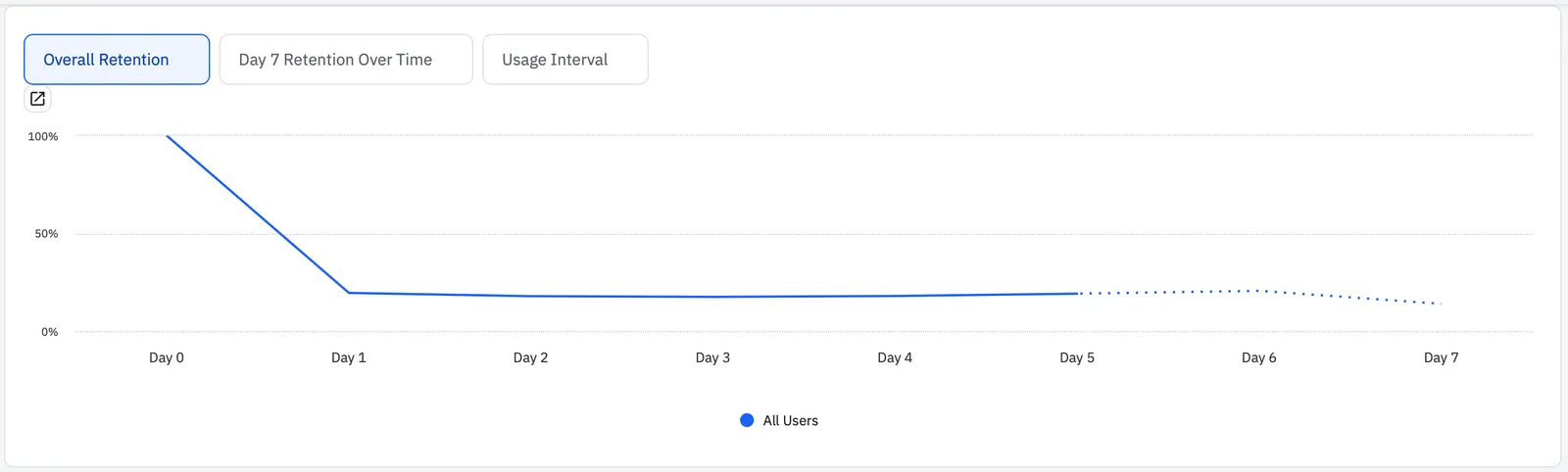
The variable that most often explains stubborn early churn never appears on those dashboards, because it is set before the user ever reaches them. By the time someone lands in onboarding, the decisive question — whether they wanted what this product is actually built to deliver — has already been answered by the ad that brought them in. Onboarding can convert intent that already exists; it cannot manufacture intent that was never there. That is why so much early churn traces back to mismatched acquisition messaging rather than to the in-product experience teams keep blaming, and why the first days after install decide whether a user ever perceives value at all.
Why does early churn survive a good onboarding flow?
Because a good onboarding flow is a conversion mechanism, not a recruitment one. It can shorten the path to value, reduce friction, and surface the aha moment faster — but it operates on the user who already arrived. If that user was recruited on a promise the product was never designed to keep, the most elegant onboarding in the category simply delivers them to the disappointment faster. The strongest churn analyses keep returning to the same lever: activation, not acquisition volume, is what predicts retention, and activation only works when the user wanted the outcome the product activates them toward. As one widely-cited framing of this puts it, time-to-value is not go-live — reaching the milestone is meaningless if it isn't the milestone the user came for.
Vitamin vs painkiller: a positioning frame, not a product category
The most useful lens for this problem is an old one from venture circles. The vitamin versus painkiller distinction — believed to have originated with Bay Area venture capitalist Kevin Fong, and later popularised by investor Marc Andreessen — sorts products by the kind of need they serve. A painkiller addresses an urgent, present pain; the user arrives with high intent and reaches for relief now. A vitamin delivers a long-term benefit; its value compounds with habit, and it asks for patience the user has to be willing to give.
The behavioural difference between the two audiences is the whole story. A painkiller-minded user, as one founder describes the dynamic, responds to fix me now far more strongly than to you'll feel better in a year — and that same user has almost no tolerance for value that arrives on a delay. A vitamin-minded user accepts the delay because the long-term outcome is the point. Neither orientation is superior; the senior reader should resist the instinct that painkiller always wins, because a successful product can sit firmly on either side of the line. The failure mode is not being a vitamin. The failure mode is the mismatch.
Painkiller vs vitamin: two users with opposite urgency and opposite tolerance for delayed value
| Painkiller-acquired user | Vitamin-acquired user | |
|---|---|---|
| Intent at install | Solve an urgent, present pain | Invest in a long-term outcome |
| Urgency | High — relief is needed now | Low — the payoff is the future self |
| Tolerance for delayed value | Minimal; abandons if value isn't immediate | High; accepts a slow build toward the benefit |
| What earns retention | A fast, tangible first hit of relief | A formed habit and compounding progress |
| Retention model the product needs | Immediate value delivery | Habit formation over time |
| Churns when | The product asks for patience they don't have | The product fails to build the habit it promised |
Painkiller vs vitamin: two users with opposite urgency and opposite tolerance for delayed value. The mismatch is recruiting one with a message written for the other.
The mismatch recruits a user the product was never built to retain
Here is the structural claim stated plainly: when the acquisition message sells a painkiller and the product is built as a vitamin — or the reverse — the campaign succeeds at the thing it is measured on and fails at the thing the business needs. It recruits a high-intent user who churns the moment the product asks for patience the message never warned them about. Not an onboarding problem, but a casting problem — the wrong person was cast for the role the product wrote.
How the acquisition message and the retention model misalign in practice
In the gap between the creative and the experience, churn is manufactured. The mechanism is not mysterious: acquisition messaging sets expectations the product then either reinforces or betrays, and a betrayed expectation becomes a cancellation. This is why a meaningful share of what teams record as "product churn" is, on inspection, an expectation-setting problem authored by the marketing message rather than a defect in the product itself.
Two patterns from real engagements show the shape of it. In a wellness-hardware engagement, roughly 90% of buyers arrived shopping for immediate stress and anxiety relief — a painkiller intent — while the product was positioned and built as a long-term wellness investment, a vitamin. The acquisition worked beautifully and the retention model never stood a chance: relief-seekers met a product that asked them to wait, and they left before the long-term benefit could land. The second pattern, a sleep app with the same structural mismatch, repeated the dynamic in a different vertical — urgent, relief-led acquisition feeding a habit-formation product whose payoff arrived too slowly for the audience it had recruited.
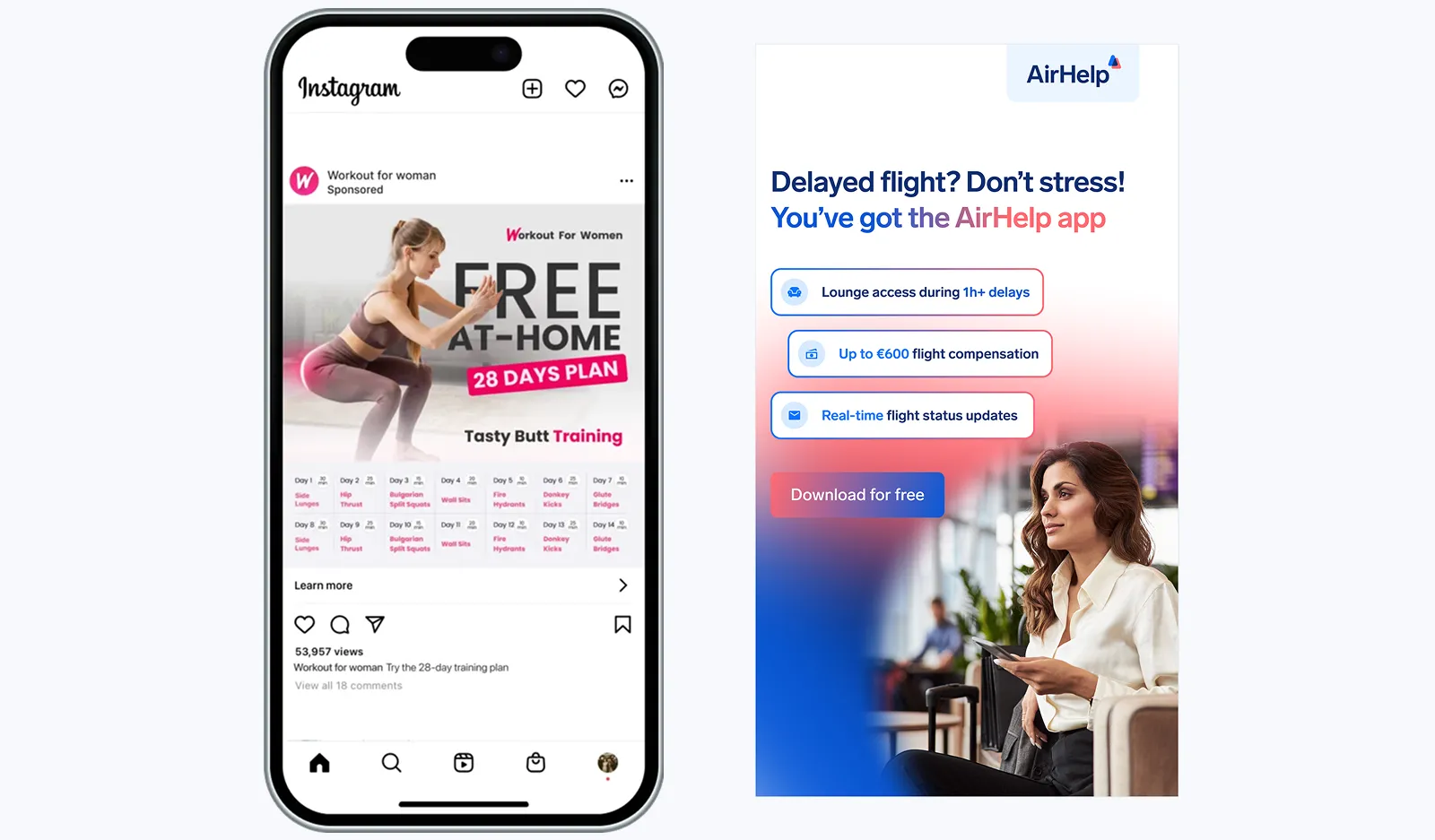
The trap is seductive because the acquisition numbers look healthy right up until the cohort decays. Optimising for the cheapest, highest-volume sign-up is exactly the move that loses users anyway when the product cannot deliver on the promise that acquired them — the cost just shows up one cohort later, in a different report, owned by a different team.
Acquisition source shapes the user you're trying to retain
The same product retains differently depending on where its users came from, because each channel and each creative recruits a different intent. A relief-led video on one network pulls in painkiller users; a benefit-led search ad pulls in vitamin users; and the product keeps only the ones whose expectations it was built to meet. This is why a channel that consistently produces high-churn users is usually signalling a creative or landing-page mismatch, not a bad channel — the fix is the promise, not the spend. It is also why blended retention numbers mislead: retention diverges sharply by acquisition source, and a single averaged curve hides the mismatched cohort inside it.
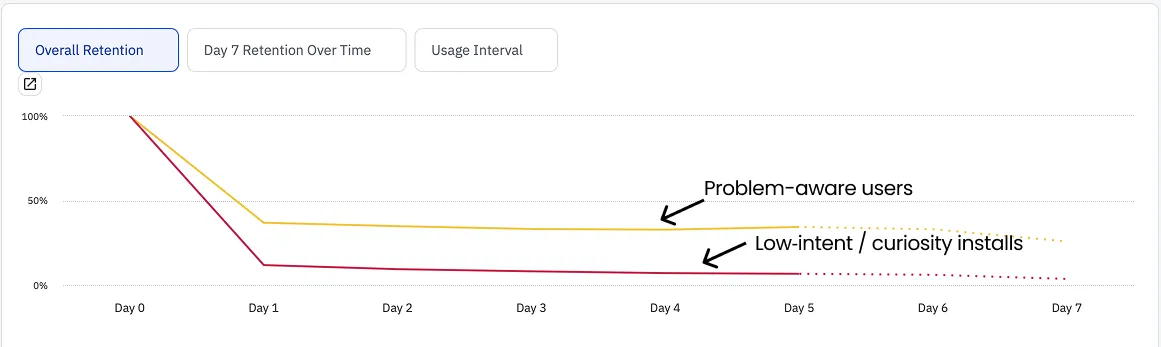
Treating acquisition source as a first-class segmentation signal — rather than an afterthought you reconcile at the end of the quarter — is the prerequisite for seeing the mismatch at all. The same logic governs why identical experiments can contradict each other depending on the traffic source feeding them, a pattern worth reading alongside this one.
How do you diagnose the mismatch in your own product?
You diagnose it by interrogating the seam between promise and delivery directly. The frame is three questions, and answering them honestly usually surfaces the mismatch faster than another round of paywall tests. First, what urgency does the winning ad promise? Name the emotional job the best-performing creative is selling — immediate relief, or a better long-term self. Second, how long until the product delivers its core value? Measure the real time-to-value, not the moment a setup flow completes. Third, does the gap between those two exceed the acquired user's patience? If the message promises now and the product pays out eventually, the gap is the churn.
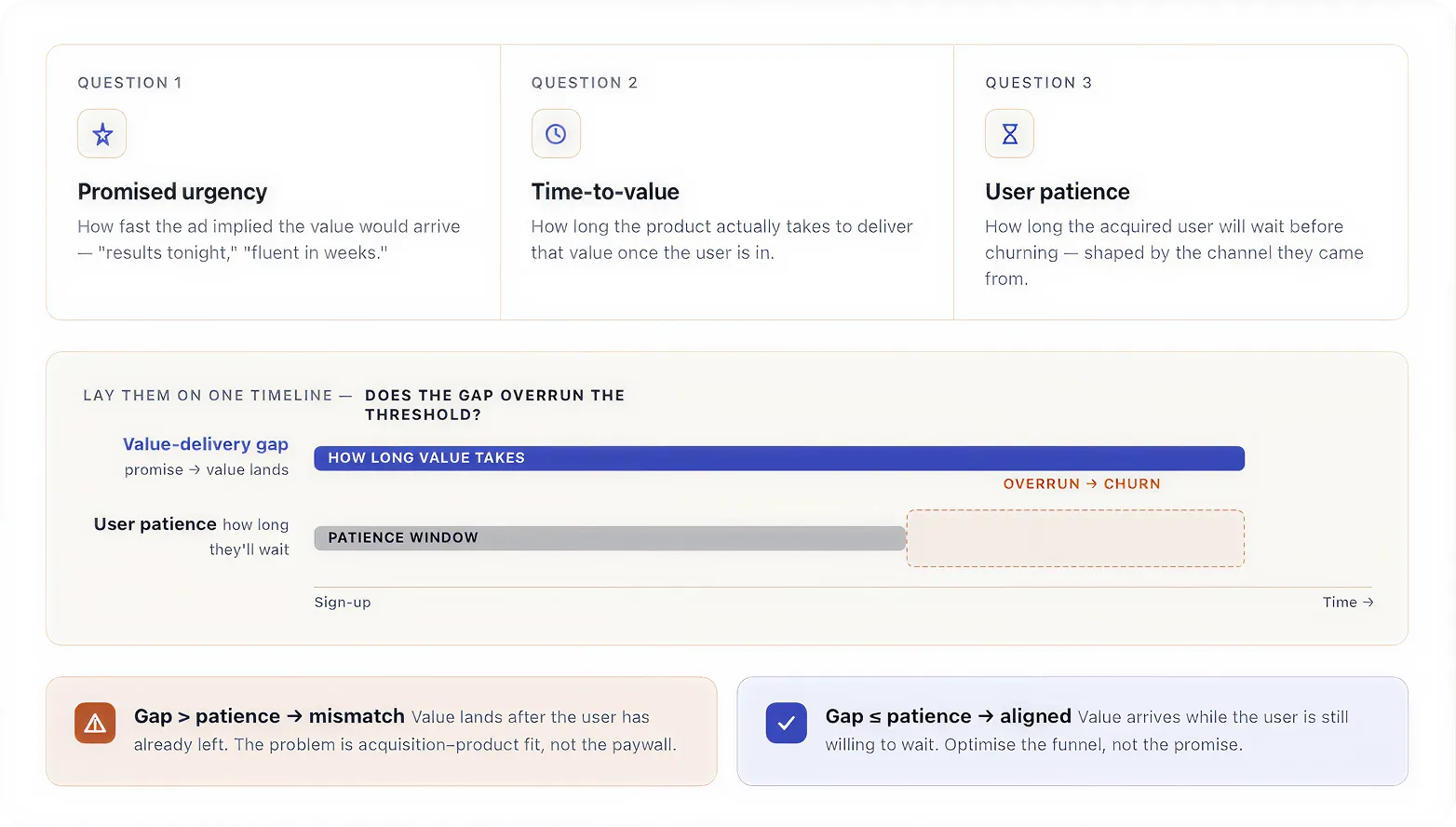
The method that answers these questions is qualitative, not another experiment. Quantitative dashboards tell you the cohort left; they rarely tell you what the user thought they were buying. The signal lives in language — the words users choose at the cancellation screen reveal the broken expectation sooner than any categorised churn-reason count, where the same data also shows how unforgiving the patience window is: users who fail to establish an early habit churn at several times the rate of those who do. Structured user interviews built on the jobs-to-be-done (JTBD) method are the cleanest way to reconstruct the job the user hired the product for — and to catch the mismatch before a redesign bakes it in deeper. That diagnostic discipline is the subject of our work on interviewing users before a product redesign, and it is the engine that drives everything below.
The two paths to fix it — and the honest trade-offs
Once the mismatch is named, there are only two structural fixes. Both are legitimate; they trade off differently, and choosing requires being honest about which user you can actually serve.
Path 1 — re-cast the message to recruit the right-fit user
Change the acquisition promise so it recruits the user the product was built to retain. This is the faster, cheaper move — it lives entirely inside the performance-marketing function and requires no product rebuild. The trade-off is volume: a message that honestly sells a vitamin will recruit fewer, better-fit users than one that implies a painkiller, because the brand promise has to match what the product actually delivers or the mismatch simply reappears one funnel-step later. You are trading top-of-funnel breadth for cohort durability. For a product whose economics depend on retention, that is usually the right trade — but it has to be made with eyes open, because the acquisition dashboard will look worse before the retention dashboard looks better.
Path 2 — re-position the product to serve the acquired user
If the acquired audience is large and economically attractive, the alternative is to make the product deliver value fast enough to keep them. That means engineering an earlier first hit of value so a relief-seeking user reaches a tangible outcome before their patience runs out — the discipline of finding and optimising the aha moment and treating the early lifecycle as a monetisation surface, not a UX afterthought. It can also mean re-shaping the offer itself: a gradual step-up pricing structure can cut the relevant early-churn event by 30–40% by lowering the commitment a painkiller user has to make before the value lands.
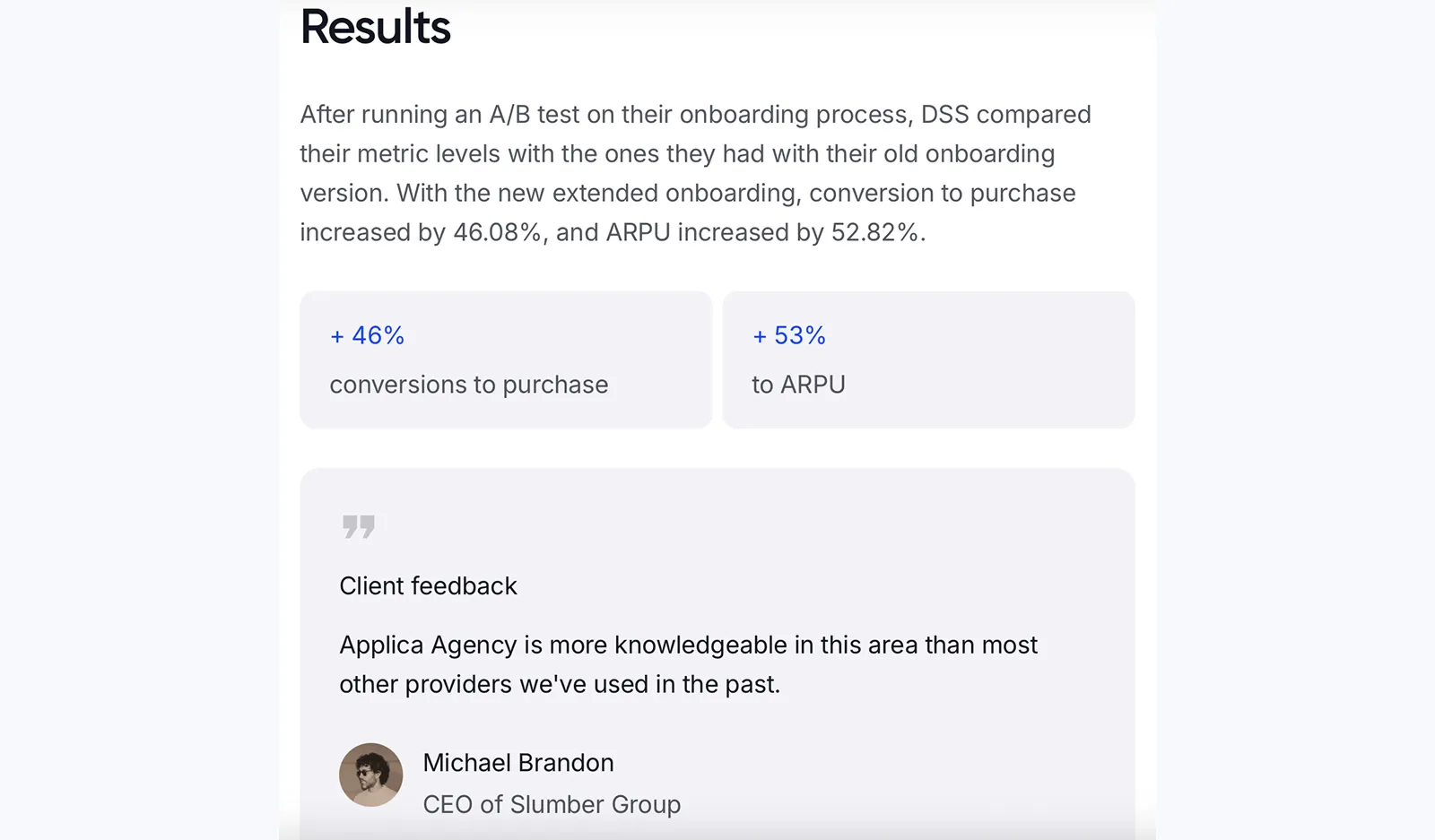
This path compounds when the right-fit user is finally in the funnel. Working with the sleep and wellness app Deep Sleep Sounds, Applica Agency lifted average revenue per user (ARPU) by 52% by treating onboarding as a monetisation surface rather than a UX pass — a demonstration of how much value the early experience can carry once it is built around the user the product is actually serving. The lever is real; it simply cannot rescue a cohort that was mis-cast at the door, which is why Path 2 only works after the casting question has an answer.
The coordination gap: why no single team sees the mismatch
The deepest reason this mismatch persists is organisational, not analytical. Marketing owns the message and is measured on customer acquisition cost (CAC) and conversion. Product owns the experience and is measured on activation and retention. The mismatch lives precisely in the seam between those two remits — and each team reads a dashboard that contains only half of it. Marketing sees efficient acquisition and declares victory; product sees a decaying cohort and blames onboarding. Neither team is wrong about its own numbers, and neither can see the single cause behind two effects.
This is the same operating-system gap Applica has mapped one layer down, where every pricing decision quietly retrains the paid algorithm and the cost lands in a different team's report on a delay. The pattern recurs because the org chart, not the customer journey, decides who looks at what. The teams that close it stop treating acquisition and product as two systems and start treating them as one.
Whose job is it to fix acquisition–product mismatch?
By default, nobody's — and that is exactly the problem. The mismatch is invisible to each team individually and only resolves when someone owns the interaction. Operationally, that means message and experience are reviewed together before campaigns ship: the people who write the promise and the people who build the payoff agreeing on which user is being recruited and whether the product can keep them. This is what message-market fit means in practice — not clever copy, but a shared, enforced answer to "who is this for, and can we keep them?" It also requires reading retention by the cohort that the mismatch actually lives in rather than as a single blended number that averages the problem out of view.
Three things to take away
Early churn that survives onboarding is often a casting problem. When D1–D7 retention won't move despite tested onboarding, paywall, and pricing, the cause usually sits upstream — in who the acquisition message recruited.
Vitamin versus painkiller names the upstream cause. A message that sells urgent relief into a habit-formation product (or the reverse) recruits a high-intent user the product was never built to retain, and no in-product tweak can fix a mismatch authored at the door.
The fix is structural and cross-team, not a tactical tweak. Either re-cast the message to recruit the right-fit user, or re-position the product to deliver value fast enough to keep the one you have — and put marketing and product in the same room to decide which, before the next campaign ships.
If your D1–D7 churn keeps surviving every onboarding and paywall experiment you run, the problem may be sitting upstream of all of them — and that is exactly the seam a structured, cross-team diagnostic is built to find. Let's talk!
If retention is the immediate fire, start with the retention strategies that actually fit your product context, then bring acquisition and product to the table together before the next creative goes live — and if the answer is to re-position the product itself, that is where retention and engagement begins.
FAQ
Is high D1–D7 churn always an onboarding problem? No. Onboarding is a common and worthwhile place to look, but when churn survives a genuinely tested onboarding flow, the cause is frequently upstream — the acquisition message recruited users whose expectations the product was never built to meet. Onboarding converts existing intent; it cannot create intent that the campaign failed to recruit.
Can I fix acquisition–product mismatch with better creative alone? Sometimes — if the product genuinely serves a user the current creative isn't recruiting, re-casting the message (Path 1) is the faster fix. But if the creative is honest and the product still asks for more patience than the acquired user has, you need Path 2: deliver value sooner or re-shape the offer. The diagnostic is whether the time-to-value gap exceeds the acquired user's tolerance.
How is this different from product-market fit? Product-market fit (PMF) asks whether a market wants the product. Acquisition–product mismatch can occur even with strong PMF: the product fits one audience well, but the acquisition engine is recruiting a different audience the product doesn't fit. It is a message-and-casting failure layered on top of a product that may be working perfectly for the right user.