
Custom Product Pages - CPPs
Custom Product Pages are additional versions of your App Store Product Page. They allow you to highlight different features, content, and visuals from your app, tailored to a unique URL. This makes it possible to deliver specific Product Pages to different types of audiences, increasing the chances of conversion.
You can publish up to 70 additional CPPs for iPhone and iPad. Each page can include different screenshots, app previews, and promotional text. This allows you to highlight specific features, gameplay, characters, or anything that may appeal to a particular audience through a unique URL, which can then be used across User Acquisition campaigns to maximise performance. Apps available for pre-order can also use Custom Product Pages. With deep links, you can direct users from your CPP to a specific destination within your app, such as an In-App Event or even a paywall.
Apple has also introduced the ability to assign keywords to CPPs. This allows your CPP to appear in search results for selected keywords, instead of directing users to your default App Store page.
When choosing keywords, make sure they clearly reflect the intent and messaging of that specific Product Page. It’s also important that each keyword set is assigned to only one CPP, to avoid overlap or internal competition between pages.
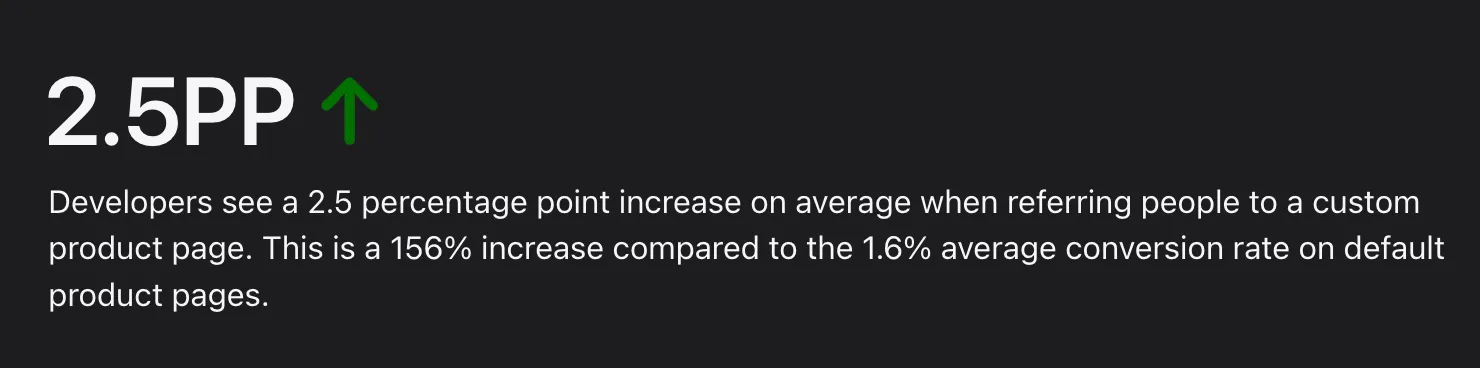
Source: https://developer.apple.com/app-store/custom-product-pages/
CPPs and Apple Ads (previously Apple Search Ads / ASA)
Apple Ads works seamlessly with Custom Product Pages, allowing you to direct users to a specific version of your App Store listing. Your ads can appear across key placements, such as the Today tab, Search tab, and top of search results and lead users to the CPP that best matches the campaign message.
As mentioned earlier, you can also include deep links within these custom pages. This means that once a user installs the app, they can be taken directly to a relevant screen, such as a specific feature, In-App Event, or paywall.
In addition, you can run multiple ad variations in search results, each linked to a different Custom Product Page. This makes it easy to tailor visuals and messaging for different audiences, feature launches, or seasonal campaigns.
Case Study - AirHelp
At Applica, we developed several Custom Product Pages for our client AirHelp, a travel companion app that helps users track flights, claim compensation for delays and cancellations, access airport lounges worldwide, and simplify the overall flying experience. The app is available globally.
In this case study, we will focus on two CPPs:
“Maps” CPP — based on one of our top-performing Meta ads creatives
“Christmas” CPP — a seasonal version created for the end-of-year period in 2025
“Maps” Custom Product Page
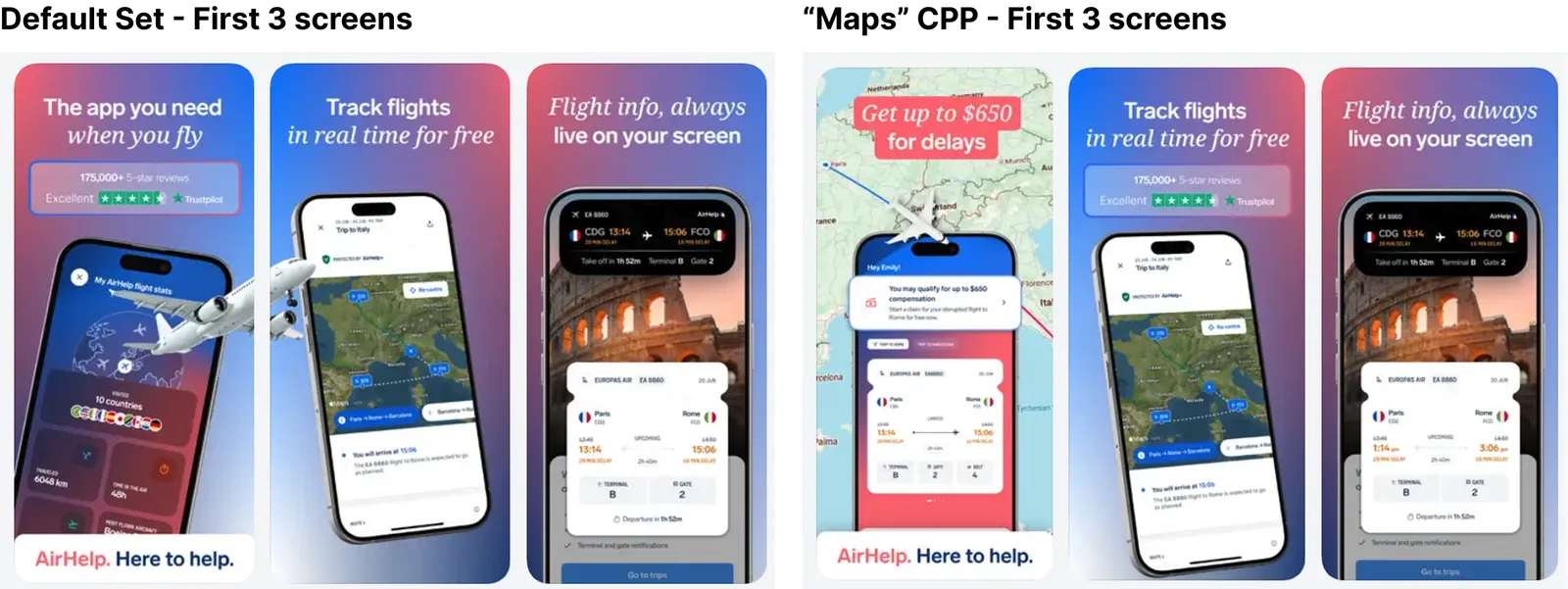
When analyzing our Meta campaigns, we noticed that our top-performing creative had a very clear and specific hook. The video opened with a small plane flying across a world map, paired with the CTA: “Get up to €600 for delays.”
Based on this insight, our UA team proposed creating a Custom Product Page that would replicate this same message in the first screenshot. The goal was to create a seamless user journey:
User sees the ad → clicks the ad → lands on the CPP → immediately recognizes the same visual and message → explores the store → installs the app.
We developed two versions of this CPP: one for Meta (where this full journey is most relevant) and one for ASA, where we aimed to test whether the same visual and hook would perform well as a first screenshot in search-driven traffic. In this case study, we will focus on the ASA results.
The main difference between this new CPP and the Default page lies in the first screen:
Metrics and Results
Campaign was launched between July 1st and March 17th, 2026.
This CPP was used across multiple countries and campaigns, with all assets fully translated and localized for each market.
Campaigns
We will analyze three campaigns types and Geos:
ASA Generic FR — a Generic campaign in France (July 1st, 2025 – March 17th, 2026)
ASA Brand EN EU — a Brand campaign in English bundling multiple European countries (October 1st – December 15th, 2025)
ASA Generic NL — a Generic campaign in the Netherlands (October 1st, 2025 – March 17th, 2026)
TTR (Tap Through Rate)
The number of times your ad was tapped on by customers divided by the total impressions your ad received.
TTR = Taps / Impressions * 100%
ASA Generic NL (+13%) and ASA Brand EN EU (+2%) showed improvements in engagement, while ASA Generic FR (-12%) experienced a noticeable decline.
Overall, the CPP delivered stronger TTR performance in some markets, but results were not consistent across all campaigns.
CPT (Average Cost per Tap)
The average amount you pay per one tap on your ad.
Avg CPT = Spend / Taps
Across all campaigns, the “Maps” CPP consistently reduced CPT compared to the Default Listing set, indicating improved efficiency.
The strongest impact was in ASA Brand EN EU (-24%), followed by ASA Generic NL (-10%) and ASA Generic FR (-7%).
Overall, the CPP delivered clear and consistent improvements in Cost per Tap across all markets.
CPI - Cost per Install (Cost per first app open)
The total ad spend divided by the total number of installs from the mobile tracker within a period.
CPI = Spend / Installs
Across all campaigns, the “Maps” CPP reduced CPI compared to the Default Listing, showing consistent efficiency gains.
The strongest impact was in ASA Brand EN EU (-26%), while ASA Generic FR (-7%) showed solid improvement and ASA Generic NL (-2%) a slight decrease in CPI.
Overall, the CPP improved CPI performance across markets and audience types, with the biggest gains in high-intent traffic (Brand).
Results
“Maps” CPP demonstrated a clear and consistent improvement in efficiency in cost-related metrics.
Across all three campaigns, the “Maps” CPP reduced CPT and CPI, with the strongest impact observed in the Brand campaign (up to -24% CPT and -26% CPI). This indicates that the CPP not only attracted users at a lower cost but also converted them more efficiently after the tap.
From an engagement perspective, results are more mixed. While TTR decreased in FR (-12%), it improved in NL (+13%) and slightly in Brand (+2%). This suggests that the Maps CPP may not universally increase click intent, but performs better when the context or audience is more aligned (e.g. Brand or localized Generic markets).
This aligns with the initial hypothesis: Even on ASA (where the full Meta-like journey is not present) the impact remains significant, validating the strength of the creative concept itself.
The key takeaway is that UA Managers shouldn’t hesitate to test creatives that have already proven successful on other channels. In some cases, like this one, those insights can translate into a strong cross-platform top performer. Without the initial testing on Meta, we wouldn’t have uncovered this opportunity or achieved these results.
“Christmas” Custom Product Page
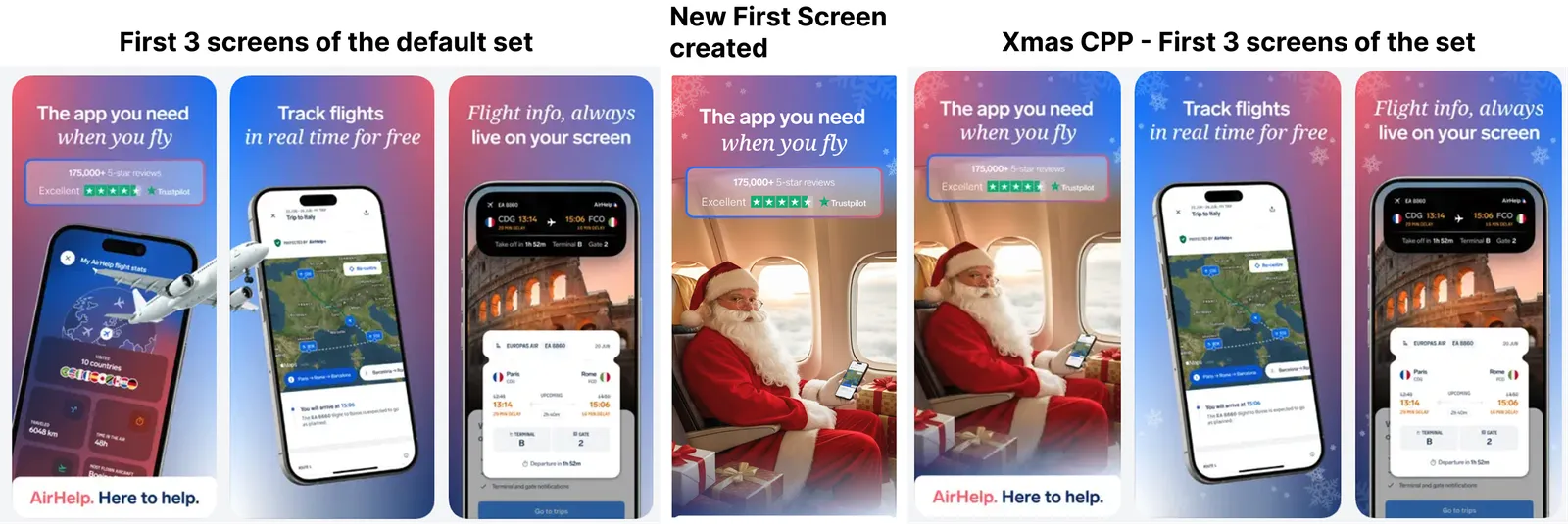
As the end of the year approached, our ASO team decided to create holiday-themed assets to A/B test in our client’s store. To leverage these new visuals, we also launched a dedicated CPP in Apple Search Ads, aiming to capture user attention with a Christmas-themed first screen and a snowy background across the entire set.
Metrics and Results
The Xmas CPP ran in ASA from Dec 12 to Jan 7 across multiple campaigns. To ensure a fair comparison, we analyzed performance in the same campaigns before and after, using matched timeframes.
Campaigns
We analyzed three ASA campaigns: a Competitor campaign across multiple EU countries, a Brand campaign also running across Europe, and a Generic campaign focused on France. For each, we compared performance between the Xmas CPP and the Default Listing using matched timeframes:
ASA Competitor EN EU
Xmas CPP (Dec 12th to Jan 7th). Default Listing (Nov 15th to Dec 11th).
ASA Brand EN EU Xmas CPP (Dec 12th to Dec 24th). Default Listing (Nov 29th to Dec 11th)
ASA Generic FR Xmas CPP (Dec 12th to Dec 24th) Default Listing (Nov 29th to Dec 11th)
TTR (Tap Through Rate)
The number of times your ad was tapped on by customers divided by the total impressions your ad received.
TTR = Taps / Impressions * 100%
Across all campaigns, the Xmas CPP reduced TTR compared to the Default Listing, indicating weaker engagement.
The largest decline was in ASA Generic FR (-30%), followed by ASA Competitor EN EU (-22%) and ASA Brand EN EU (-10%).
Overall, the CPP consistently led to lower tap-through rates across all campaigns.
CPT (Average Cost per Tap)
The average amount you pay per one tap on your ad.
Avg CPT = Spend / Taps
Across all campaigns, the Xmas CPP increased CPT compared to the Default Listing, indicating lower efficiency.
The strongest negative impact was in ASA Brand EN EU (+63%), followed by ASA Generic FR (+14%) and ASA Competitor EN EU (+12%).
Overall, the CPP consistently drove higher costs per tap across all campaigns.
CPA (cost-per-acquisition)
Total campaign spend divided by total downloads resulting from a view or a tap on your ad within the reporting period.
Across all campaigns, the Xmas CPP increased CPA compared to the Default Listing, indicating lower efficiency.
The strongest negative impact was in ASA Brand EN EU (+67%), followed by ASA Competitor EN EU (+25%) and ASA Generic FR (+25%).
Overall, the CPP consistently led to higher acquisition costs across all campaigns.
CPM (Average Cost per Thousand Impressions)
The average amount you pay per one thousand ad impressions.
Avg CPM = Spend / (Impressions / 1000)
Across campaigns, the impact of the Xmas CPP on CPM was mixed.
ASA Competitor EN EU (-13%) and ASA Generic FR (-20%) showed improvements, while ASA Brand EN EU **(+48%)**experienced a significant increase, indicating lower efficiency.
Overall, CPM performance was inconsistent, with gains in some campaigns but a strong negative impact in Brand.
Results
The Xmas CPP, a localized creative featuring Santa Claus in the first screenshot, consistently underperformed across all campaigns, indicating that the seasonal approach had a negative impact on overall performance.
Across Competitor, Brand, and Generic campaigns, we observed a clear pattern:
Higher CPT (+12% to +63%) → more expensive traffic
Lower TTR (-10% to -30%) → weaker user engagement and lower intent
Higher CPA (+25% to +67%) → worse conversion efficiency
While CPM decreased in some campaigns (Competitor and Generic), suggesting cheaper impressions, this did not translate into better performance, as users were less likely to tap and convert.
The impact was particularly strong in Brand campaigns, where high-intent users responded worse to the seasonal creative, but the decline was also consistent across Competitor and Generic campaigns, showing that the CPP did not resonate even in upper-funnel contexts.
Overall, the Xmas CPP diluted the core value proposition by prioritizing seasonal visuals. This suggests that strong seasonal theming (e.g. Santa Claus) can reduce both engagement and conversion, and should be used more subtly, supporting the message rather than leading it.