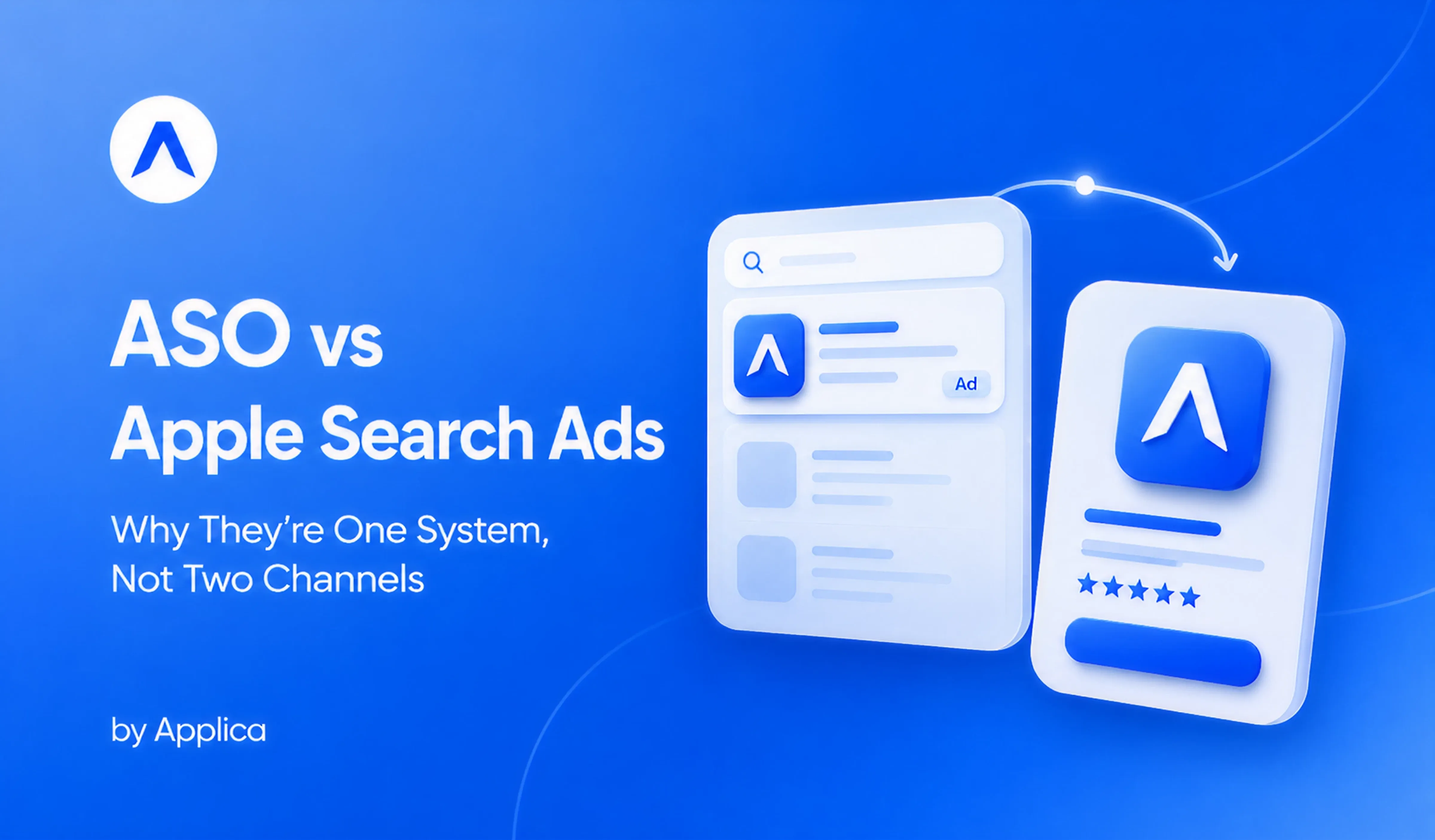
Most teams frame ASO vs Apple Search Ads as a budgeting question: which one deserves the next dollar. That framing is the mistake. App Store Optimization (ASO) — the organic discipline of tuning your listing's keywords, metadata, and visuals — and Apple Search Ads (ASA) — the paid placements at the top of App Store search — are not two channels competing for the same budget. They are one system. ASA bids on the exact keywords ASO is trying to rank for, and every paid tap lands on a product page that ASO built.
With roughly 65% of App Store downloads starting from a search, the two are fighting over the same square of real estate — the search result — from opposite sides. Treat them as separate functions and you open a quiet leak: the keyword and creative learnings paid generates never reach the organic side, and the organic relevance that makes paid cheaper never gets credited. This piece breaks down how Apple's auction actually links the two, why the real failure is organisational rather than tactical, and how to run them as a single loop — with a real account that did exactly that.
ASO vs Apple Search Ads: what each actually does
The confusion is understandable, because the two disciplines look similar from the outside and behave very differently underneath.
What is App Store Optimization (ASO)?
ASO is the ongoing practice of improving how your app surfaces and converts in organic App Store search — the keywords in your title and subtitle, the metadata Apple reads to rank you, and the visuals (icon, screenshots, preview video) that decide whether a viewer taps install. It is an owned, compounding asset: slow to move, but it doesn't switch off when you stop paying. It also decays if ignored — apps that set metadata once and forget it lose rankings steadily as search trends and competitors shift.
What are Apple Search Ads (ASA)?
ASA is Apple's paid platform for promoting apps inside the App Store, with placements across the Today tab, the Search tab, search results, and competitors' product pages. A mature account is structured into four distinct campaign types — brand, competitor, category, and discovery — each doing a different job, from protecting your branded traffic to mining new keywords. It is the highest-intent paid channel for iOS, and unlike ASO it delivers signal in days, not weeks. You pay per tap, so its core efficiency metrics are cost-per-tap (CPT), tap-through rate (TTR), and return on ad spend (ROAS).
Why "which one?" is the wrong question
Because both resolve onto the same surface: the App Store search result and the product page beneath it. ASA buys the top of a result that ASO is simultaneously trying to earn — and the question matters more now that, from March 2026, Apple is expanding paid placements in search results from a single slot into positions two through five. More of the result page is becoming paid, which raises the stakes of getting the paid-and-organic interplay right rather than running each blind to the other.
They share one auction — how relevance actually works
This is where "one system" stops being a slogan and becomes mechanics. The link between organic strength and paid efficiency runs through Apple's auction, and it pays to be precise about how that actually behaves.
Apple's relevance gate
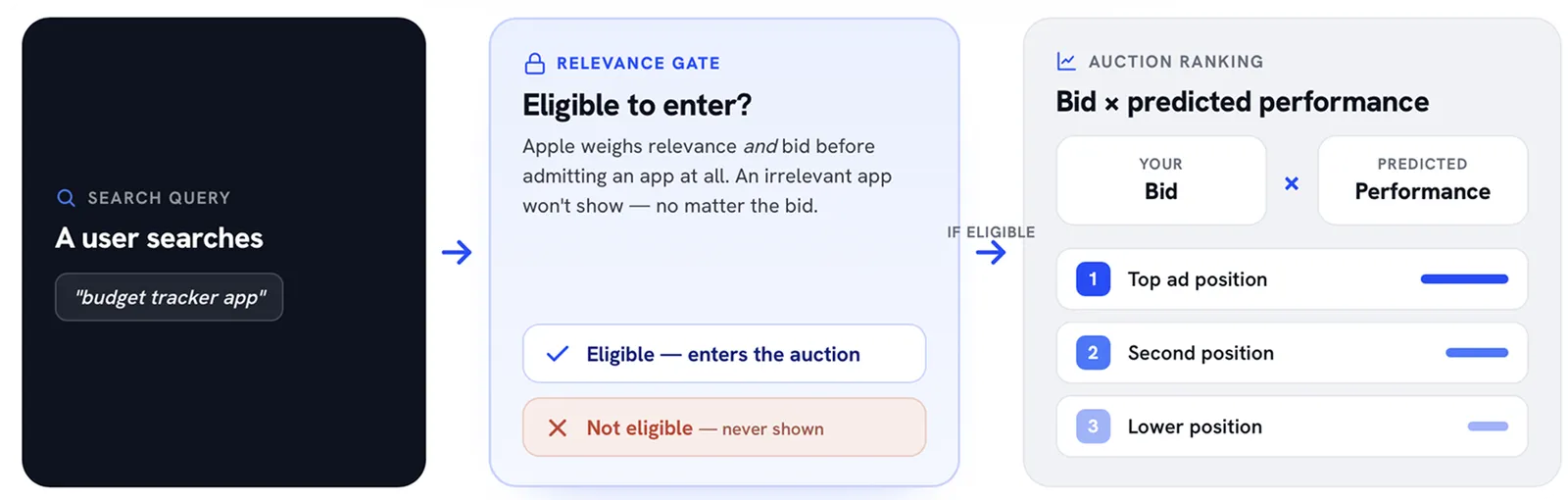
Apple's own documentation is unusually direct here: an app that isn't relevant to what the user searched won't be shown regardless of how much you bid, and Apple considers both relevance and bid before admitting an app to the auction at all. In other words, relevance is a gate. You don't buy your way past it — your listing has to earn eligibility first.
But once you clear the gate, bid does most of the ordering
Here is the nuance most vendor explainers skip. An independent 2026 analysis of UK auction data across 132 keywordsfound that semantic relevance behaves like a threshold rather than a ranking dial — once apps clear it, bid and predicted performance do most of the position-ordering. The same dataset showed bid winning over the more relevant app in 44% of cases. Apple does not publish a Google-style "quality score," and you shouldn't assume one exists. The honest read: strong ASO doesn't automatically slash your CPT — it gets you eligible and competitive, after which your bid still does the heavy lifting.
What this means for your listing
The connection is concrete, not mystical. Apple's automated matching, Search Match, draws on your App Store listing metadata and genre to decide which searches your ad can appear for — so weak organic metadata literally narrows where paid can reach. Apple also notes that exact-match keywords tend to carry higher tap-through and conversion because intent is tighter. The better your organic foundation, the more efficiently paid finds the right searches.
Do Apple Search Ads help your ASO?
Running ASA does not directly change your organic ranking — Apple keeps the two systems formally separate. But they compound through shared data and shared creative, and ignoring that connection is where most of the lost efficiency hides.
ASA → ASO: paid is your fastest keyword read-out
Apple Search Ads shows you the actual search terms users typed before tapping your ad — ready-made evidence of real demand language. Organic keyword work otherwise waits weeks for ranking signal to confirm a hypothesis; paid hands you the same intent data in days, which you then feed straight into your metadata decisions.
ASO → ASA: a relevant listing makes paid cheaper to run
The return trip is just as real, if more probabilistic. Practitioners consistently observe that strong organic relevance improves ad competitiveness and that Custom Product Pages lift relevance, and that a well-executed ASO foundation is associated with lower cost per install (CPI) on paid campaigns. Hold this loosely — it's an observed association, not a guaranteed lever — but the direction is consistent: the organic side subsidises the paid side.
Custom Product Pages — the shared testing surface
The clearest place the two meet is the Custom Product Page (CPP). Instead of sending every paid tap to your default listing, CPPs let you match the landing page to the keyword's intent, and feature-specific pages built per keyword theme reliably convert better than one generic page. This is exactly the territory of Applica Agency's CPP work with AirHelp. The winning CPP message then graduates into your organic screenshots — the same discipline covered in A/B testing creatives for ASO — closing the loop between paid and organic creative.
The real leak isn't tactical — it's organisational
Every mechanic above only compounds if one team can see both sides at once. Most can't, and that structural gap costs more than any single bid setting.
When paid and organic live in separate teams — the user acquisition (UA) team owns ASA, an ASO specialist owns organic — three things quietly break. Search-term learnings never reach metadata, because ASO specialists often don't look at paid campaign results when making keyword decisions. CPP wins never reach organic screenshots, because the person testing them doesn't own the listing. And the organic relevance subsidising paid CPTs never gets measured, because campaigns get judged on cost-per-acquisition alone, which ignores organic uplift entirely.
One owner, one keyword and CPP loop
The fix is organisational before it is tactical: one owner for the App Store surface, and a single shared keyword and CPP feedback loop running between paid and organic. This is the integrated operating model behind how Applica Agency works — paid and organic treated as one acquisition engine rather than two budgets defended in separate meetings. It's also why the choice of where ASA reporting sits, alongside broader performance marketing, matters as much as the campaign settings themselves.
What this looks like in practice: scaling beyond brand
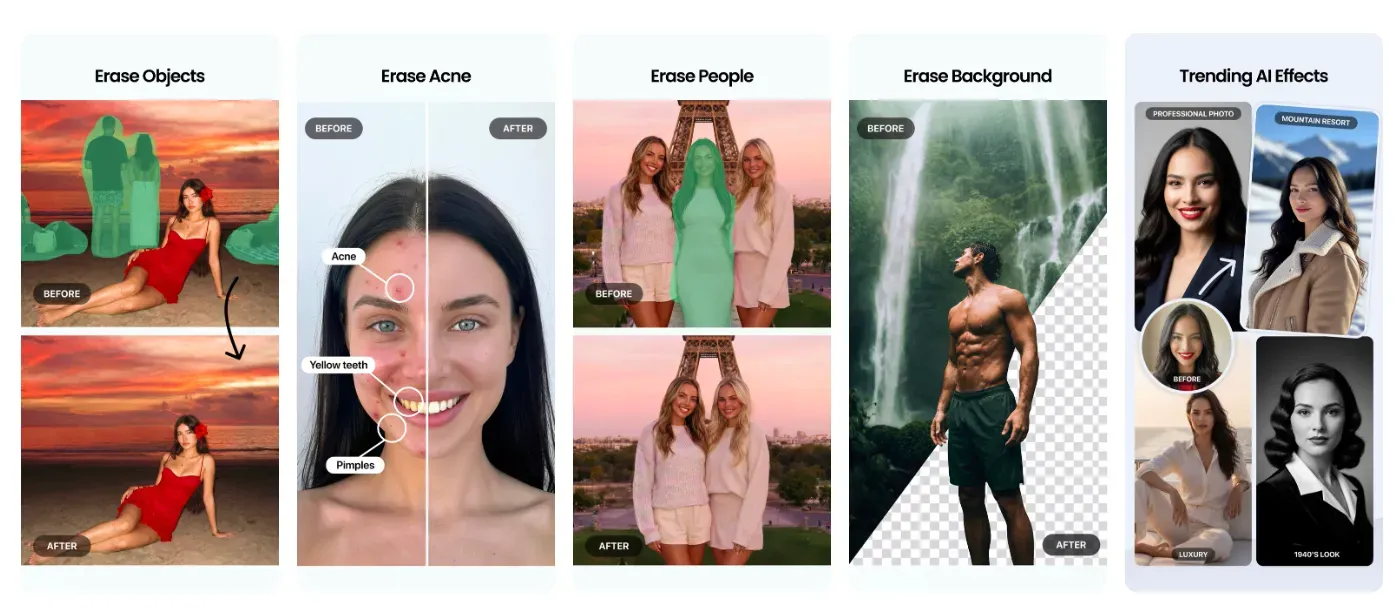
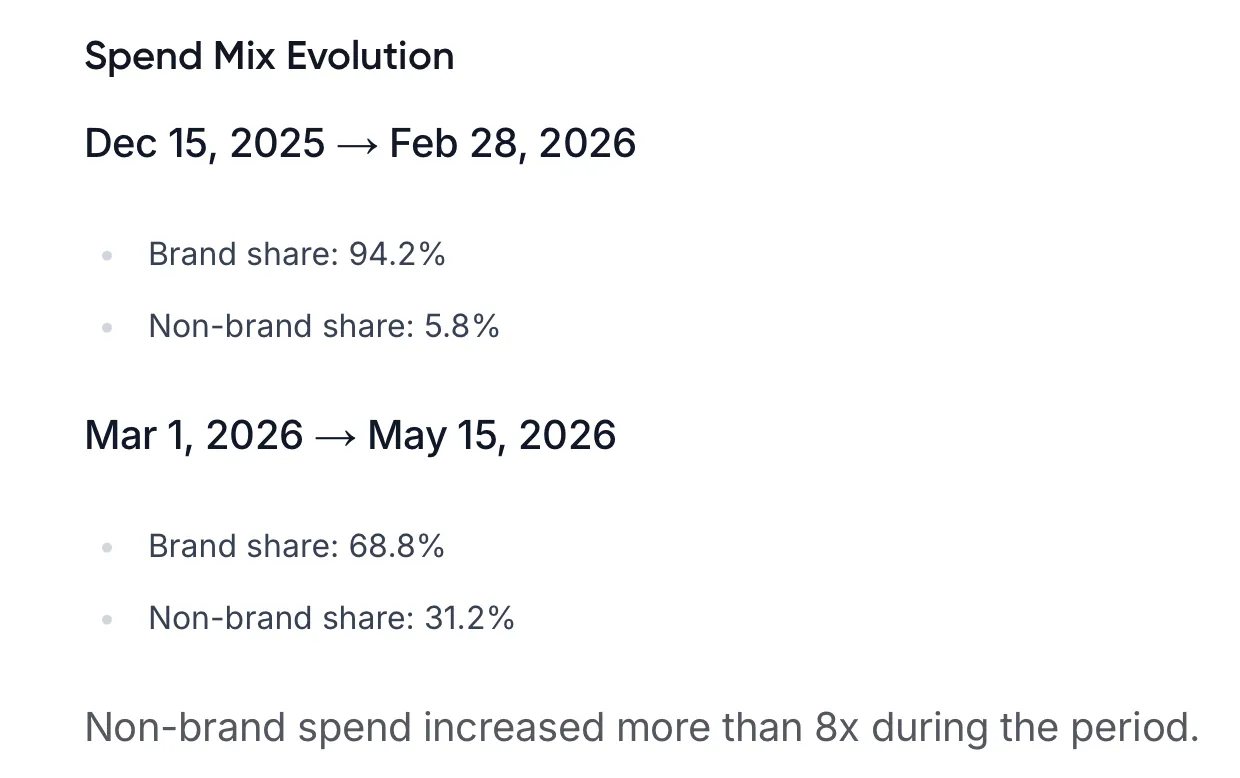
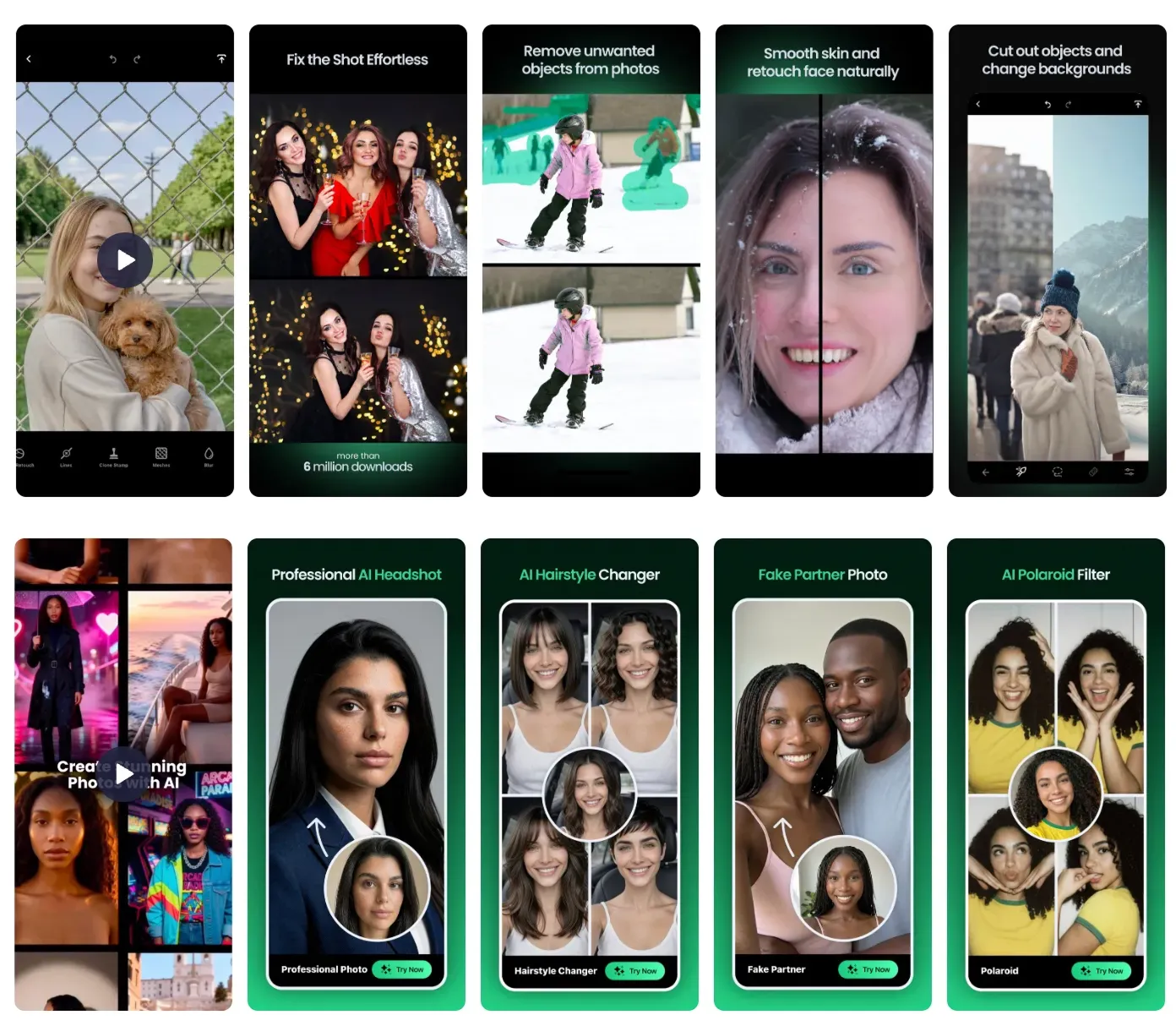
When TouchRetouch, a photo-editing app, came to Applica Agency, its Apple Search Ads were almost entirely brand-dependent — efficient, but capped, with non-brand making up just 5.8% of spend. Treating the account as one system rather than isolated campaigns, the team rebuilt it around intent-based keyword clusters, continuous CPP iteration, and tight ASO–UA collaboration. Non-brand spend share climbed to 31.2% while efficiency held, lifting overall spend +53.3% and revenue +41.3%.
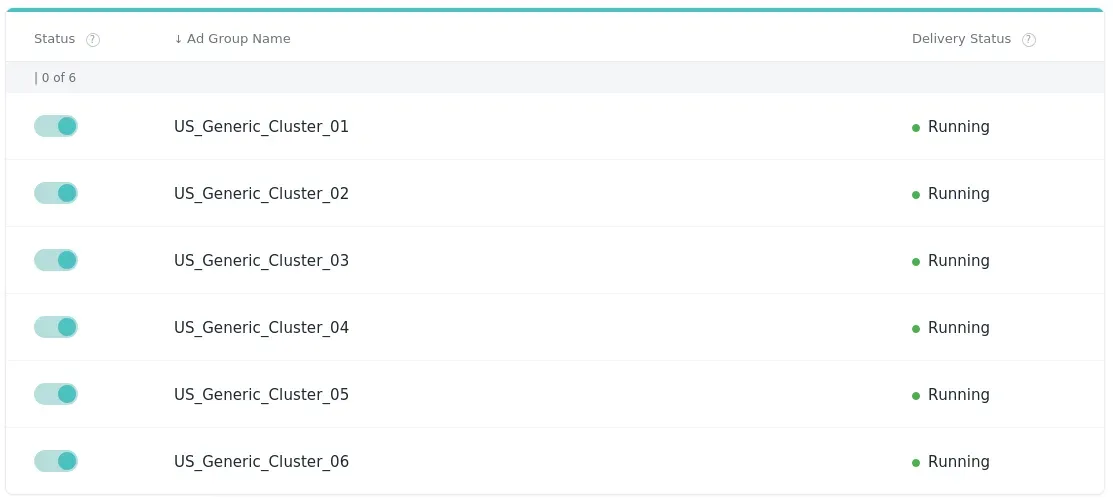
The closed loop was the engine: paid search-term mining fed the organic keyword clusters, and CPP tests fed both paid placements and organic creative. One finding makes the case for keeping both halves under one eye — a Christmas-themed CPP won on tap-through rate, while a social-proof CPP won on downstream ROAS. That divergence is the classic trap of optimising to a top-of-funnel proxy (TTR) instead of the commercial outcome — and you only catch it when the same team sees the tap and the revenue. The intent-matched "Smart Scenes" CPP, meanwhile, beat the default product page on CPI by 47.4% and ROAS by 108%.
How do you measure ASO and Apple Search Ads as one system?
You measure the system, not the channels — because the two halves resist clean separation by design.
Why there's no clean isolated ROAS on the organic half
Organic uplift is a compounding, lagging effect; privacy-era attribution blurs the line between paid and organic installs; and paid spend itself inflates what gets counted as "organic" through the halo effect. So you cannot hand ASO a clean return on ad spend the way you can a paid campaign — and any agency that promises one is selling a number it can't defend.
Budget the system, not the channels
Set measurable ROAS targets on ASA, where the per-tap economics are real and immediate. Treat ASO as compounding infrastructure, judged on trend — organic install and ranking lift tracked over two to three months against where you started, not against a fixed monthly KPI. Then read blended efficiency across both, and watch for the incrementality signals — does organic strengthen as paid mines new terms, does branded search rise as awareness compounds — that tell you the loop is actually turning.
Stop choosing. Start operating them as one.
Three things hold the system together. One auction, where relevance gets you in and bid does the ordering. One listing, because every paid tap lands on the page your organic work built. And one owner, because the loop only compounds when someone sees both the tap and the revenue behind it.
The teams that win the App Store in 2026 won't be the ones who picked ASO or Apple Search Ads correctly. They'll be the ones who stopped treating that as a choice. If your Apple Search Ads and ASO sit in separate silos and you suspect the learnings aren't crossing between them, that's the gap worth closing — explore how Applica Agency approaches App Store Optimization as a single growth system.