The decision usually arrives at the worst time. Growth has slowed, runway is finite, and the founder is still doing product manager work at 11pm on a Thursday. Should the next dollar go toward hiring a senior product manager (PM) internally, or toward engaging an agency that can start running experiments next week? The in-house vs outsourced product team question is one most growing subscription apps hit at exactly this kind of moment — and most comparisons on it are written by one side defending its own model, which is exactly why most procurement-stage readers end up making the call on incomplete information.
The honest answer is that the right structure isn't a philosophy — it's a function of stage, problem type, and how much capacity the existing team can realistically absorb. The cheapest line in the spreadsheet is rarely the cheapest outcome twelve months later. This piece lays out what each model genuinely brings, where the real trade-offs sit, and why most mid-market subscription apps land on a hybrid rather than picking a side. The framework is built for someone who is genuinely shopping — not for someone who has already decided.
Why this is one of the hardest decisions for growing subscription apps
Three forces converge on the in-house-vs-outsourced decision, and they rarely pull in the same direction.
The first is capital. A full in-house marketing and product growth team — four to six specialists across paid acquisition, search engine optimisation (SEO), content, analytics, and creative — costs $440,000 to $590,000 or more annually fully loaded, once benefits, payroll taxes, tooling, and management overhead are counted. A specialist agency retainer covering an equivalent functional scope runs $5,000 to $25,000 per month, or $60,000 to $300,000 annually. The gap looks decisive on paper. It usually isn't, for reasons we'll cover below.
The second is time. A senior PM search in a Tier-1 market takes 60 to 90 days at the front end, with another three to four months of ramp before that hire is producing leveraged output. Product managers searching the other direction average around 19 weeks between roles. An agency engagement, by contrast, is typically delivering first work inside two weeks.
The third is the expertise gap itself. The skills a subscription app needs — paywall optimisation, monetisation modelling, lifecycle retention, A/B testing infrastructure — are specialist disciplines, and a single in-house hire usually only carries depth in one of them. The risk isn't that the hire is bad. It's that the hire is good at one thing when the company needs proficiency in four.
What an in-house product team brings
An internal team's first structural advantage is institutional context. The PM who's been at the company for eighteen months knows the product surface, the codebase quirks, the customer-support inbox, the historical paywall variants that did and didn't work, and the political map between engineering and marketing. That knowledge compounds. No external partner walks in with it.
Second is full attention. An in-house PM doesn't have a portfolio of other clients competing for the calendar. The roadmap is their job, not one of five projects.
Third is direct control. The internal team's priorities, methodology, hiring path, and reporting cadence are set by the company, not negotiated through a statement of work. For founders who care deeply about a specific design language, a particular research methodology, or a non-standard operating cadence, this matters more than the spreadsheet suggests.
Fourth is knowledge retention. Every experiment a salaried PM runs leaves a record inside the company. The institutional memory accumulates. Five years in, a mature in-house team can answer questions about why the paywall is structured the way it is, what was already tested in 2024, and which segments behaved differently last time — questions no agency can answer with the same fidelity.
The honest counterpoint is that those advantages take time to materialise. A first in-house PM hire at a Series A subscription app is often a generalist who needs support in the specialist channels. The signal that it's time to make the hire isn't "we've exhausted every channel"; it's "we have a repeatable acquisition motion that needs a dedicated owner." The role of a Product Growth Manager is decisive once an app crosses a certain maturity threshold — but trying to hire one before that threshold usually produces an expensive learning loop.
What an outsourced product team brings
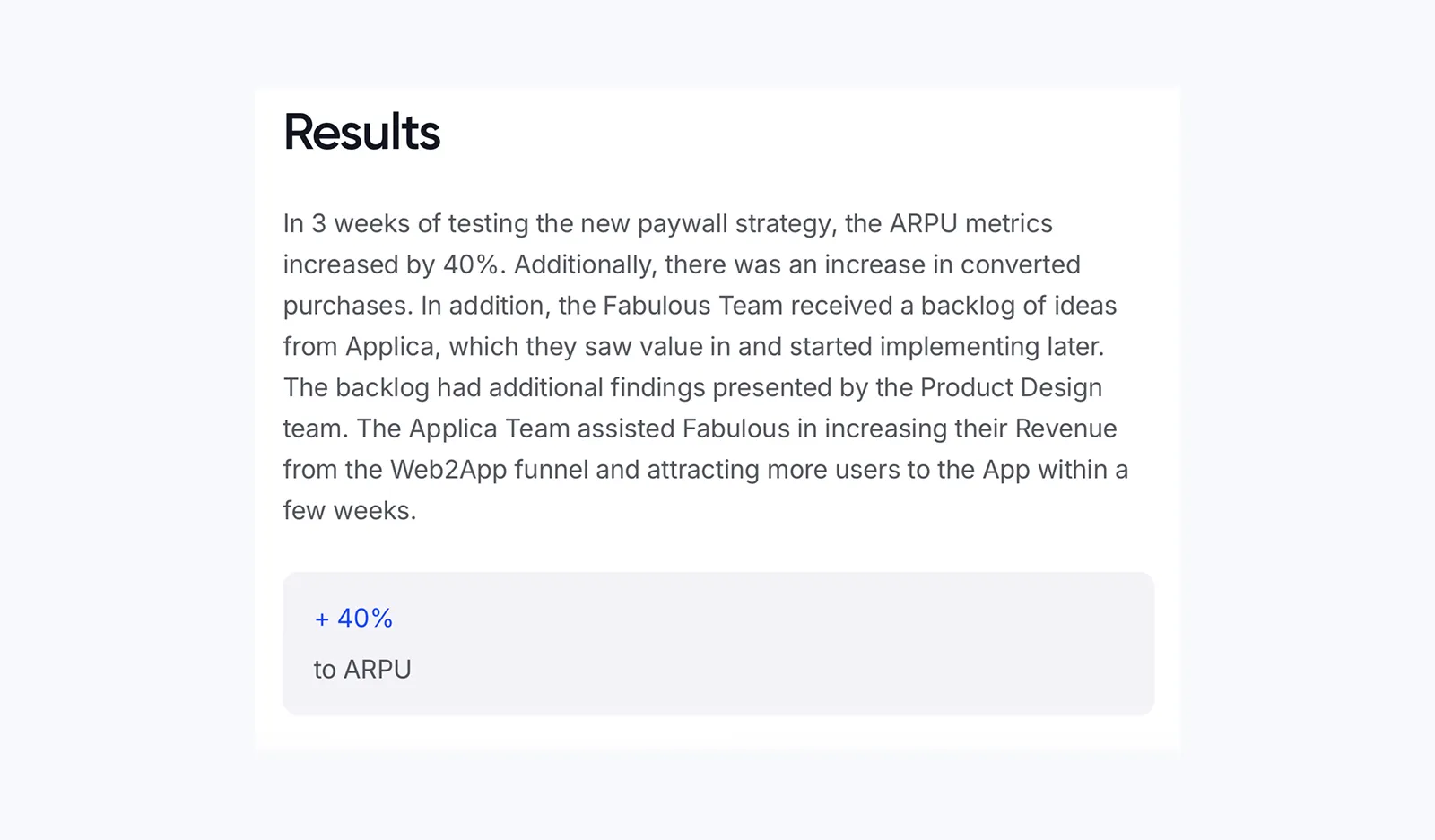
The outsourced model's first structural advantage is speed-to-impact. Fabulous, a wellness app Applica Agency worked with, lifted Web-to-App average revenue per user (ARPU) by 40% in four weeks through a pricing experiment with discount-strategy variations at the end of the funnel. Four weeks is faster than most in-house teams can complete an interview loop for a senior hire, let alone produce a measurable revenue lift. That kind of throughput is the structural advantage of an outsourced partner, not the exception. Agency engagements typically break even in two to four months; in-house hires take six to twelve to reach the same point.
Second is cross-client pattern recognition. An agency that runs paywall experiments across twenty subscription apps a year sees patterns no single in-house team can build inside one product. Which onboarding sequences move D7 retention in WellTech but break trust in FinTech. Which paywall configurations train Meta's pixel toward profitable users versus high-intent free-trial chasers. Which event taxonomies silently aggregate the wrong populations. This is institutional knowledge of a different shape — wider rather than deeper, but wider in ways that translate directly into experimental priors.
Third is specialist depth across the stack. A subscription app needs proficiency across product management, design, paid acquisition, creative production, and analytics. Hiring a specialist in each costs four to six hires. A specialist agency carries the equivalent of those four to six specialists as a structural feature, which is why the comparison often favours agencies at early stages where coverage matters more than depth.
Fourth is flexible scope. An agency engagement can scale up for a paywall rebuild quarter, scale down for a maintenance quarter, and reshape entirely if priorities change. In-house headcount can't flex like that. Salaries are fixed costs that don't move with revenue.
The honest counterpoint is that an outsourced team operates with less institutional context, the retainer math compounds quietly over multi-year engagements, and vendor risk is a real category. Agency incentive structures can also drift toward keeping retainers renewed rather than maximising client growth, which is a problem the best agencies solve through outcome-aligned engagements but the worst agencies hide.
The real trade-offs (what most comparisons miss)
The cost numbers most procurement decks compare aren't apples-to-apples. The five dimensions that actually matterare cost, ramp time, quality variability, knowledge retention, and risk profile — and each one resolves differently than the spreadsheet suggests.
In-house vs outsourced product teams — the trade-offs side by side
| Dimension | In-house team | Outsourced team | Hybrid model |
|---|---|---|---|
| Annual cost | $440K–$590K+ for 4–6 specialists, fully loaded | $60K–$300K agency retainer for equivalent functional scope | One in-house lead + agency execution; cost in between |
| Time to first output | 60–90 days to hire + 3–4 months to ramp | ~2 weeks from kickoff to first work | Same as in-house for strategy; same as agency for execution |
| Quality variability | Depends on a single hire being right | Depends on team allocation and seniority assigned | Lower variance — in-house catches agency drift, agency catches in-house blind spots |
| Knowledge retention | Institutional memory compounds inside the company | Cross-client pattern access; less institutional depth | Best of both — in-house keeps the memory; agency keeps the patterns |
| Risk profile | Bad hire takes 6–9 months to unwind; turnover costs ~2x salary | Vendor switch is operationally simpler than firing | Lowest organisational risk; either side can be replaced without destabilising the other |
A few of those rows deserve unpacking. On cost: a UK mid-level Product Manager carries a median salary of £67,000, rising to £109,100 at senior level; US Senior PM bands sit in the $122,000 to $190,000 range; a senior PM in a US metro market commands $150,000 to $210,000 base before benefits, equity, and recruiting fees. One hire of that calibre is roughly the annual cost of a full-service agency engagement — mid-tier agencies typically run $54,000 to $132,000 per year all-in. Five hires of that calibre is roughly six times that retainer, before tooling, recruiting fees, or turnover replacement is factored in.
On knowledge retention, the cost of getting it wrong is well-documented. A study from Northeastern, Liverpool, and Toronto found that turnover of senior marketing executives, mid-level managers, and even junior employees causes measurable damage to brand performance over time, because departing employees take their experience, customer relationships, and accumulated context with them. The same departure dynamic doesn't apply to an agency relationship, where the institutional memory belongs to the agency's portfolio across all its engagements.
When each model is the right call
The decision resolves by asking a small set of honest questions in sequence.
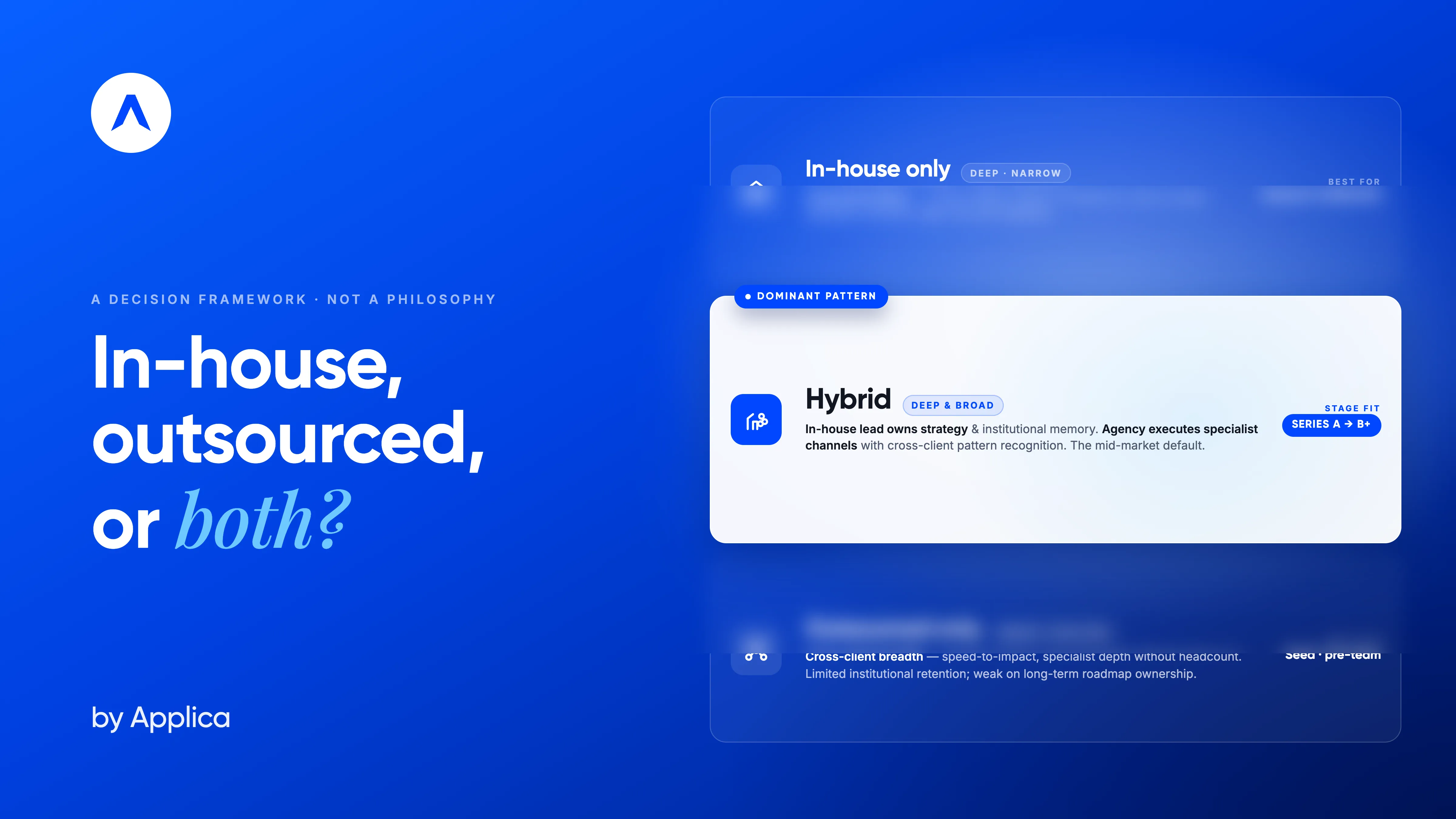
By stage. The dominant trajectory across VC-backed subscription apps is agency-first at Pre-Seed and Seed, hybrid after Series A, and in-house leadership plus agency execution at Series B and beyond. Apps below roughly $1M monthly recurring revenue (MRR) almost always start outsourced, because the volume of channels they need to test exceeds the headcount they can responsibly hire. Apps above $5M MRR tend toward hybrid because they have the budget for both layers and the volume to justify in-house specialists alongside agency partners.
By problem type. A one-off project — a paywall rebuild, a market expansion, a measurement-stack overhaul — almost always favours an outsourced team. The work has a defined scope and a defined end, and hiring for it locks in fixed cost long after the project ends. An ongoing optimisation programme can go either way, depending on whether the company can build the testing cadence in-house faster than it can rent it. A strategic transformation — repositioning the product, restructuring the monetisation model — usually requires both: external pattern recognition to design it, internal ownership to execute it.
By internal team capacity. A company with no product manager almost always needs to outsource first, because hiring a senior PM into a vacuum produces a generalist who has to invent a methodology while running it. A company with a junior PM benefits enormously from an agency that can mentor across cross-client patterns the junior hire hasn't seen yet. A company with an experienced senior PM is usually best served by a hybrid — the senior leader owns the strategy, the agency owns specialist channels.
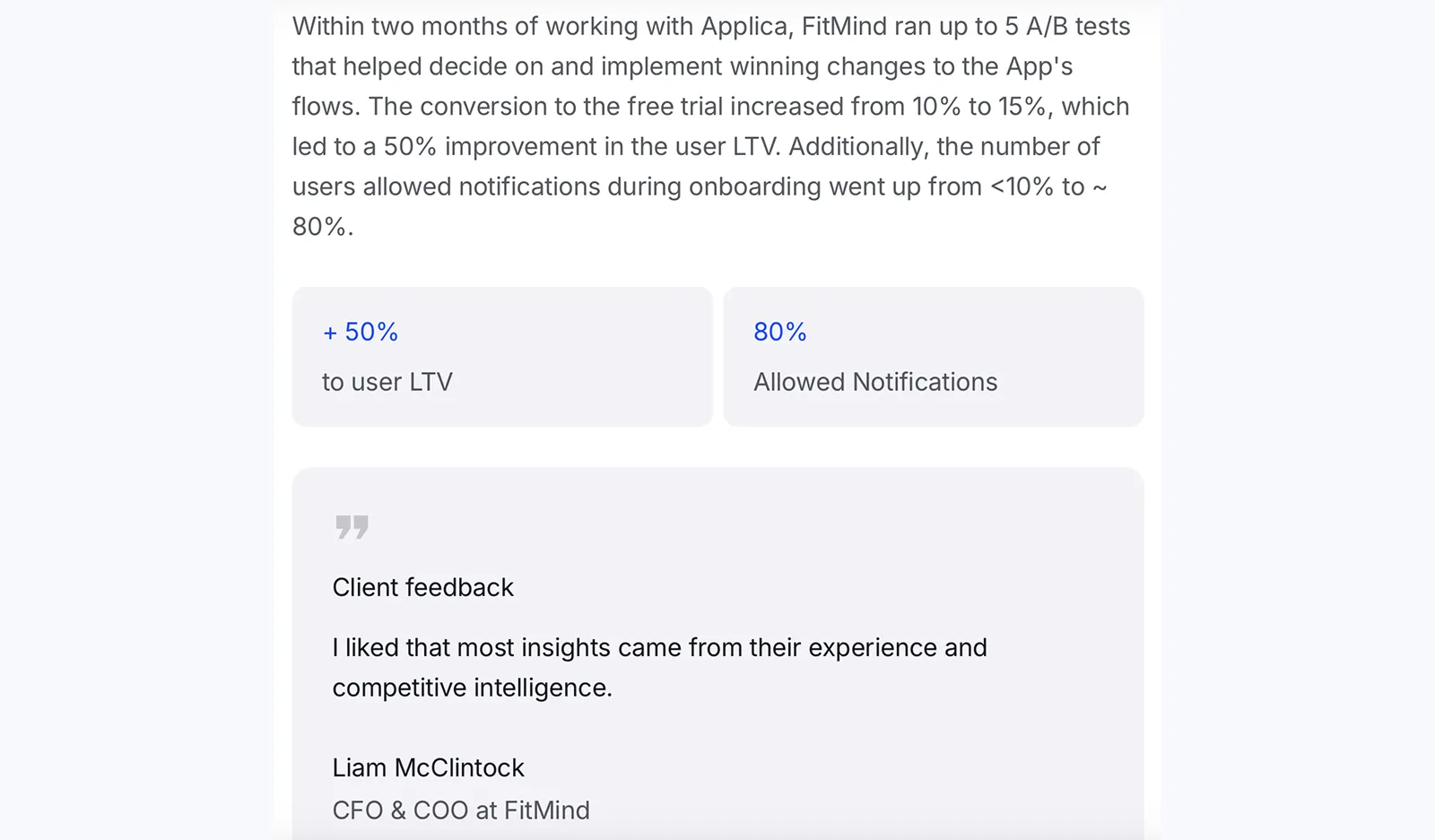
By cross-client pattern need. FitMind, a meditation app, lifted ARPU by 50% across just five A/B tests in two months— but only because the engagement opened with finding the in-app event tracking that had been silently breaking the previous testing setup. Five tests in two months sounds modest, until you realise most in-house teams in the same situation would have spent two months running tests on broken instrumentation before discovering the underlying problem. The structural advantage isn't running more tests; it's knowing where to look first. That kind of pattern recognition is built by working across dozens of similar engagements, not by going deep inside one.
What does a hybrid product team look like in practice?
The hybrid structure that most subscription apps between Series A and Series C end up with is straightforward: one in-house leader owns strategy, brand direction, institutional knowledge, and the agency relationship; the agency executes specialist channels — paid acquisition, paywall optimisation, A/B testing infrastructure, creative production — and reports to the in-house lead on a weekly cadence.
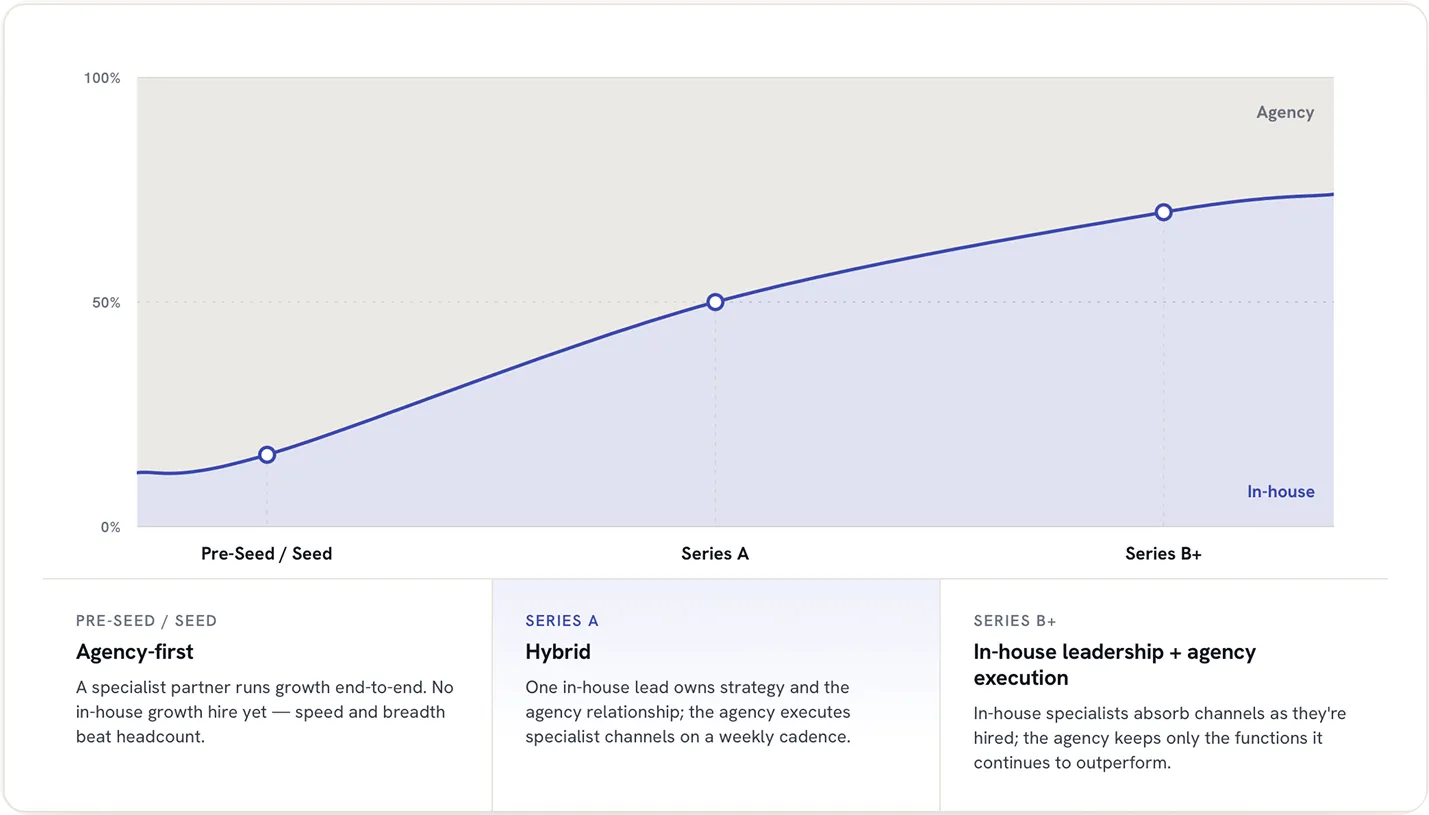
The structure isn't a compromise. Each side does what it's structurally best at. The in-house lead carries institutional context, makes hiring decisions, owns the political map, and translates business strategy into channel priorities. The agency carries cross-client patterns, runs the testing cadence at a velocity in-house teams rarely sustain, and brings specialist depth without specialist headcount.
The common mistakes are predictable. Treating the agency as cheap labour — handing over tasks rather than strategic problems — wastes the cross-client pattern access that's the whole point. Hiring in-house "to manage the agency" is a tell that the engagement isn't scoped correctly; a good agency manages itself against a clear brief. Terminating the agency the day the senior hire signs is the most expensive mistake of all, because the new hire's first ninety days are exactly when they need cross-client patterns to calibrate. The transition should be a handoff, not a replacement — agencies hand off channels to in-house specialists as those specialists are hired, retaining only the functions where they continue to outperform a single hire.
How do you onboard an agency without disrupting an in-house team?
Four things, in order, prevent the hybrid model from collapsing into duplicated work or unclear lines of responsibility.
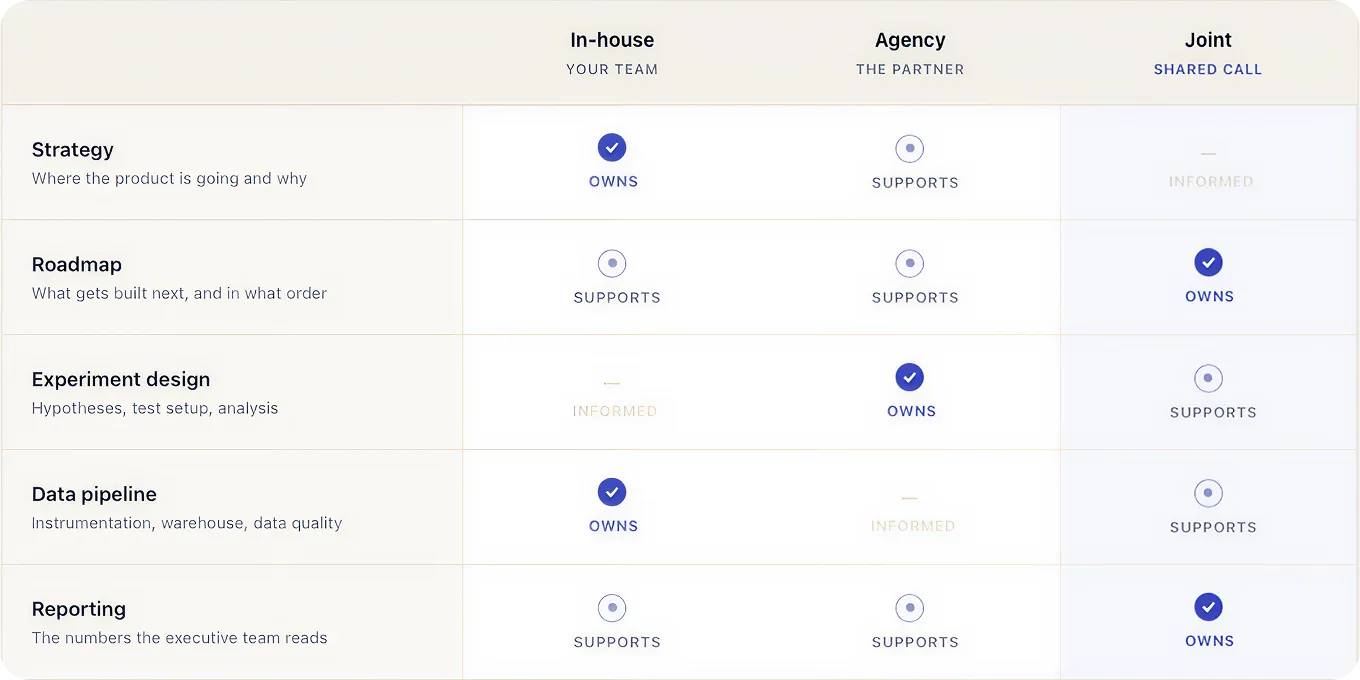
Define ownership boundaries upfront. Who owns the roadmap? Who owns experiment design? Who owns the data pipeline? Who owns the reporting layer the executive team reads on Monday mornings? These questions deserve answers in the engagement contract, not in the second month when something goes wrong.
Set decision rules before the engagement starts. What's the success threshold for a test? Who has authority to ship a winner? What's the escalation path when results contradict expectations? Pre-defining these prevents the most common hybrid-model failure: a successful test that no one ships because no one owns the call.
Establish a quarterly review cadence. Which functions stay agency, which migrate in-house, which need re-scoping? The hybrid model is dynamic — the right mix at Q1 isn't the right mix at Q4. A standing review forces the question deliberately rather than letting drift make it implicitly.
Pre-define the handoff and exit plan. No engagement is permanent. The exit clause should specify what knowledge transfers, what documentation hands over, and what the in-house team owns at the end. The companion procurement guide on how to evaluate and choose a partner covers the upstream version of this discipline.
Frequently asked questions
Can we replace our in-house product manager with an agency to save money?
Usually not. An agency can replace specialist execution — a paid acquisition manager, a creative production lead — but the role of a product manager is structurally different. The PM owns roadmap, prioritisation, and the interface between business strategy and execution, which requires institutional context that an external partner can't accumulate. The right move when budget is tight is usually to keep the PM and replace specialist headcount with agency capacity, not the other way around.
When does it make sense to bring everything in-house?
Typically at Series B or later, once the company has proven channels, stable budgets, and enough volume to justify dedicated specialists in each function. The signals are concrete: a repeatable acquisition motion that survives without daily oversight, channel economics that have stabilised across multiple quarters, and a budget that supports both leadership headcount and specialist depth. Most subscription apps don't hit this point until well past $5M MRR. Below that threshold, the outsourcing market continues to grow because the in-house math doesn't work at that scale.
What's the minimum company size where in-house product hiring starts to make sense?
There's no universal floor, but two signals matter more than headcount. The first is a repeatable acquisition motion — at least one channel that converts predictably, even imperfectly. The second is enough institutional context worth retaining: a product roadmap that's accumulated complexity, a customer base with non-obvious segmentation, or a competitive position that requires consistent narrative across channels. Companies that have one or both of these signals are ready for an in-house lead. Companies with neither are usually better served by an agency engagement that builds those signals before the in-house hire is made.
Three takeaways
First, the in-house vs outsourced decision isn't binary. Most subscription apps below Series B end up running a hybrid because the trade-offs don't resolve cleanly to one side, and the apps that succeed are the ones that knew why they were making each choice before they signed anything.
Second, the right model depends on stage, problem type, and team capacity — not on cost alone. The spreadsheet comparison usually favours the agency at small scale and the in-house team at large scale, but the spreadsheet rarely captures ramp time, quality variability, or the cost of unwinding a wrong hire.
Third, the cross-client pattern recognition advantage is the structural reason a specialist agency outperforms a generalist in-house team on specialist work. It's also the reason an in-house leader paired with a specialist agency outperforms either model alone. The hybrid isn't a compromise. It's the dominant pattern across mid-market subscription apps for a reason.
If you're weighing whether to hire your first in-house product lead, engage an external partner, or restructure an existing setup that isn't working, let's talk through what fits your stage. Applica Agency's conversion rate optimizationengagements start with a diagnostic of where the leverage actually sits — sometimes that's an agency engagement, sometimes it's a hand-off plan to an in-house lead, sometimes it's a hybrid restructure. The honest answer depends on what you're trying to do next.