Search still drives the majority of App Store downloads, according to Apple, and the rise of AI assistants has not moved the decision point: in AppTweak's September 2026 survey of US adults, 59% of people who got an app recommendation from AI still checked the store for reviews, ratings, or screenshots before installing. So the real question for a growth team is not whether App Store Optimization pays, but when to start ASO and how much to commit at each stage.
Most teams get the timing wrong in one of two expensive ways. Some funds a full ASO program before the product retains users, optimizing a listing for installs that churn within a week. Others launch paid user acquisition on a product page that nobody has tested, and pay a premium for every install as a result.
This guide lays out the two moments that justify ASO investment, a three-phase framework for sequencing the work, and the signals that tell you which phase you are in.
When should you start ASO? The short answer
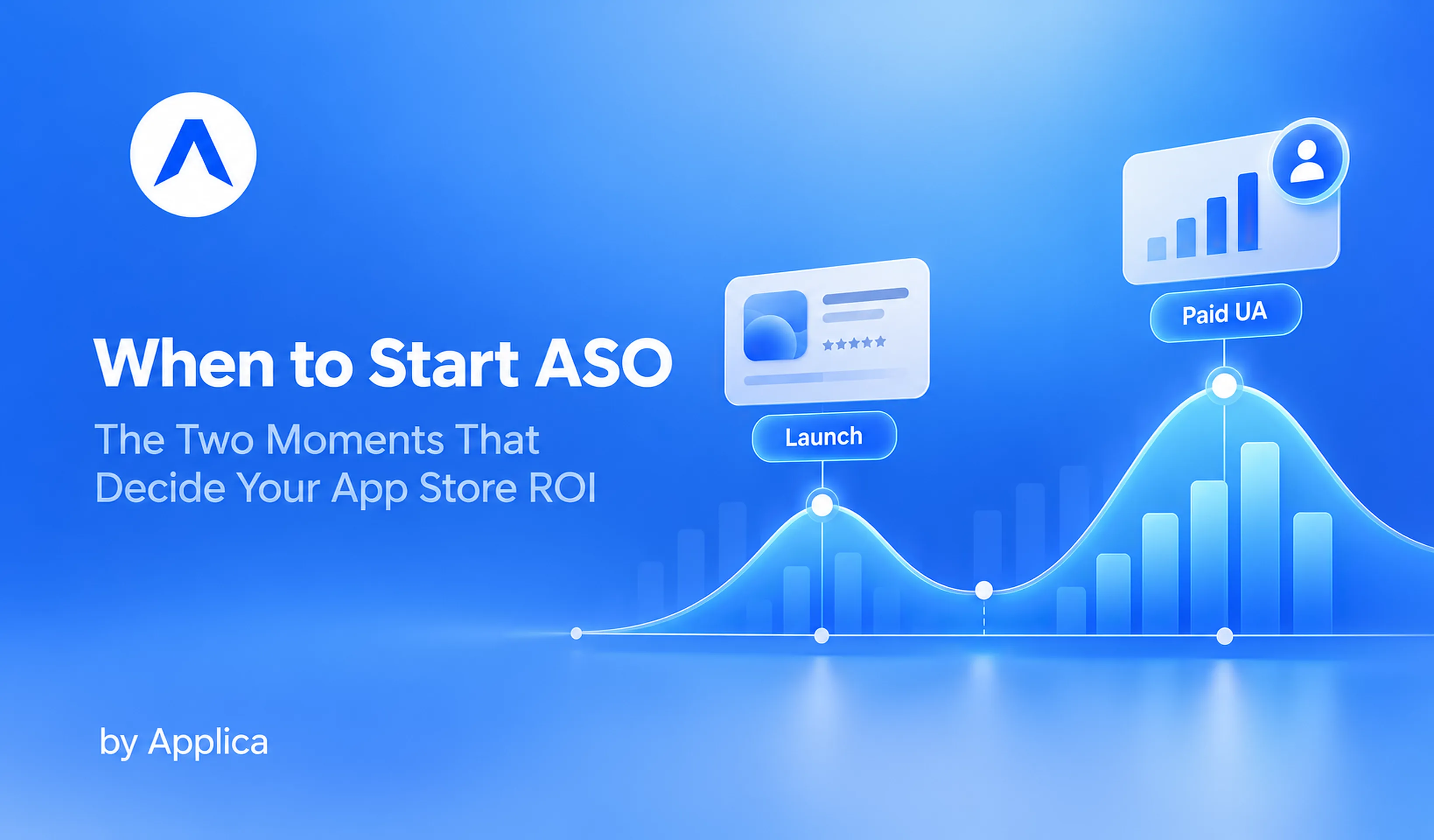
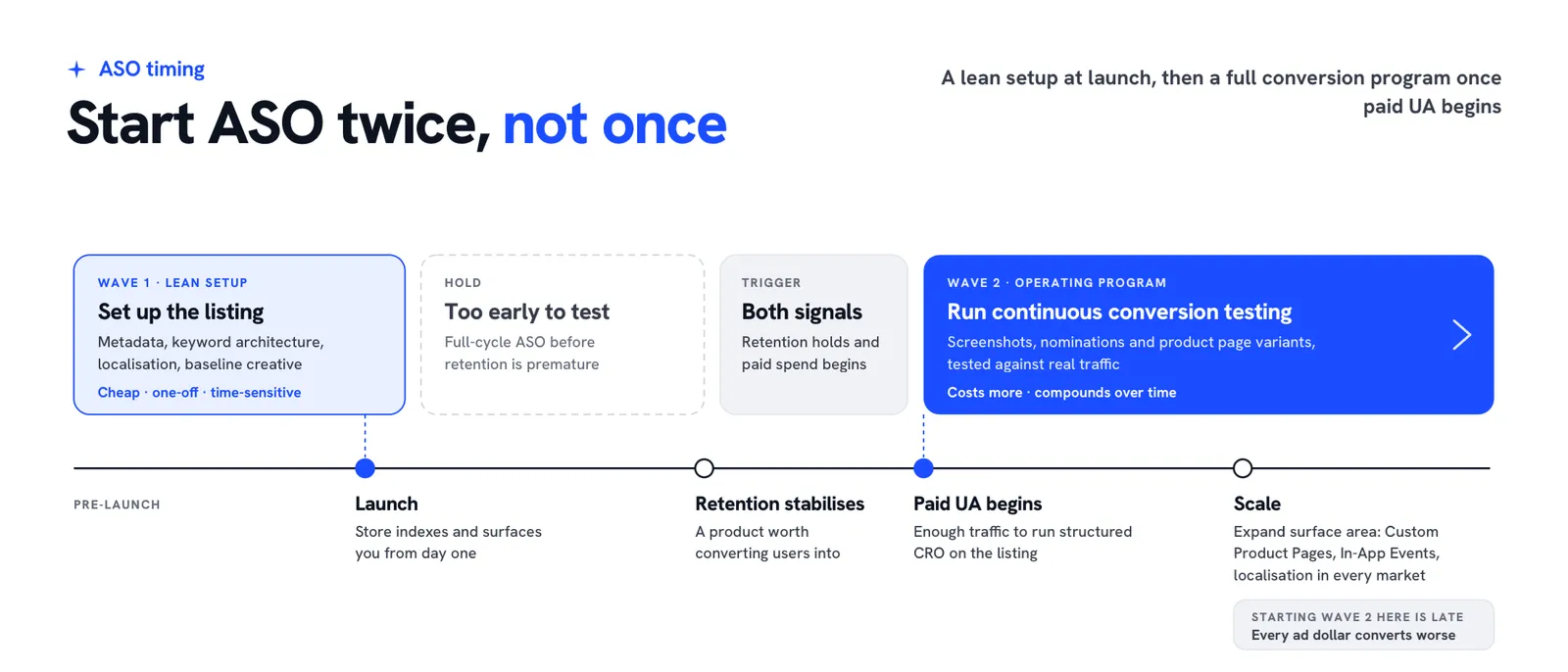
You should start ASO twice: a lean setup before launch, to capture first-release visibility and build early reputation, and a full conversion program once retention stabilizes and paid acquisition begins. Full-cycle ASO before retention is premature; waiting until paid spend has already scaled means every ad dollar converts worse than it should.
Two waves, not one budget line
The root cause of most timing errors is treating ASO as a single budget line that is either "on" or "off." In practice, the work splits into two different investments. The first is a setup: metadata, keyword architecture, localization, and baseline creative. It is relatively cheap, mostly one-off, and time-sensitive. The second is an operating program: continuous testing of screenshots, nominations, and product page variants, run against real traffic. It costs more, compounds over time, and only pays back when there is enough traffic and a product worth converting users into.
What "investing in ASO" means at each stage
At launch, investing in ASO means getting the foundations right so the store can index and surface you correctly from day one. After product-market fit, it means running a structured conversion rate optimization program on the listing. At scale, it means expanding the surface area: Custom Product Pages, In-App Events, and localization across every market you serve.
Wave one: the launch window
The first release is the one moment where ASO work is both cheap and unusually high-leverage, because the store gives you a window of visibility (opportunity to rank high) you cannot easily recreate later.
Why the first release is a one-time opportunity
Practitioners have long observed that newly released apps rank better for their keywords in the first days after launch than they do once the listing settles. Sensor Tower first documented the pattern as a drop around day seven, and more recent practitioner work from RadASO notes that the effect appears only once per market, at first release or on first availability in a new country. Apple does not confirm or describe any launch boost, so treat it as an observed pattern rather than a guaranteed mechanic. The practical implication holds either way: whatever keywords your title and metadata carry on launch day are the ones you get to test that window against.
What to lock before day one
A launch-ready listing needs four things: a metadata structure that places your highest-value terms in the fields that carry weight, a semantic core built from real App Store keyword research, localization for your top markets, and a baseline set of screenshots that communicate the core value in the first frame. None of this requires a testing program. It requires research, discipline before building the ships.
Reputation compounds from the first review
Apple lists user behavior, including downloads, ratings, and reviews, alongside text relevance as inputs to search results. That makes the first few weeks disproportionately important: early ratings shape how both the store and prospective users judge the listing. Word of mouth from launch users is also the cheapest acquisition you will ever get, and a listing that clearly explains the product is what turns a recommendation into an install.
Why does full ASO investment require retention first?
A full ASO program amplifies whatever the product already does. If users stay, stronger visibility and conversion compound into growth; if they uninstall within days, ASO accelerates churn and spends budget optimizing for installs that never become revenue.
What the stores say they measure
The two stores are not equally transparent, so it is worth separating what is documented from what is inferred. Google is explicit that technical quality affects visibility: apps that exceed Android vitals bad-behavior thresholds are likely to be less discoverable on Google Play, and for metrics such as DAU/MAU and user loss rate, an app may show a store-listing warning or lose eligibility for certain surfaces. Apple states only that user behaviour feeds search results. Beyond that, practitioners such as AppTweak treat engagement and retention as Google Play ranking factors based on platform observations, rather than a published specification.
Ranking an app that users delete
We do not have evidence that D1 or D7 retention is a direct, weighted-ranking input for either store, and no team should plan around a precise formula. The principle is simpler and does not depend on the mechanism: every visibility gain sends more users into the product, so a leaky product converts that gain into churn, poor reviews, and weaker engagement signals. That is why the full program waits until retention stabilizes. Until then, keep the launch setup healthy and put the budget into the product funnel.
Wave two: the conversion tax of late ASO
The second moment arrives when retention holds, and you start experimenting with paid user acquisition. This is where delaying ASO becomes measurably expensive.
What is the conversion tax?
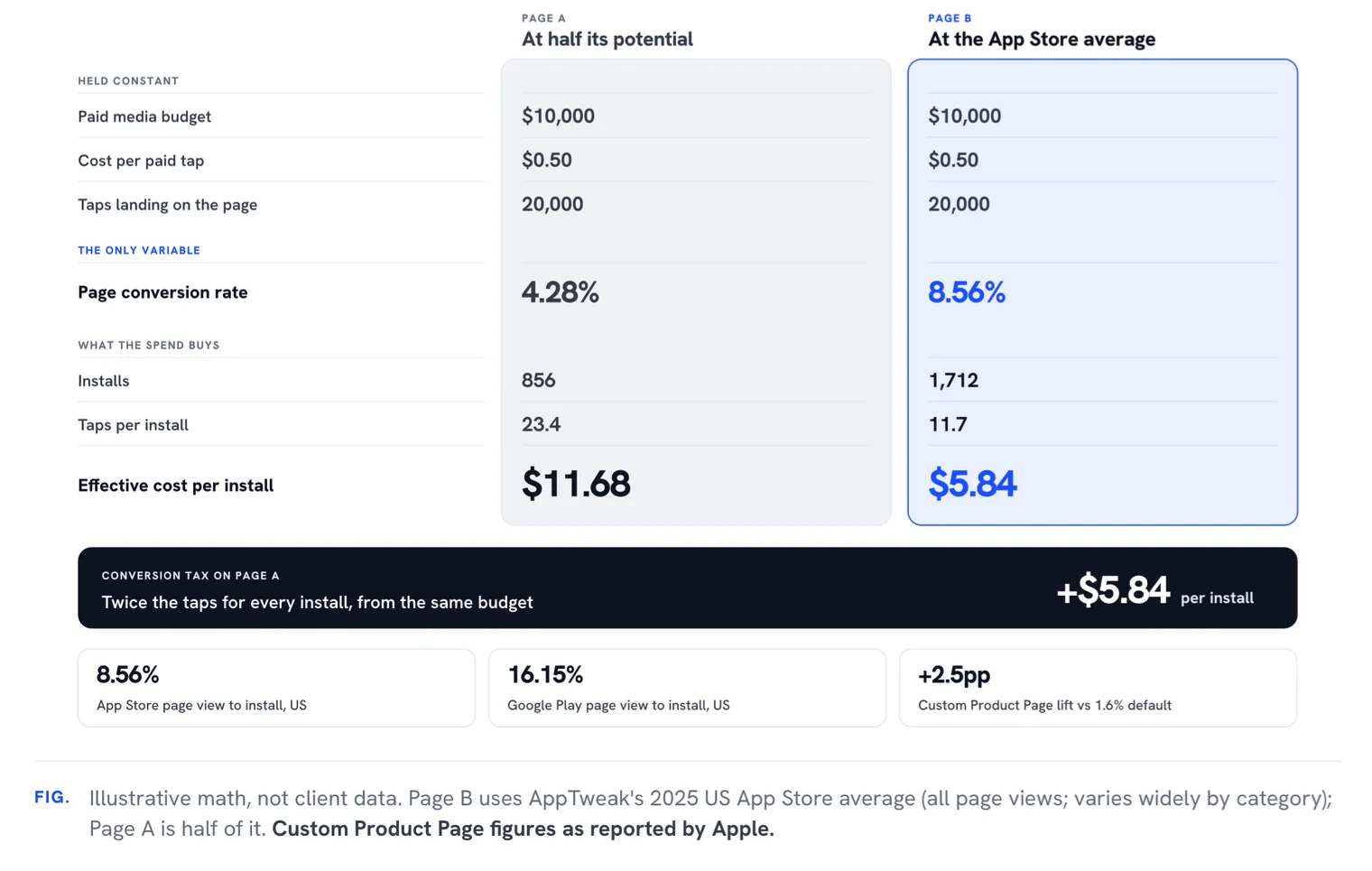
The conversion tax is the extra cost per install you pay when paid traffic lands on an unoptimised product page. Every paid tap arrives at the same listing organic users see, so the page's conversion rate multiplies against every dollar of spend: a weaker page means more taps, and more money, for each install.
The benchmarks show how much room there is. AppTweak's 2025 data puts the average US conversion rate from page view to install at 8.56% on the App Store and 16.15% on Google Play, with wide variance by category. Apple's own figures show that sending users to a Custom Product Page rather than the default listing lifts conversion by 2.5 percentage points on average, against a 1.6% average for default pages. If a listing converts at half its potential, the paid efforts is effectively paying for two taps to earn one install. As we argued in our piece on app store conversion optimization, this is the half of ASO most growth teams underfund.
What we see across accounts
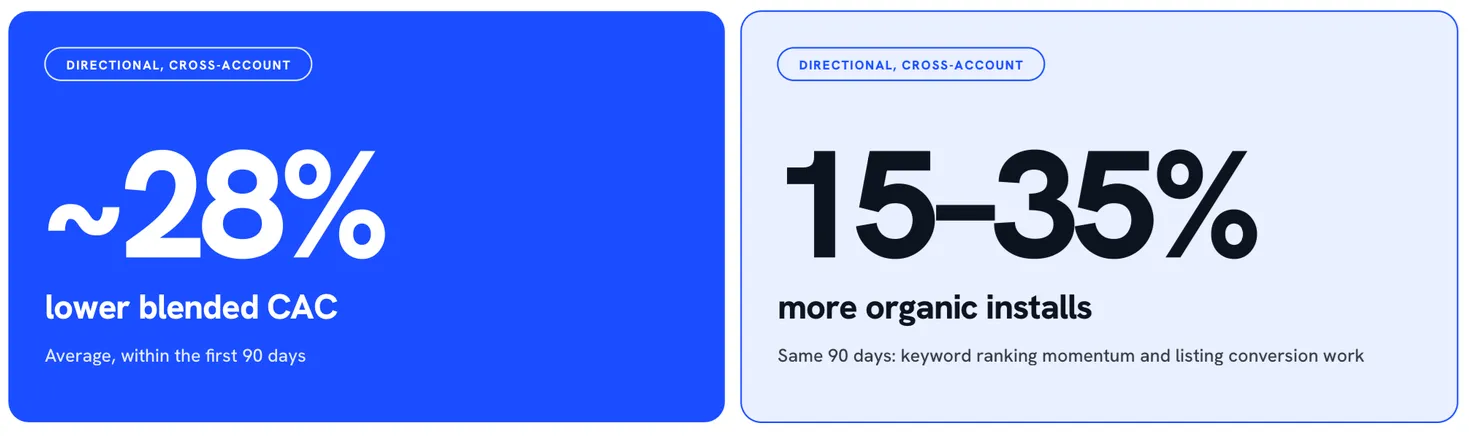
Across Applica's managed portfolios, a consistent pattern emerges. Apps that started full ASO during their early paid UA phase, rather than waiting until paid spend plateaued, saw blended customer acquisition cost fall by around 28% on average within the first 90 days. Over the same period, organic installs rose by 15% to 35%, reflecting keyword ranking momentum and conversion work on the listing. We treat both as directional cross-account benchmarks rather than a formula; the exact effect varies with category, market, and how much paid volume the listing receives. In one case, a meal plan app doubled year-over-year revenue in three months under a combined ASO and paid marketing program.
I advise developers to look at ASO in two distinct waves. The first is right at launch, where you need to maximize visibility, conversion, and brand reputation from day one while taking full advantage of Apple's organic boost and word of mouth. The second wave comes once your retention stabilizes and you begin experimenting with paid UA. If your store page isn't optimized by the time paid spend scales, you are effectively paying a heavy conversion tax on every single ad dollar.
Luisa Ronchi, Head of Marketing at Applica
The three-phase ASO investment framework
The two waves translate into three phases of work. Each phase has a distinct objective, a distinct set of levers, and a clear trigger for moving on.
Three-phase ASO investment framework from launch to scale
| Phase | When | Objective | Core levers |
|---|---|---|---|
| Before and at first release | Be indexed correctly and capture launch visibility | Metadata structure, semantic core, top localisations, baseline / evergreen creative |
| Retention stable, paid tests starting | Raise listing conversion before paid scales | Screenshot and icon testing, message testing, review management |
| Paid and organic both material | Match the listing to every intent and market | Custom Product Pages, In-App Events, featuring nominations, global localisation |
Phase 1: at launch
The launch phase is a setup, not a program. Structure the title, subtitle, and keyword field around a researched semantic core, localise for the markets that matter most, and ship screenshots whose first frame explains the product. The goal is a listing that is correctly indexed and credible on day one, not one that has been optimised through testing.
Phase 2: post-product-market fit
Once retention holds and paid tests begin, conversion becomes the priority. Run high-velocity tests on the top-of-funnel creative, starting with the first screenshots, since that is where most of the conversion work happens. Both stores offer native testing, Product Page Optimization on iOS and Store Listing Experiments on Google Play, so the constraint is rarely tooling (you can also test via Apple Ads). It is testing cadence and discipline about which metric decides a winner.
Phase 3: scale and maturity
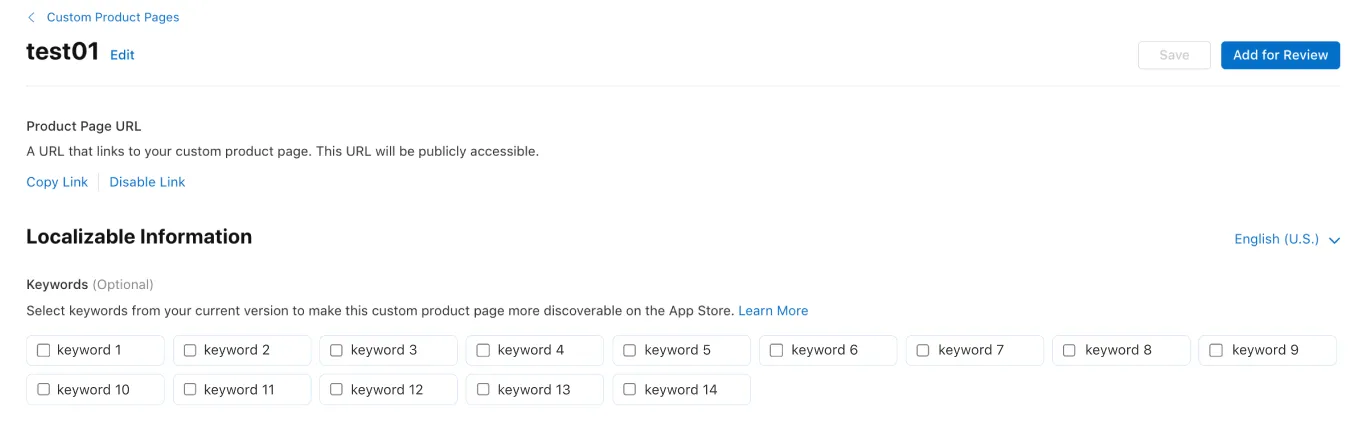
At scale, one listing cannot serve every audience. Since October 2025, Apple allows up to 70 Custom Product Pages, each of which can be assigned keywords and appear in organic search results for those terms. That makes CPPs a tool for both paid campaigns and organic intent. Add In-App Events for recurring visibility, retargeting and extend localisation beyond your first markets.
Signals that you are ready for the next phase
Move from Phase 1 to Phase 2 when retention curves flatten rather than decay towards zero, and when you are ready to commit paid budget beyond small experiments. Move from Phase 2 to Phase 3 when paid spend is material across several channels or markets, and when your ad creative is converging on distinct audience segments that one default page cannot address.
How do organic ASO, paid UA, and AI search work together at scale?
At scale, keyword optimisation drives organic impressions, store conversion work makes every paid install cheaper, and the same listing now also answers users arriving from AI recommendations. The three reinforce each other only when one team owns the listing across all of them.
Keywords drive impressions; conversion makes paid efficient
Organic and paid traffic share one product page, which is why the returns from ASO show up in both channels. Paid campaigns also generate the highest-signal data ASO has, from converting search terms to winning creative concepts. We covered how to operationalise this in ASO and user acquisition as one feedback loop. One caution on expectations: AppsFlyer found the organic uplift from paid campaigns too variable to publish a statistically valid multiplier, so plan for the paid-to-organic link to be real but account-specific.
Preparing listings for AI search
AI assistants are now a mainstream discovery channel: 58% of US adults in AppTweak's survey have used one to find or choose apps. But the store remains the verification step, so a listing that states clearly what the app does, who it is for, and why it is credible serves both the AI summary and the user who clicks through to check. We explore the brand side of this shift in AEO vs ASO in 2026.
When to start ASO: a sequencing decision, not a yes or no
ASO timing is a sequencing decision: set up the listing properly before launch to capture a one-time visibility window, hold the full program until retention proves the product is worth scaling, then invest in conversion before paid spend grows, because every point of listing conversion lowers the cost of every paid install. If your paid budget is growing and your product page has not been tested in the last quarter, that is where to start. Explore Applica's App Store Optimization service to audit where your listing is costing you installs.