A founder has just decided to bring in outside help. The harder decision sits one step downstream: which kind of partner. A discovery call with an engineering shop, a positioning consultancy, and a subscription-product specialist all describe their work using overlapping language — "we own the product roadmap," "we drive growth," "we run experiments." Three categories of vendor, three different problems they solve, one shared procurement vocabulary that hides the differences.
That ambiguity is structural. The search engine results page for how to choose a product management partner is contested by product development listicles, product marketing rankings, and recruiting agency pages — most of which aren't describing the same service. The result is procurement-stage confusion that costs subscription mobile apps months of runway when the wrong category gets picked.
This piece is the framework for someone who's already past the "do we go outsourced" question and now needs to evaluate specific partners. 5 evaluation criteria, 4 red flags, 6 questions to ask — built for genuine shopping, not for someone who has already decided.
Why choosing the wrong product management partner is expensive
The procurement-stage cost looks predictable on paper. Month one goes to ramp and discovery. Months two and three deliver first outputs. Month four is when the founder notices the engagement isn't compounding — deliverables are landing, but the metric that mattered hasn't moved. By the time the engagement is honestly unwound, 4–6 months of runway has been spent on work that produced motion without traction.
The harder cost is that bad engagements don't fail loudly. They produce results that look fine on the dashboard but never connect causally to a business outcome. The "we improved engagement" deliverable lands; the trial-to-paid conversion the founder was actually trying to move stays flat. Across the broader agency landscape, founders who have had a bad agency experience consistently say in retrospect they should have asked more questions before signing — the engagement signal was visible in the discovery call, but the questions that would have exposed it weren't asked. The reframe worth holding onto, and one Applica Agency raises during scoping conversations consistently: this isn't a who's the best partnerquestion. It's a what kind of partner does my specific problem need question.
What is a product management partner? (And what it isn't)
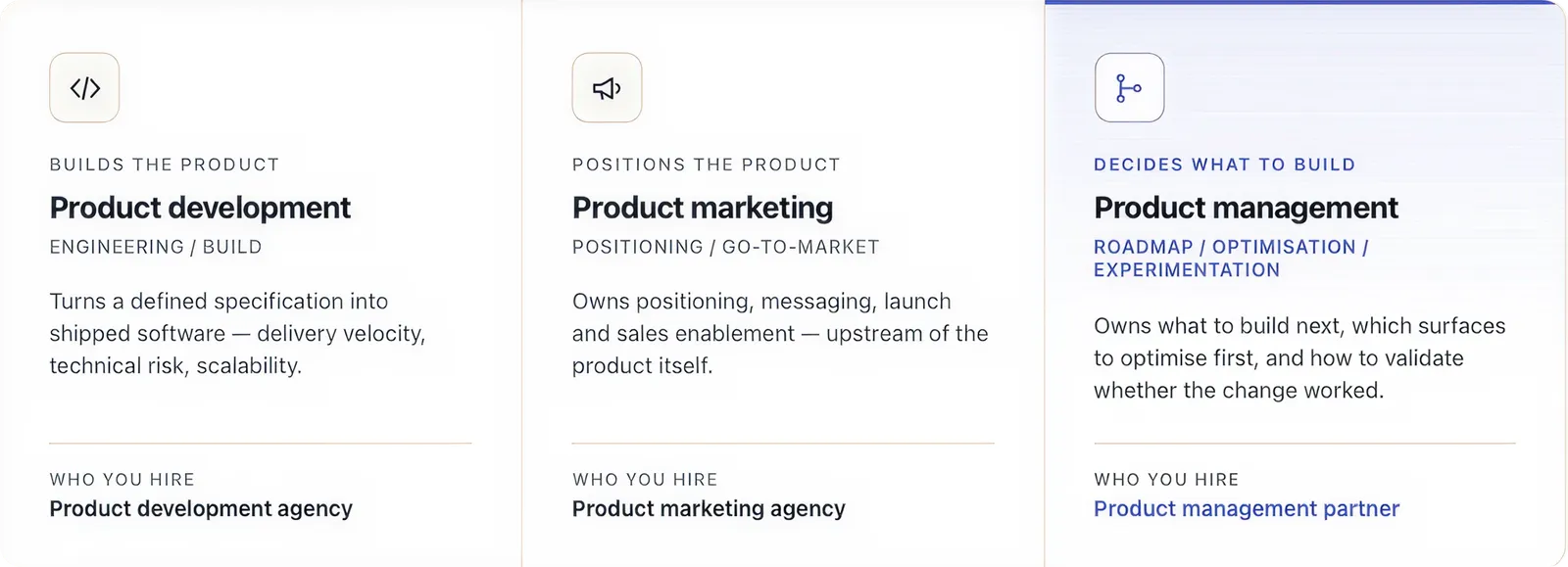
A product management partner is an external team that owns or co-owns the product roadmap, optimisation programme, and experimentation cadence for a subscription mobile app. The scope covers onboarding, paywalls, activation event design, trial mechanics, retention loops, and the testing infrastructure that lets the team read whether any of those interventions actually moved the metric.
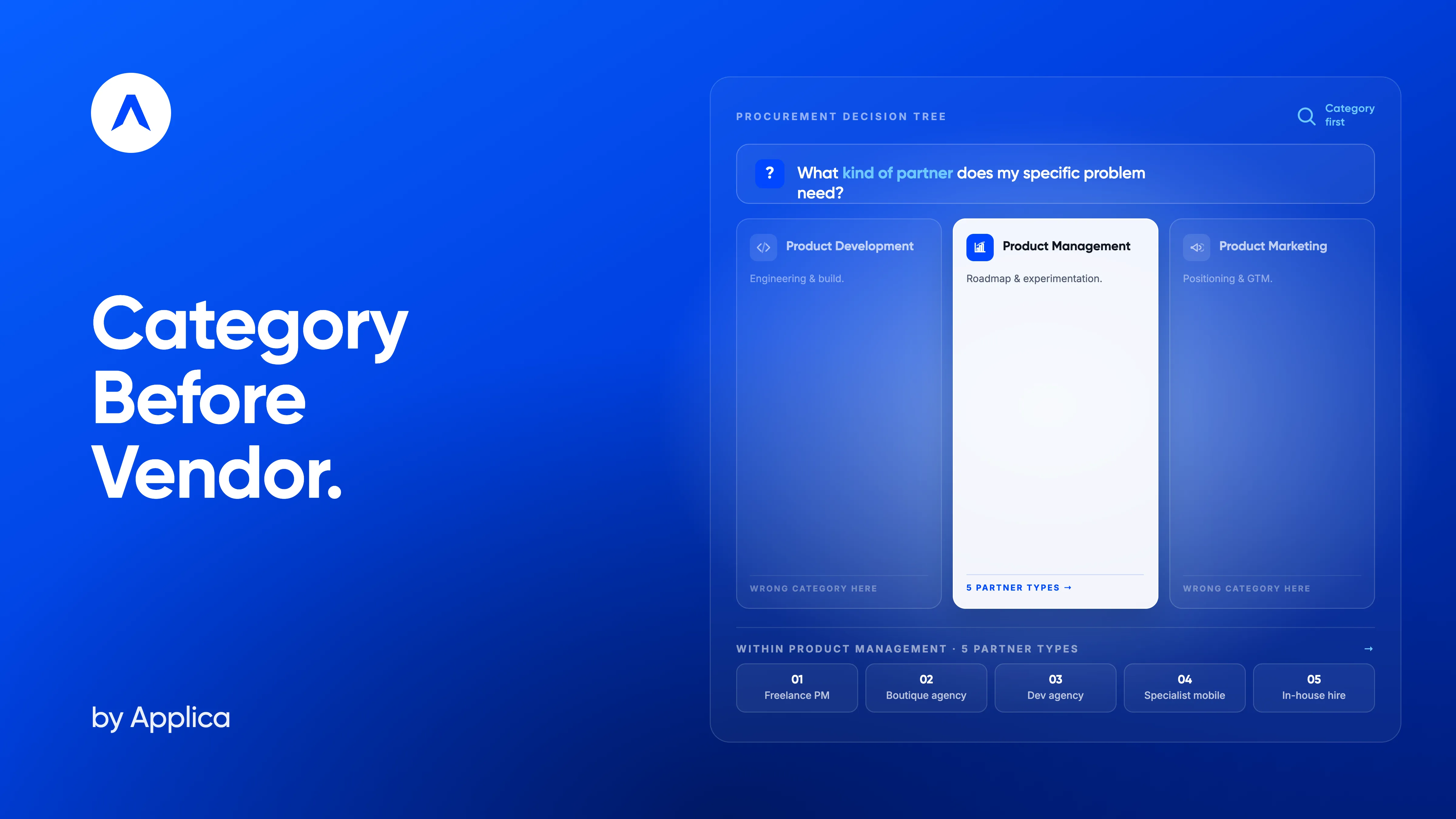
The category is distinct from three adjacent procurement archetypes the SERP frequently conflates with it.
What's the difference between a product management partner and a product development agency?
Product development agencies execute against a roadmap you bring. Their core capability is engineering, design, and build velocity — turning a defined specification into shipped software. Most product development guides frame the relationship around delivery infrastructure, technical risk management, and scalability foresight — the assumption is that what to build has already been decided. Other practitioner guides go further and argue that the management layer — accountability and quality control — is exactly what distinguishes an agency engagement from a freelance build.
A product management partner runs the layer above that. They own what to build next (the roadmap), which surfaces to optimise first (the prioritisation framework), and how to validate whether the change worked (the experimentation cadence). Development agencies execute against the roadmap; product management partners build it.
Product management partner vs. product marketing agency
Product marketing agencies own positioning, messaging, go-to-market, and sales enablement. The category's own self-definition centres on the strategic layer between product and market — how to position, message, and enable sales so the product sells. Recent 2026 rankings describe their work as brand strategy, market research, launch coordination, and digital campaigns — almost entirely upstream of the product itself.
A product management partner owns the product surfaces (onboarding, paywall, retention) and the testing programme — almost entirely downstream of the message. If you need to position a product for launch, you need a product marketing agency. If you need to lift trial-to-paid conversion on a product that already has paying users, you need a product management partner. For the marketing-side equivalent of this buyer's guide, Applica Agency's article on choosing a mobile app marketing agency in 2026 covers the App Store Optimisation (ASO) and paid user acquisition (UA) procurement question separately.
The 5 categories of product management partners
5 vendor archetypes show up in this procurement category. The right choice depends less on size than on the structural match between what the partner is built for and what the engagement actually needs.
1. Freelance product managers. Independent senior product managers (PMs) working solo. Best for: narrow scope, defined surface, short runway. Structural limitation: no cross-functional team — research, design, analytics, and engineering all sit somewhere else.
2. Boutique product agencies. Small specialist teams, typically 5–15 people, often vertical-focused. Best for: depth in a specific category, strong methodology, founder-friendly engagement structure. Structural limitation: capacity ceilings — when one client's emergency lands, the others wait.
3. Full-service development agencies with a product practice. Engineering shops that also offer product management as part of bundled engagements. Best for: end-to-end build-and-optimise programmes where the same partner ships the code and the testing programme. Structural limitation: product management is rarely the centre of gravity. Methodology rigour varies by team.
4. Specialised mobile product growth agencies. Vertical-focused subscription-mobile specialists with full functional coverage across product, design, analytics, paid UA, and creative — the category Applica operates in. **Best for:**subscription apps where the bottleneck spans multiple surfaces and the team needs cross-client pattern access. Structural limitation: scope discipline — the breadth of functional coverage can drift into "we do everything" if engagement boundaries aren't set tightly.
5. In-house hire (the not-quite-a-partner option). Hiring a senior PM internally rather than engaging external help, sometimes via a specialised product-management recruiting agency. Best for: when the company has a repeatable acquisition motion, stable budgets, and institutional context worth retaining. Structural limitation: ramp time — a senior PM hire takes 60–90 days to land plus three to four months to ramp, and the decision is reversible only at high cost. The companion piece on in-house vs outsourced product teams covers the upstream decision in depth.
The 5 categories of product management partners
| Category | Best for | Typical monthly cost | Typical engagement length | Structural limitation |
|---|---|---|---|---|
| Freelance product manager | Narrow scope, defined surface, short runway | Low-to-mid four figures | 1–3 months | No cross-functional team |
| Boutique product agency | Vertical depth, founder-friendly process | $10K–$20K | 3–6 months | Capacity ceilings |
| Full-service dev agency with product practice | End-to-end build-and-optimise programmes | $15K–$30K | 6–12 months | Product management isn't the centre of gravity |
| Specialised mobile product growth agency | Multi-surface bottlenecks, cross-client pattern access | $20K–$60K | 6–12+ months | Scope discipline required to avoid drift |
| In-house hire | Repeatable acquisition motion, institutional context worth retaining | Senior PM salary + benefits + recruiting fees | Permanent (with 60–90 day hire + 3–4 month ramp) | High cost to reverse a wrong hire |
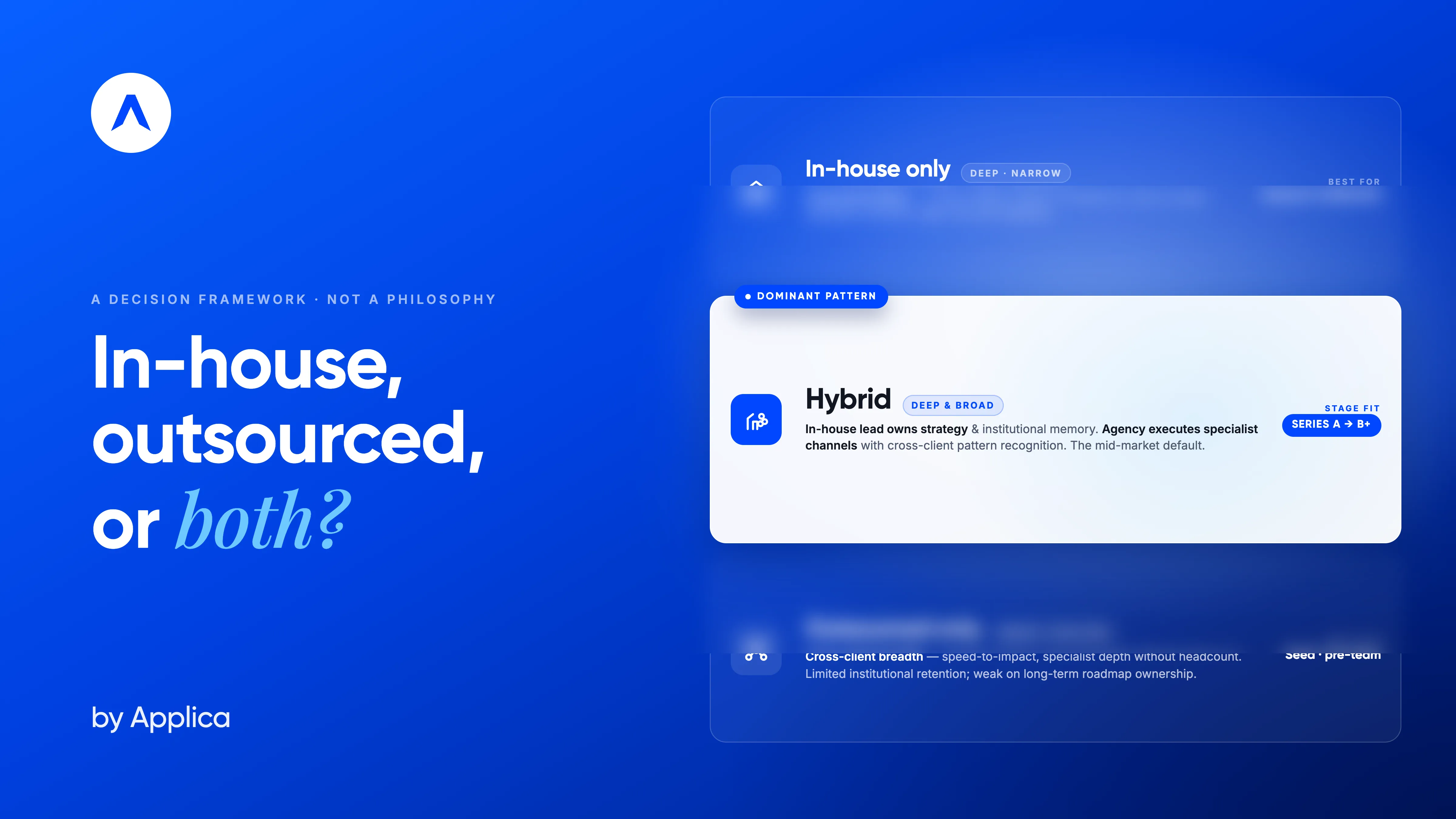
Most subscription apps below $5M in monthly recurring revenue (MRR) end up at category 4 for structural reasons: cross-client pattern recognition, multi-surface coverage, and engagement flexibility that fixed in-house headcount can't match.
The 5 evaluation criteria that actually matter
Inside the right category, 5 criteria separate the partners that compound from the ones that just deliver. Walk every shortlisted vendor through this framework before signing.
1. Vertical expertise
Does the partner know subscription mobile economics specifically — and your vertical inside it? The hard problems in fintech (compliance, verified-user value), wellness apps (habit formation, daily ritual), and edtech (perceived progression, completion mechanics) don't transfer cleanly between categories. Across the product engineering landscape, domain expertise is consistently cited as decisive — a partner with stellar results in one vertical may not be experienced in another.
What to look for: case studies in your specific category, named numbers, and a partner who can name the structural differences between verticals when asked. A partner who can't tell you why fintech and edtech monetisation work differently has probably never had to.
2. Methodology rigour
Does the partner have a named operating process, or does every engagement get described as "bespoke" and "tailored to you"? Bespoke is a tell that the methodology doesn't exist. Real methodology repeats — the same diagnostic phase, the same prioritisation framework, the same disciplined testing cadence, applied across clients with category-specific variations on top.
The clean signal: a partner who can describe their first 30 days the same way every time, and who has artifacts to prove it. Applica's experiment-history review framework is one example — a structured way to evaluate prior product experiments before designing the next one, used identically across clients regardless of vertical.
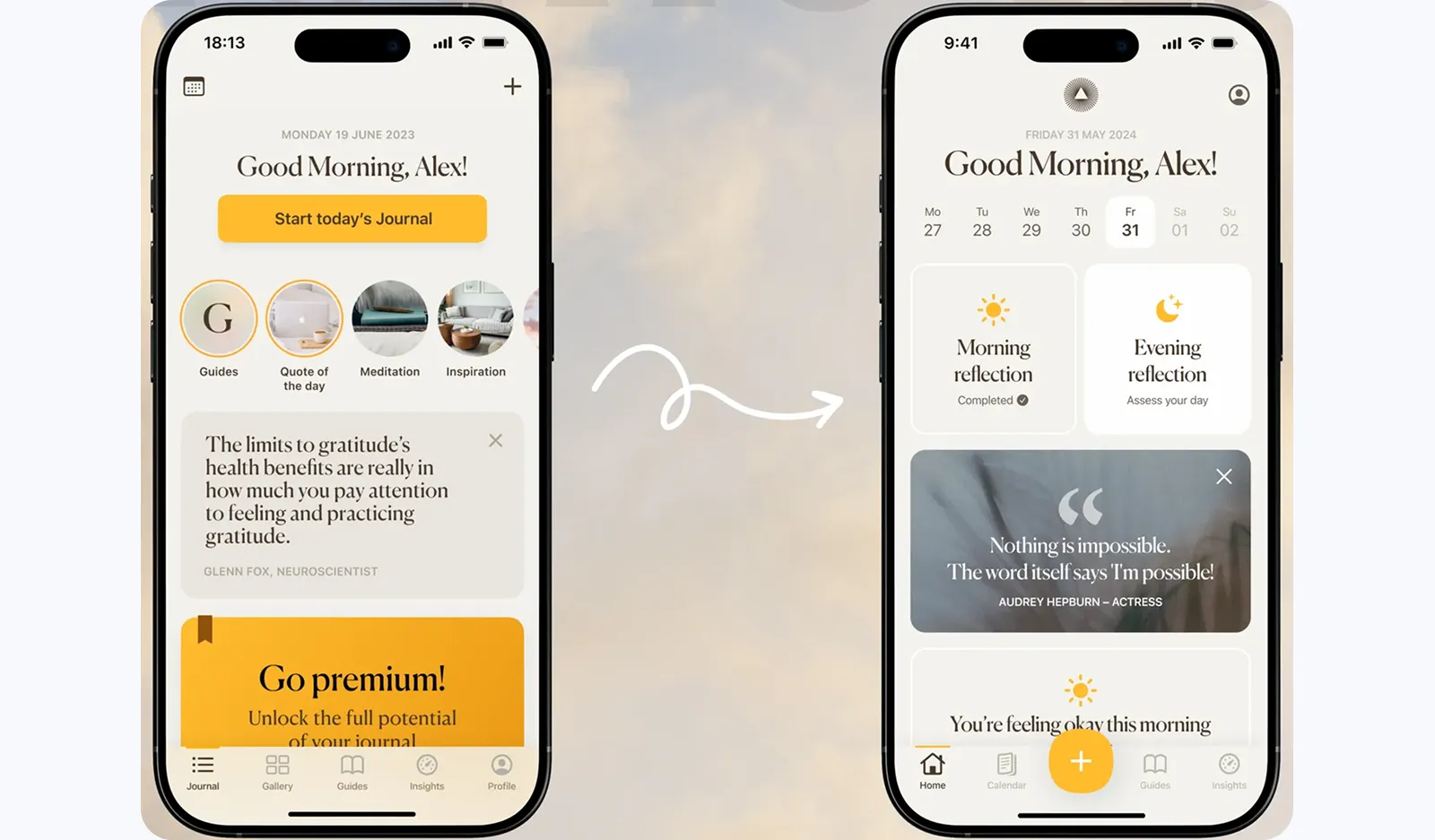
Five Minute Journal, a journaling app, illustrates what methodology-led work looks like in practice. The +20% Average Revenue Per User (ARPU) lift came from rebuilding onboarding around the activation event — the user behaviour most predictive of long-term retention — rather than redesigning onboarding as a general UX pass. The methodology produced the win; the design rebuild was the execution layer downstream of it.
3. Track record — measurable outcomes, not just logos
Case studies should show named numbers, a time horizon, and a methodology that connects the two. "We helped Brand X grow" with no metric, no scope, and no time anchor is procurement-stage marketing — it tells the buyer nothing about whether the partner can replicate the result.
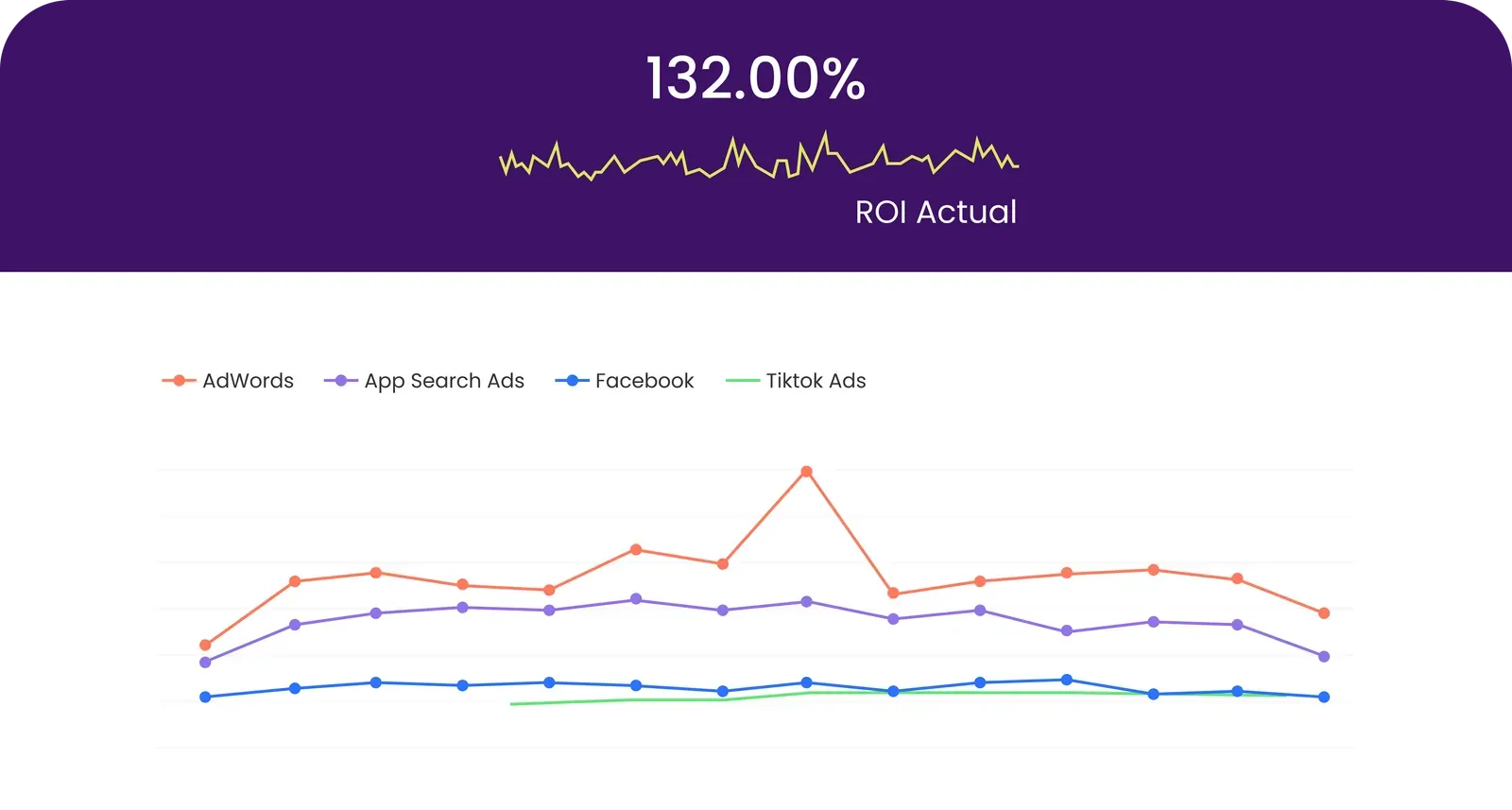
Drops UA, a language-learning app, scaled non-organic user acquisition 40x in 3 months — but the framing matters more than the number. The growth was downstream of an attribution and creative-testing infrastructure rebuild, not a budget increase. The methodology made the budget productive; the budget alone would have produced channel saturation, not scaling. A partner who can connect a hero number to a causal methodology is operating differently from one whose case studies stop at the logo.
4. Communication discipline
The most common engagement failure isn't bad work — it's good work nobody ships because ownership wasn't defined upfront. Weekly reviews, pre-defined decision rules, source-of-truth dashboards, and a clear escalation path are not nice-to-haves; they're the structural difference between a partner that compounds and one that produces deliverables you have to manage.
What to ask for: a sample weekly review artifact, the decision rule for shipping versus scrapping a test result, and the named individual who runs the account day-to-day. Procurement guides consistently flag that the pitch team is often different from the account team — and meeting the actual account team before signing is the most underused step in vendor evaluation.
5. Cross-client pattern access
This is the structural advantage agency partners have over in-house teams: they've seen what doesn't work, in your vertical, in the last 12 months. Pattern recognition is built by working across dozens of similar engagements — and translates directly into experimental priors that compress the time-to-first-win.
The signal: a partner who can describe, in concrete terms, what they've seen go wrong in apps adjacent to yours. A partner who deflects toward generalities ("every engagement is different") usually doesn't have the cross-client pattern to draw on.
4 red flags to watch for in vendor evaluation
4 patterns show up consistently across underperforming engagements, and all 4 are visible in the discovery call.
1. Over-promising timelines without conditions. A partner who promises "first lift in 6 weeks" without qualifying on traffic volume, instrumentation maturity, or hypothesis quality is quoting a marketing number, not a forecast. The honest answer is conditional. The companion piece on [how long product optimisation takes to show return on investment (ROI)][TODO-INSERT-TASK-02-URL-WHEN-LIVE] covers the 4 conditions that actually determine timeline.
2. No documented methodology. Every engagement described as "tailored to your unique situation." Tailoring is fine; tailoring without a base methodology to tailor from is a red flag. The most consistent signal across underperforming agency engagements is vague process descriptions — and the most reliable counter-signal is a partner willing to walk through their workflow step by step.
3. Case studies without numbers. "We helped Brand X grow" is not a case study; it's a logo wall. If the partner's own marketing won't say what they delivered, the engagement won't either.
4. A fixed quote with no discovery phase. A fixed-price proposal arriving within 24 hours of a 20-minute call is procurement-stage fast — not procurement-stage thoughtful. A partner who hasn't asked substantive questions about your traffic, your funnel maturity, or your current testing cadence has already decided what they're going to sell you. Adjacent to this: a partner who avoids substantive contract clauses on data access, work-product ownership, and exit conditions is signalling that the engagement will operate on their terms, not yours.
The 4 red flags in product management partner discovery calls — and what a credible alternative answer sounds like instead.
| Red flag | What a credible alternative answer sounds like |
|---|---|
| Over-promising timelines without conditions | "First lift depends on your traffic volume, instrumentation maturity, and hypothesis depth. We'll qualify after the diagnostic." |
| No documented methodology | "Here's our first-30-days operating sequence — same diagnostic, same prioritisation framework, applied across every engagement with category-specific variations." |
| Case studies without numbers | "Here's the result, the methodology that produced it, the time horizon, and the engagement scope." |
| Fixed quote with no discovery phase | "We'd start with a paid 2–4 week discovery sprint to read your funnel and current testing cadence before quoting the full retainer." |
6 questions to ask in vendor calls
The questions that surface engagement reality aren't the ones partners are expecting. Most discovery calls flow toward yes. 6 questions disrupt that flow and reveal how the partner actually operates.
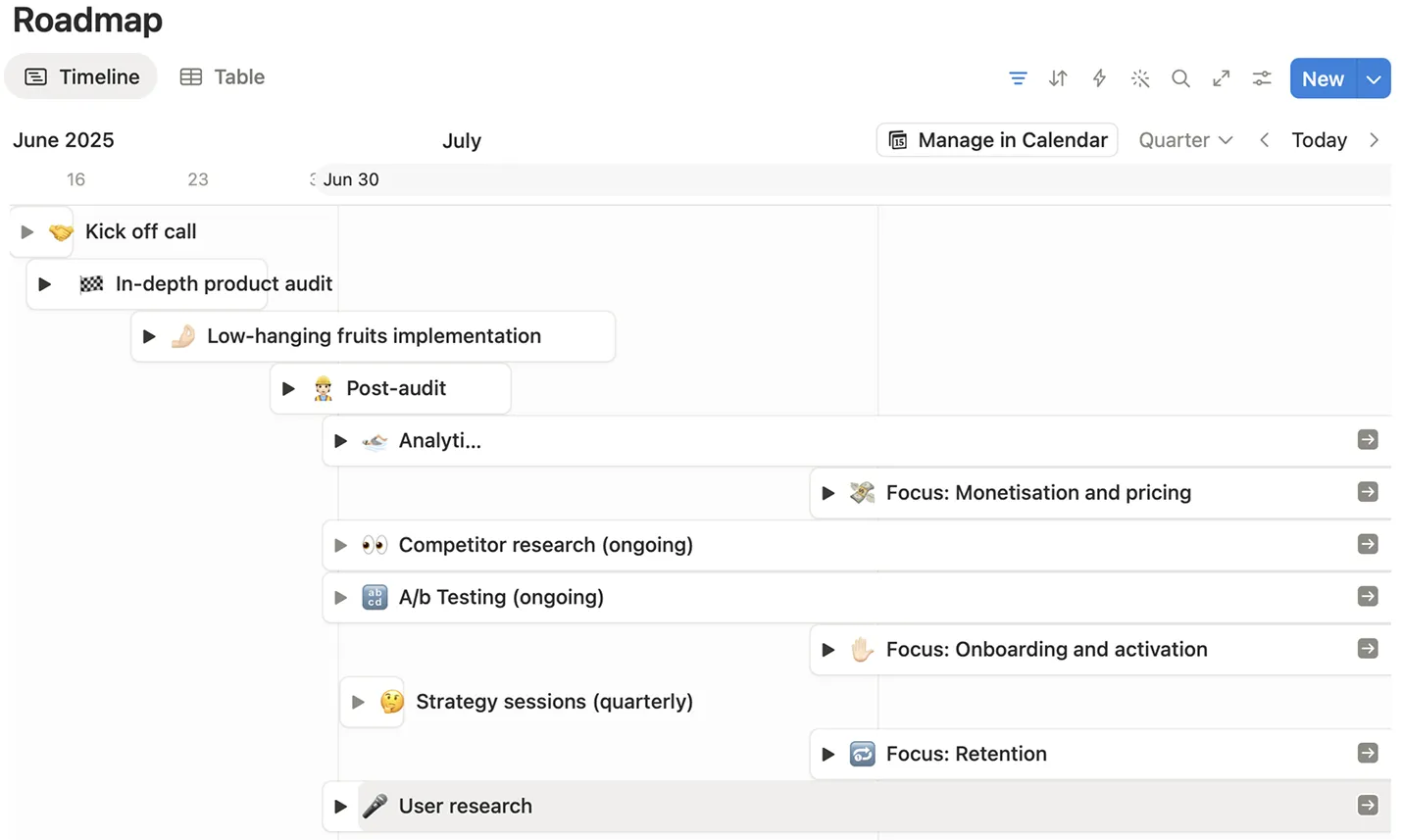
1. What's your operating sequence in the first 30 days? Listen for: diagnostic-first, not execution-first. A partner who starts with "we'd run X tests" before reading your funnel is selling a tactic, not designing an engagement. Applica Agency's guide to kicking off a subscription optimisation engagement shows what a diagnostic-first sequence looks like.
2. Tell me about a recent engagement where the result was disappointing — and what you learned. *Listen for:*specifics, not deflection. Failed projects are always a two-way issue; a partner who blames previous clients without owning their part of the failure will do the same when your engagement hits friction.
3. Who will run my account day-to-day, and what else are they on? Listen for: a name, a role, current account load. More than 8–10 active accounts on a single account lead is a capacity red flag. Insist on meeting that person before signing — not the strategists running the pitch.
4. How do we decide when to ship a winner or scrap a test? Listen for: pre-defined decision rules, not "we'll discuss it." Writing decision rules before launching a test is the difference between a partner that ships winners and one that produces readouts no one acts on.
5. What does the engagement look like at month 6 if everything goes right? Listen for: compounding outcomes, not a repeat of the pitch. A partner who answers with the same words used in the proposal hasn't actually thought beyond the initial campaign build.
6. What does the engagement look like at month 6 if it isn't working — and what's the off-ramp? Listen for: a process, not silence. A credible partner has a defined process for performance reviews and a willingness to discuss accountability. Silence on this question is silence you'll meet again at month 6.
How Applica positions within this framework
Applica Agency operates in category 4 — a specialised mobile product growth partner with vertical focus across fintech, edtech, and welltech (wellness technology). The methodology is named and consistent: a diagnostic phase that reads the full funnel before any test launches, a prioritisation framework that turns 50+ hypotheses into a quarterly testing roadmap, and a disciplined testing programme with pre-defined ship-or-scrap decision rules. Case studies — Drops UA, Five Minute Journal, and others — show named numbers connected causally to that methodology.
When the bottleneck is genuinely one surface and the rest of the funnel is healthy, a boutique agency or a senior freelance PM is the right call, and we say so during scoping. When the constraint spans multiple surfaces or when cross-client pattern access matters, category 4 earns its place. The framework above is meant to make that decision honest, not to argue for one specific partner.
Frequently asked questions
How much does a product management partner cost in 2026?
Pricing varies by category and engagement model. Freelance senior PMs typically run a monthly retainer in the low-to-mid four figures. Boutique agencies and full-service development agencies with a product practice usually quote $10,000–$30,000 per month depending on functional coverage. Specialised mobile product growth agencies — full functional coverage across product, design, analytics, paid UA, and creative — run higher, often $20,000–$60,000 per month, scaled to scope. The lowest retainer is rarely the lowest total cost — engagements that need re-scoping mid-flight, or that produce work that doesn't compound, are expensive at any retainer.### How long is a typical product management partner engagement?
Most useful engagements run 6–12 months minimum. The compounding window for testing programmes opens around month three (first shipped winners) and accelerates through quarters two and three as winners stack. Engagements scoped under three months are diagnostic-only or single-sprint — useful for specific decisions, not for moving a business metric. Annual retainers are common at category 4; quarter-by-quarter is more common at categories 1–3.
Can we start with a small engagement and expand if it works?
Most credible partners will agree to a discovery sprint or pilot engagement — typically 2–4 weeks, scoped to deliver a prioritised hypothesis backlog, an instrumentation audit, and a 90-day roadmap. The pilot is also the partner's chance to read your situation before committing to longer-term scope. A pilot or discovery sprint is one of the most reliable ways to de-risk a longer-term engagement — both sides learn whether the working relationship compounds before either commits to the full retainer. A partner who refuses a pilot at all is signalling that their economics depend on long lock-ins, which is itself a procurement-stage signal worth weighing.
Three takeaways
First, category before vendor. The procurement vocabulary across product development, product marketing, and product management is overlapping enough that picking the wrong category is the most common — and most expensive — mistake at this stage. Get the category right and individual partner evaluation becomes tractable.
Second, methodology outranks logos. Case studies with named numbers connected causally to a named operating process are worth more than a hero list of brand names without scope or outcome. A partner whose own marketing won't say what they delivered won't deliver more inside the engagement.
Third, the discovery-call signal is the engagement signal. How the partner sells is how they deliver. Vague process descriptions, deflection on failed engagements, fixed quotes without discovery — every one of those patterns is visible before signing and predicts every one of them inside the engagement.
If you're scoping a product management partner and want to pressure-test fit before signing, let's talk — Applica Agency's Conversion Rate Optimization engagements start with a diagnostic of where the leverage actually sits, and an honest scoping conversation about whether category 4 is even the right fit for your specific situation.