We reviewed 40 shopping ads agencies and feed vendors, opened every case study they publish, and checked what each result is actually attributed to. Ten of the 40 publish a figure attributed to Google Shopping or Performance Max. The other 30 publish account-wide, paid-search or multi-channel numbers instead, and those ten are not the same as the ten ranked below: three agencies on this list publish nothing channel-attributed and are here on capability, which each entry says plainly. And on the question this article was commissioned to answer, how Shopping works for an app, one of the 40 other agencies sells it and none has published a result.
Shopping ads here means Google Shopping ads, the product listing ads served from Google Merchant Center, including Shopping inventory inside Performance Max. Microsoft Shopping ads are the obvious alternative and get one mention here; amazon ads sit outside this list because they are a retail-media buy rather than a Merchant Center one. The distinction between Standard Shopping and Performance Max matters more than it sounds, because Performance Max results are routinely presented as Shopping results and they are not the same buy.
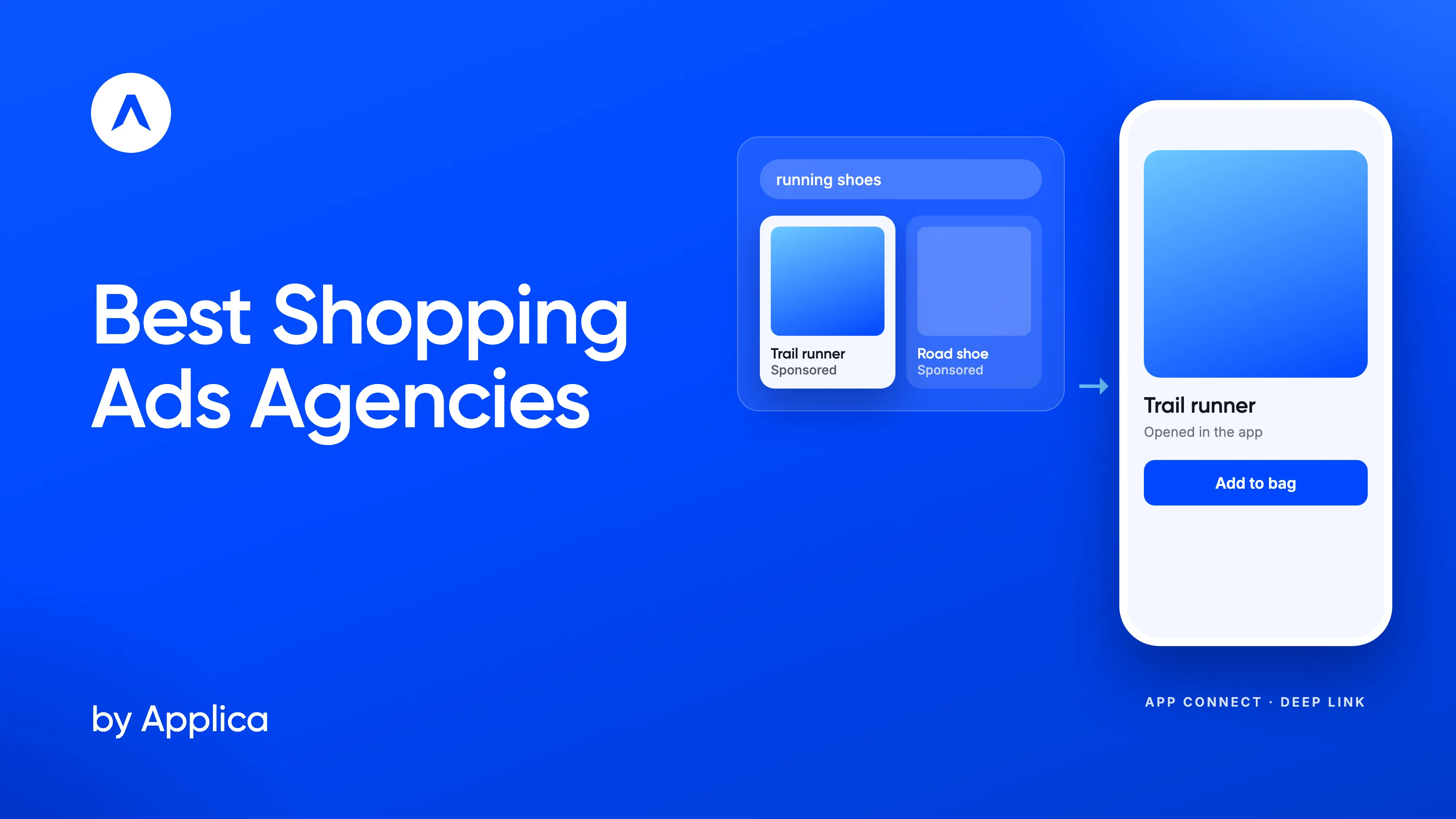
Two figures from Google's own pages. Advertisers that shifted from Standard Shopping campaigns to Performance Max drove a 25% increase in conversion value, on average, at a similar roas; that is Google's own aggregate data for October 2022 to March 2023, self-reported with no methodology or sample size, and the measurement window closed three years ago, so read it as Google describing its own product rather than as an independent benchmark. The second figure is the one this article is built on, and it is far more specific. Google publishes de Bijenkorf's Head of Search saying that with App Connect the retailer saw a 2x conversion increase and a 48% average-order-value increase when customers landed in-app instead of on the mobile site, and a 68% roas uplift for its Performance Max campaigns.
TL;DR
- Shopping ads are product listing ads from google merchant center, served through standard shopping campaigns and inside performance max. The product feed decides which searches you appear for, so feed work is media work.
- Of 40 agencies and feed vendors reviewed, 10 publish a figure attributed to Shopping or Performance Max and 30 do not. Several of the ten publish both, separately labelled, which is the right way to do it.
- Only 2 of 40 publish a profit-grade figure rather than revenue or roas, and neither names a client.
- Only 1 of 40 publishes an actual price for feed management.
- The app route is real and Google has proven it, but the agency market has not built a practice around it. Of the 40 agencies reviewed alongside us, one sells Shopping or Performance Max for apps with app deep links, and none publishes an app result from either.
- Feed tools and media buyers are honestly separated in this market. Three of the major feed vendors state in writing that they do not buy media, and every deep Shopping result in the software tier was produced by an agency using the tool.
- Best for app-first ecommerce and marketplace brands: Applica. Deepest published Shopping revenue: Bidnamic. Clearest Performance Max migration proof: Inflow.
A google shopping agency sets up and maintains Merchant Center, writes and structures the product feed, runs standard shopping and performance max campaigns, bids to a target roas built on margin rather than on revenue, segments products so spend follows profit, and reports in conversion value. For a shopping app, there is one more job: getting the click to open the product inside the app rather than on the mobile web.
How we selected. Two questions. Is the published result attributed to Shopping or to Performance Max, named every time, because conflating them hides which buy produced the outcome. And how far down the funnel does it go: profit beats revenue, revenue beats roas, roas beats cpc, and an account-wide number with no channel attached counts for nothing. Feed tools appear only where they run a genuine managed service, with software and service clearly separated. Those two tests are what separate the top shopping ads agencies from the thirty that publish account-wide numbers instead.
One finding shapes the whole list, and it applies to us too. Nobody in this market publishes a Shopping or Performance Max result for a mobile app, Applica included. Across the seven leading Shopping and feed specialists, Admiral Media excluded, we enumerated roughly 2,235 published pages and found no mention of app deep links, web-to-app or App Connect at all. One of the 40 other agencies sells the capability, and we are the second team doing it. Google documents the mechanism and publishes a named retailer using it. The practice simply does not exist yet, which is why this article treats it as a capability gap rather than as a ranking criterion.
The problems this list is meant to solve are the ordinary ones. Thin product titles and missing attributes capping reach before bidding ever matters. Performance Max hiding which products and queries carried the result. Spend drifting to low-margin or out-of-stock lines. Merchant Center disapprovals nobody owns. Target roas set without margin data, so revenue grows and profit does not. And for a shopping app, paid traffic landing on the mobile web when the customer already has the app installed.
Below are the best shopping ads agencies worth a conversation, what each one actually proves, and who each one is for.
Why google shopping agencies matter in 2026
The top google shopping agencies treat the product feed as media work rather than as a technical chore. Five things follow from that.
The feed is the keyword list. Titles, attributes, gtin, product types and custom labels decide which searches a product can appear for. An agency that treats feed work as a technical chore has given away the part of the account with the most leverage.
Performance Max now carries most Shopping spend, and hides most of the detail. Asset groups, listing groups and signals are the inputs you still control. Query and product visibility is the thing to negotiate for in reporting before you sign.
Margin-based targets separate profit from vanity revenue. A target roas built on blended revenue will happily scale your worst products. Custom labels by margin, by seasonality and by stock pressure are how that gets fixed.
Merchant Center health is an operational discipline. Disapprovals, policy changes and suspensions are routine, and the difference between a good and a bad month is often who was watching the diagnostics.
For shopping apps, the click can open the app. Merchant Center accepts app link attributes, and Google documents App Connect across Search, Shopping and Performance Max campaigns. The capability is real. The market has not productised it, which is the gap this article is about.
Want Shopping traffic to land in your app, not on the mobile web?
Talk to Applica's UA team.
The best shopping ads agencies at a glance
| No. | Agency | HQ | Founded | Team | Core Shopping expertise | Best for |
|---|---|---|---|---|---|---|
| 1 | Applica | London | 2022 | 25+ | Shopping and Performance Max with app deep links and web-to-app, app purchases measured with an MMP | Ecommerce and marketplace apps |
| 2 | Bidnamic | Leeds, United Kingdom, with a US base in Austin | 2018 | Not published | Search-term-level Shopping control, own CSS | Mid-market and enterprise retail |
| 3 | Inflow | Not stated; Tampa and Denver offices | 2007 per Clutch | 10 to 49 per Clutch | Standard Shopping to Performance Max migration mechanics | Brands moving onto Performance Max |
Most google shopping ads agencies publish numbers with no channel attached, which is why only ten of the forty cleared this bar. On the two tests above, these are the best google shopping agencies in the market right now.
Founded, team and HQ are as each agency states them, with the source named where the agency does not publish the number itself.
1. Applica: Shopping traffic that opens the app

Applica is a mobile app growth agency. On this channel its scope is narrow and worth stating plainly: it is for app-first ecommerce and marketplace brands, where the point of a Shopping or Performance Max click is to open the product inside the app and be measured on what the buyer does there. If you are a pure web ecommerce brand with a large catalogue and no app, the feed and Shopping specialists further down this list are the better call, and this article says so rather than pretending otherwise.
Founded 2022 · HQ London · Team 25+ specialists · Shopping specialties Merchant Center app link attributes and App Connect across Shopping and Performance Max, web-to-app funnels, app purchases measured with an MMP rather than only web conversions, Performance Max creative assets produced in house, Shopping inside a cross-channel plan
What Applica publishes, with the channel and the client named
- NEMO, an investing app: cost per first-time deposit down 4x over seven months, 3x lower on Google Ads specifically, across 700+ tested creatives
- Fabulous: +40% ARPU within four weeks of a web-to-app funnel audit and a new paywall strategy
- TouchRetouch: +41.3% revenue on +53.3% spend in Apple Search Ads, with non-brand roas improving nearly 4x
- 7 Minute Workout: 201.2% total ARPU uplift and 50% ARR growth through disciplined paywall and pricing testing
Why that is the relevant proof here. None of it is Shopping, and the methodology note above says nobody in this market publishes an app result from Shopping either. What the record does show is the two things the app route actually requires: moving revenue inside a web-to-app funnel, and measuring a paid click through to the purchase rather than to the landing page. The Google Ads work on NEMO is the closest adjacent proof on the platform itself.
Recognition. Business of Apps Top App Marketing Company 2024. Clutch 5.0 from 19 reviews. $100M+ in ad spend managed, 10,000+ ads produced, 500+ growth experiments run and 50+ Tier-1 apps partnered.
Pricing model. A monthly fee plus a percentage of ad spend once media passes a threshold, with creative production included rather than billed per asset. Applica works with subscription apps from $100K MRR.
Best for: ecommerce and marketplace apps that want Shopping and Performance Max traffic landing in the app and measured there.
2. Bidnamic: the deepest published Shopping revenue, named twice
A Shopping specialist whose entire thesis is search-term-level control, run on its own technology and its own Comparison Shopping Service, with a data-science team behind it.
Founded 2018 · HQ no headquarters label; its office address is in Leeds, United Kingdom, with a US base in Austin, Texas · Team not published · Clutch no profile found
Two named clients with Shopping-attributed revenue, which is rarer than it should be. Oh Polly: revenue up 661% year on year, clicks up 457%, conversion rate up 24%, with the page stating outright that what it ran was Google Shopping. Rab: revenue up 526% comparing June to December 2024 against the same period in 2023, conversions up 283%, clicks up 48%, cpc down 15%.
Alongside it, the scale claims: 83% average purchase-intent impression share, more than 500 million search terms analysed, over a billion pounds of Shopping spend, and two unusual commercial models including a performance-uplift arrangement.
The honest limits. It publishes no current team size and labels no headquarters. Its feed offering is thin exactly where a feed specialist should be deep, with no mention of gtin work, custom labels, promotions or local inventory ads. And there is no third-party review profile, so the service experience is unverified.
Best for: mid-market and enterprise retail that wants query-level Shopping control.
3. Inflow: the clearest Performance Max migration proof
The only agency publishing the actual mechanics of a Standard Shopping to Performance Max migration with named-client numbers attached.
Founded 2007 per Clutch · HQ not stated on its own site; Clutch lists Tampa, Florida, with a Denver office · Team 10 to 49 per Clutch · Clutch 4.9 from 13 reviews
For KEH Camera, named, it reports that its performance max campaigns delivered a 9.93x average monthly roas, alongside ad revenue up 76.3% and transactions up 44.1%. A second named client, Skreened, carries a 360% roas attributed to google shopping. The migration detail is the valuable part: more than 70 Smart Shopping campaigns consolidated, Performance Max spend staged from a fraction of a percent up to 56% of the account, and short Performance Max sale campaigns.
Two caveats a buyer should hold. The 76.3% figure is a period-over-period comparison rather than a controlled test, and the flagship Performance Max study is now around three years old. It is also the smallest team in this set, and its own site publishes no headquarters, founding year or headcount.
Best for: ecommerce brands moving a Shopping account onto Performance Max.
4. LP: revenue-level Performance Max attribution at scale

A large US full-service agency, formerly Logical Position, with feed work as a named service line rather than an afterthought.
Founded 2010 · HQ Lake Oswego, Oregon, labelled as headquarters on its own site · Team not on its own site; 250 to 999 per Clutch · Clutch 4.5 from 2 reviews, reset by the rebrand and not comparable with the review volumes further down this list
For Teskey's Saddle Shop, named, it reports an additional $99,000 of year-on-year revenue on $3,800 more spend after a Performance Max migration, and $134,000 of Shopping revenue separately.
One trap on that page, worth flagging because it is easy to misread. The headline 16x roas on the same case belongs to paid social, not to Shopping, and the page mixes four channels together. Quote only the lines that name the channel.
Best for: high-SKU retail and B2B ecommerce.
5. Admiral Media: the only agency selling Shopping for apps

The one agency in this entire review that has productised Google Shopping and Performance Max for apps. Its own wording is specific: feed-led Shopping and Performance Max with app deep links that open the product inside your app, and once app deep links are set up in Merchant Center, Shopping ads and Performance Max can open the product in the app. It names AppsFlyer and Adjust for first-order and repeat-purchase events.
Founded 2019 · HQ Dubai, United Arab Emirates, per its own about page · Team not published; 10 to 49 per Clutch · Clutch 4.9 from 49 reviews
It publishes no Shopping-attributed or Performance Max-attributed figure at all. All five figures on its own Shopping page are attributed to TikTok, to a Snapchat, TikTok and Meta mix, to generic paid user acquisition, to feed-driven retargeting and to Google App campaigns. Not one to Shopping or Performance Max.
So the placement is honest about what it rests on: this is the only team selling the capability this article says the market lacks, and the capability is unproven in public. On published results alone it would sit at the bottom of the list, not in the middle. Its own most-read article on the channel is an argument against Performance Max, which is at least a point of view.
Best for: shopping and marketplace apps looking for one team across feed, Shopping and app measurement.
6. smec: margin-based bidding at enterprise scale
Nineteen years in a single niche, with a software platform and a real media-buying arm, and the most unusual toolset here: margin and profit-based bidding, campaign orchestration, dynamic segments and marketing mix modelling.
Founded 2007 · HQ no headquarters label; founded in Linz, Austria, with Linz, Vienna and London offices · Team its own site's most recent figure is more than 120 employees, from a 2020 timeline entry, so treat it as stale · Clutch no profile found
For Shade Station, named, it reports revenue up 57% across more than 20 markets year on year, with sales up 42%, clicks up 31% and average order value up 10%, attributed to Performance Max in the headline. One caveat: the results block itself names no channel, so the attribution comes from the hero line rather than from the data.
Worth knowing against its reputation: despite being thought of as a feed shop, its agency page never mentions Merchant Center or product feeds. And most of its 23 case studies attribute no figure to a campaign type, which makes its loudest numbers unusable for a comparison like this one.
Best for: enterprise retailers running many markets who want profit-based bidding.
7. JumpFly: the only published price in the category
A long-established US media buyer with the cleanest separation between feed work and media buying, and the only company anywhere in this review that publishes what feed management actually costs.
Founded 2003 · HQ Hoffman Estates, Illinois, stated on its own site · Team more than 40 stated on its own site; 50 to 249 per Clutch · Clutch 4.9 from 97 reviews
For ShopWildThings, named, it reports Shopping campaign revenue up 59% on Shopping spend up 46%, attributed explicitly to google shopping. Its published feed pricing is $500 for one-time setup, then $250 a month for one feed or $350 for two covering up to 5,000 SKUs, with per-thousand-SKU tiers above that.
The limits are dates. That Shopping figure is from 2018, and its strongest recent case headlines a roas achieved across channels, which fails the attribution test this list applies.
Best for: buyers who want feed management and media bought and priced separately.
8. Tinuiti: scale, benchmarks and a single review
The largest independent performance agency here, publishing quarterly Shopping and Performance Max benchmark data alongside client work.
Founded 2004 · HQ not labelled; the predecessor business was based in New York City · Team 1,000+ stated · Clutch 5.0 from a single review, which is effectively no third-party proof
For Murad UK, named, it reports a 98% year-on-year roas improvement attributed to shoppable Performance Max campaign types. For Burt's Bees Baby, named, ad revenue up 84% and roas up 71% attributed to paid Shopping, though that study compares March to April 2020 against the same months in 2019, so it is a pandemic-period comparison and should be read as one.
It is enterprise-only in practice, and the Burt's Bees page is internally inconsistent about whether the 84% figure is conversions or revenue, so quote the metric the page states next to the number you use.
Best for: enterprise retail and DTC advertisers buying measurement and benchmarks.
9. Disruptive Advertising: feed work priced as its own product
The cleanest product architecture in this study. It states outright that Shopping media buying and feed management are two separate but interdependent products, and it sells feed management on its own.
Founded 2011 per Clutch · HQ not stated on the Shopping page; Clutch lists Pleasant Grove, Utah · Team 50 to 249 per Clutch · Clutch 4.8 from 374 reviews, the highest review volume on this list
It reports 34% improvements in revenue and profitability attributed to google shopping, with a further 25% attributed specifically to feed management. That makes it one of only two companies in the 40 to publish anything profit-grade.
The weakness is that both figures are self-reported averages with no client named, no timeframe and a results-vary disclaimer, so neither is verifiable. Performance Max is not named anywhere on its Shopping page, which is notable in 2026.
Best for: buyers who want to understand and price feed work separately from media.
10. OuterBox: the deepest feed substance, the thinnest proof
The most technically detailed published feed practice of anyone reviewed: account-level and item-level diagnostics, supplemental feeds that add or override selected attributes without replacing the primary feed, gtin, mpn and brand cleanup, and custom labels by margin, seasonality and inventory pressure.
Founded 2004 · HQ not in its own footer; Akron, Houston and Tuscaloosa offices, with Clutch listing Copley, Ohio · Team 300+ stated · Clutch 5.0 from 93 reviews
It publishes no Shopping-attributed or Performance Max-attributed figure despite selling both. Its strongest numbers, including paid conversions up 425% for one client and revenue up 550% with a 744% roas for another, are explicitly attributed to a broader paid strategy rather than to Shopping.
It is also the only company in the entire review that mentions promotions mapping, and nobody at all mentions local inventory ads, which tells you something about where the market's attention is.
Best for: technical feed and Merchant Center work where the proof matters less than the engineering.
One near-miss worth knowing: DemandMore publishes Cuckooland at revenue up 72% and roas up 35% on cost up 27%, but states the work ran across paid search and Shopping together, two channels combined, so it fails the attribution test. It has the deepest published Shopping methodology library in the UK and is the first name to add if a slot opens. Separately, SavvyRevenue publishes no client results by deliberate policy and explains why: a growth percentage without the baseline means nothing. That is the most honest position encountered in the research and it is quoted in the section below.
Feed tools are not agencies, and this market is honest about it
Worth one short section because the brief asks for the distinction and because the finding was the opposite of what we expected. Three of the major feed vendors state in writing that they do not buy media and that strategy and campaigns stay with you or your agency. One of the largest is a premium Comparison Shopping Service with no in-house managed service at all, operating a partner directory of nearly two hundred agencies instead.
More telling: every genuinely deep Shopping result in the software tier was produced by an agency using the tool, not by the vendor. The feed platform supplies the plumbing and an agency runs the account, and in the best example the client describes that three-party arrangement in his own words.
We found no agency selling feed management as media buying, or the reverse. The split is honest across the board, which matters practically: if you are buying both, you are buying two things, and you should know which of your two vendors owns a drop in impression share.
The most honest position we encountered came from an agency that publishes no client results at all, by policy, on the grounds that showing you 10% or 110% revenue growth without the baseline means nothing. Worth remembering when you read everyone else's percentages, including the ones in this article.
How to choose a google shopping agency
Specialist or generalist. A shopping ads agency lives in Merchant Center and the feed. A general PPC agency runs Shopping as one of eight line items. Both can work; only one will notice a feed-level problem in week one.
Ask what the published result is attributed to. Shopping or Performance Max, by name. Thirty of the forty companies we reviewed publish neither, and the ones that conflate the two are hiding which buy produced the outcome.
Feed depth, tested with specifics. Titles, attributes, gtin, supplemental feeds, custom labels, promotions. Feed optimization is where most of the available upside sits, so ask how they would label your catalogue by margin, how they handle the shopify or other platform feed export before supplemental feeds are layered on, and whether they have ever run local inventory ads.
Performance Max strategy, and what you will be able to see. Asset group structure, listing groups, signals, and which query and product reporting you will get. Negotiate reporting access before signing, not after.
Margin-based targets. Ask where the margin data comes from and how target roas is derived from it. If the answer is a blended number, your worst products will get your best bids.
Merchant Center health. Who watches diagnostics, how disapprovals are triaged, and what happened the last time an account they ran was suspended.
App deep links and web-to-app, if you have an app. Ask whether they have configured the Merchant Center app link attributes, whether they have run App Connect across Shopping or Performance Max, and how app purchases get measured. One of the forty agencies we reviewed sells this, so expect to be told no, and treat an honest no as better than a vague yes.
Measurement. Conversion value, GA4, and an MMP where purchases happen in an app rather than on the web.
Partner status, reviews and price. Google Partners status is checkable in Google's own directory for any agency you shortlist, and Clutch reviews are worth reading rather than counting. On price, only one company in this entire review publishes a rate, so ask early: percentage of spend, flat fee, feed management priced separately, minimum budget, and who owns the account and the feed at the end.
Get your Shopping and Performance Max campaigns reviewed by Applica
Comparison
| Agency | Focus | Deepest published result | Attributed to | Client named | App deep links | Team and Clutch | Pricing model |
|---|---|---|---|---|---|---|---|
| Applica | Ecommerce and marketplace apps | None on Shopping; adjacent web-to-app and Google Ads proof | n/a | n/a | Yes, with MMP | 25+ specialists; Clutch 5.0 from 19 reviews | Monthly fee plus a percentage of ad spend |
| Bidnamic | Mid-market and enterprise retail | Revenue +661% year on year | Google Shopping | Yes | No | Not published; no Clutch profile found | Not public; two commercial models including a performance-uplift arrangement |
| Inflow | Ecommerce | 9.93x average monthly roas | Performance Max | Yes | No | 10 to 49 per Clutch; Clutch 4.9 from 13 reviews | Not public |
| LP | High-SKU retail, B2B | +$99K revenue on +$3,800 spend | Performance Max | Yes | No | 250 to 999 per Clutch; Clutch 4.5 from 2 reviews | Not public |
| Admiral Media | Shopping and marketplace apps | None | n/a | n/a | Yes, sole seller | Not published; 10 to 49 per Clutch; Clutch 4.9 from 49 reviews | Not public |
| smec | Enterprise multi-market retail | Revenue +57% across 20+ markets | Performance Max, in the hero line | Yes | No | 120+ from a 2020 entry, treat as stale; no Clutch profile found | Not public |
| JumpFly | Mid-market retail | Shopping revenue +59% on spend +46% | Google Shopping | Yes | No | 40+ stated; 50 to 249 per Clutch; Clutch 4.9 from 97 reviews | Published: $500 feed setup, then $250 to $350 a month up to 5,000 SKUs |
| Tinuiti | Enterprise retail and DTC | Roas +98% year on year | Performance Max | Yes | No | 1,000+ stated; Clutch 5.0 from a single review | Not public |
| Disruptive Advertising | Ecommerce | +34% revenue and profitability, +25% from feed work | Google Shopping, and feed management | No | No | 50 to 249 per Clutch; Clutch 4.8 from 374 reviews | Feed management sold as its own product; rate not public |
| OuterBox | Technical feed work | None channel-attributed | n/a | No | No | 300+ stated; Clutch 5.0 from 93 reviews | Not public |
Why app teams choose Applica for Shopping ads
Performance marketing for mobile apps with Shopping and Performance Max planned for app-first ecommerce and marketplace brands, where the click is meant to open the product in the app rather than on the mobile web. Merchant Center app link attributes and App Connect configured and then retested after each app release, because deep links break quietly. App purchases measured with an MMP, not only web conversions, so the roas you report is the one your finance team can reconcile. Performance Max creative assets produced in house rather than briefed out. And Shopping sized inside a cross-channel plan with Google, Meta, Apple Ads and TikTok by a mobile user acquisition agency that owns the whole funnel.
If you are a web-only ecommerce brand with a large catalogue, say so on the call and we will tell you which of the specialists above fits better. That is a shorter conversation than a bad engagement.
Business of Apps Top App Marketing Company 2024. Clutch 5.0 from 19 reviews. $100M+ in ad spend managed, 10,000+ ads produced, 500+ growth experiments run and 50+ Tier-1 apps partnered.
They showed a good blend of experience in the team setup, and the quick turnaround in activating campaigns was also impressive.
Pras Murukesvan, Growth Marketing Head, Nemo Money
See UA case studies or book a strategy call with Applica.
Conclusion
Shopping is the most mature channel in this series and the one where published proof is thinnest relative to the number of agencies selling it. Ten of forty publish a figure attributed to Shopping or Performance Max. Two publish anything profit-grade. One publishes a price.
The gap that matters most, if you run an app, is the one nobody has filled. Google documents app link attributes in Merchant Center and App Connect across Shopping and Performance Max, and publishes a retailer reporting a 2x conversion increase, a 48% higher average order value and a 68% Performance Max roas uplift from sending customers into the app. One agency of the forty sells that. None has published a result from it.
So when you shortlist the best shopping ads agencies, ask two questions and listen for specifics. What is your published result attributed to, Shopping or Performance Max. And if I have an app, what happens to the click. The best google shopping agency for a web catalogue and the best one for a marketplace app are not the same company, and most of this market is honest enough to tell you which it is.
Choose a shopping ads partner that grows profit, not just revenue.
FAQ
What are the best shopping ads agencies?
The best shopping ads agencies name the channel their result came from. On that test Bidnamic publishes the deepest Shopping-attributed revenue with two named clients, Inflow the clearest Performance Max migration proof, JumpFly the only published price, and Disruptive Advertising one of only two profit-grade figures in the market. Admiral Media is the only agency selling Shopping for apps, and publishes no Shopping result. Applica is for ecommerce and marketplace apps that want the click to open the app.
What does a Google Shopping ads agency do?
A google shopping ads agency owns Merchant Center, builds and maintains the product feed, runs standard shopping and performance max campaigns, bids to a target roas derived from your margins, segments products with custom labels so spend follows profit, keeps on top of disapprovals, keeps free listings in Merchant Center healthy alongside the paid inventory, and reports in conversion value. The feed is the part most buyers underestimate: titles and attributes decide which searches your products can appear for at all.
What is the difference between Shopping ads and Performance Max?
Standard shopping campaigns buy Shopping inventory and give you product-level control. Performance max is a single campaign type that buys Shopping inventory plus Search, Display, YouTube, Discover, Gmail and Maps, with Google automating most placement and bidding decisions from the assets and signals you supply. Google reports that advertisers moving from Standard Shopping to Performance Max drove a 25% increase in conversion value at a similar roas, measured between October 2022 and March 2023 in its own data. They are different buys, which is why a Performance Max result should never be presented as a Shopping result.
How much do Google Shopping agencies charge?
Most charge a percentage of ad spend, a flat monthly fee, or both, with feed management sometimes priced separately. Price transparency in this market is close to non-existent: of forty companies we reviewed, one publishes a rate, at $500 for feed setup and $250 to $350 a month for up to 5,000 SKUs. Ask what the fee covers, whether feed work is inside it, what the minimum ad budget is, and who owns the account and the feed when the engagement ends.
Can Shopping ads send users to my app instead of my website?
Yes, and Google documents the mechanism. Merchant Center accepts app link attributes for Android and iOS, and App Connect is documented across Search, Shopping and Performance Max campaigns. Google publishes de Bijenkorf reporting a 2x conversion increase and a 48% higher average order value when customers landed in the app instead of the mobile site, with a 68% roas uplift for its Performance Max campaigns. The caveat is supply, not capability: one of the forty agencies we reviewed sells this, and none has published a result from it.
Which Google Shopping agency is best for a marketplace app?
Ask three things. Have you configured the Merchant Center app link attributes on a live account. Have you run App Connect on Shopping or Performance Max, and what happened. How do app purchases reach your reporting, with which MMP. Almost nobody in this market will answer yes to the first two, so an honest no plus a credible plan beats a confident yes. Applica runs this setup for ecommerce and marketplace apps, and Admiral Media is the only other agency in our review that sells it.