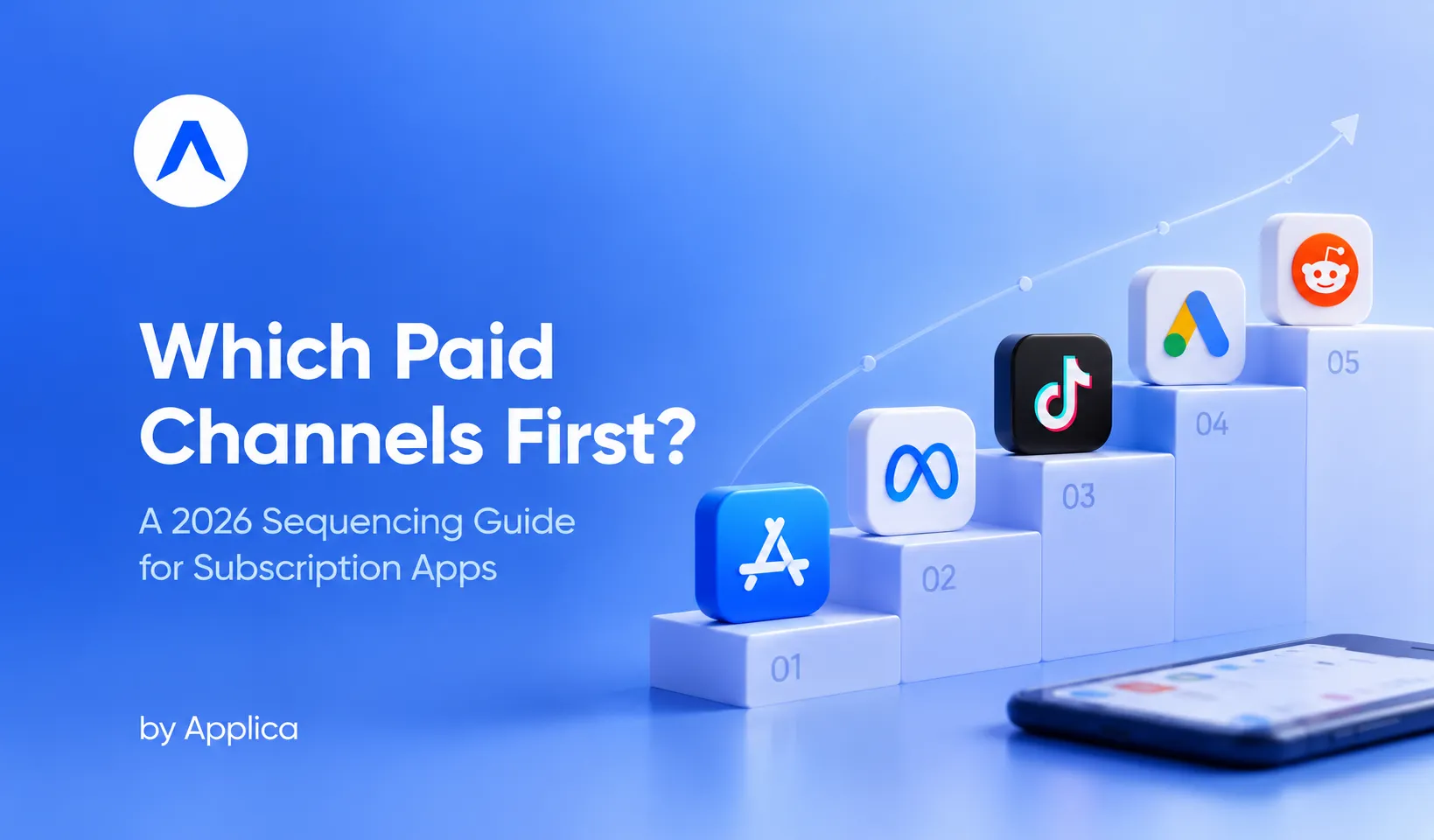
Most subscription apps do not fail at paid acquisition because they picked the wrong channel. They fail at paid channel sequencing: they run every channel at once instead of in order. A team raises a round or frees up budget, opens Apple Ads, Meta, and TikTok in the same week, splits the money three ways, and then spends the next quarter wondering why nothing is efficient. The channels never had a chance. Each one was starved of the conversion signal it needed to optimise, so all three underperformed in parallel.
The order you switch channels on is a bigger lever than the channels themselves. Under roughly $1,500 per month, Apple Search Ads is realistically the only viable place to start, because it captures existing iOS search intent rather than paying to manufacture demand. That intent shows up in the numbers: Apple Ads convert installs to paying users at about 2.1 times the rate of other paid channels, according to Adapty's June 2026 benchmark drawn from more than a million ad groups, with trial starts running roughly 2.5 times higher. That is why it earns the first dollar.
This is the core idea of the guide. Paid channel sequencing for a subscription app is a sequence of proof, not a ranking of channels, because each channel only earns the next once it exits learning and hits a spend ceiling, and splitting budget too early starves them all of signal. What follows is the running order, the graduation gates between channels, and the one metric that actually tells you whether a cheap channel is worth keeping.
Why running every paid channel at once starves them all
Paid platforms are optimisation engines, and optimisation engines need volume. A Meta ad set that sees six conversions a week cannot learn who to target; a TikTok campaign fed scraps never escapes exploratory delivery. When you divide a modest budget across three channels, you convert one under-fed account into three under-fed accounts, and you multiply the problem instead of solving it.
This is the quiet cause behind a lot of "our CAC is too high" complaints. As we have written before about the three paid user acquisition mistakes that quietly burn budget, the damage is usually structural rather than creative: the account is built in a way that prevents any single unit from accumulating enough signal to stabilise. Spreading budget across channels is the same mistake at portfolio level.
There is also an opportunity cost. Time spent nursing three half-funded channels is time not spent pushing the one channel that is already working past its ceiling. The 2026 mobile channel landscape is wider than ever, spanning Apple Ads, Meta, Google, TikTok, and Reddit, but breadth is a late-stage advantage, not a starting position. Concentration is what gets you your first clean read on unit economics.
What is paid channel sequencing, and why treat it as a sequence of proof?
Paid channel sequencing is the deliberate order in which you activate acquisition channels, where each new channel is switched on only after the previous one has proven it can acquire paying users efficiently at increasing scale. It is not a menu you order from all at once. It is a relay, where one channel has to finish its leg before it hands the budget to the next.
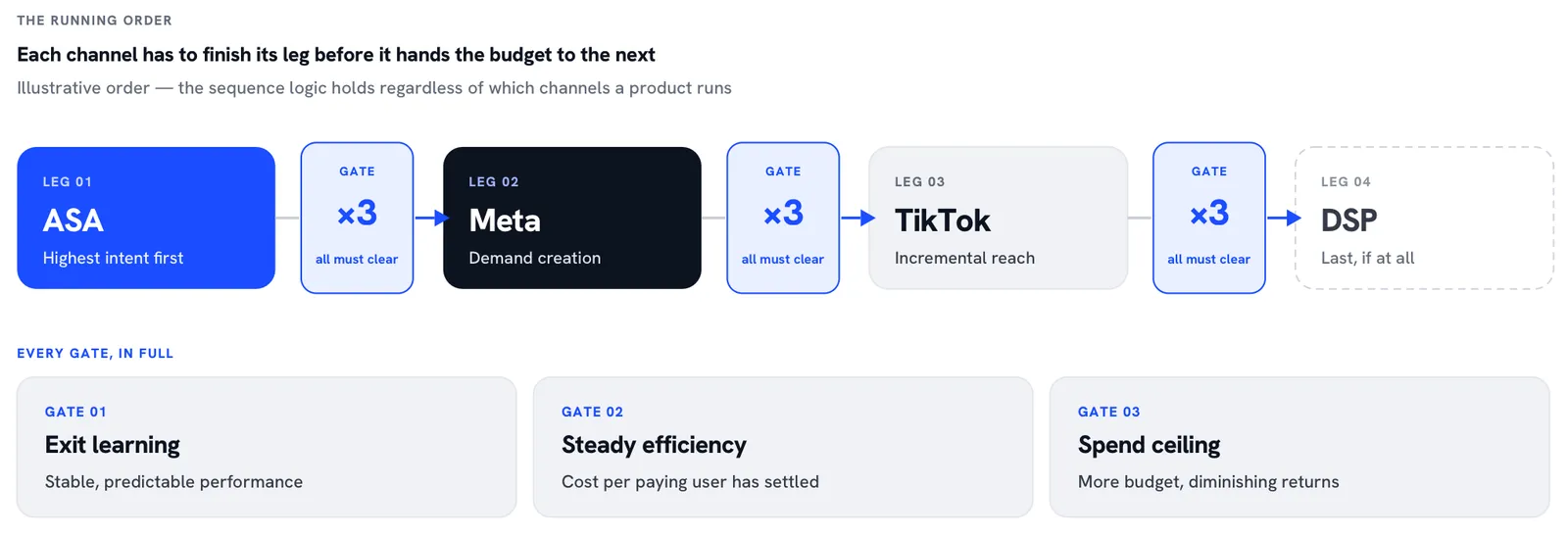
That framing matters because it changes what "adding a channel" means. You are not diversifying for its own sake; you are graduating budget from a proven channel to an unproven one, and you only do it when three gates are cleared. First, the current channel has exited its learning phase and delivers stable, predictable performance. Second, it has reached steady efficiency, so cost per paying user has settled rather than drifting. Third, it has bumped a spend ceiling, the point where pushing more budget into it produces diminishing returns. Until all three are true, more budget belongs in the channel you already trust, not in a new one.
The mistake isn't choosing the wrong channel. It's running them all at once. The apps that scale treat paid channels as a sequence, not a menu, and let each one earn the next.
© Diana Daniuk, UA Manager at Applica.
That is the whole thesis in one sentence. The rest of this guide is the running order, gate by gate.
Which ad channel should a subscription app run first?
A subscription app should run Apple Search Ads first. It is the highest-intent paid channel for iOS, it is deterministic rather than modelled, and it captures users at the moment they are searching the App Store for something your app already does. No other paid channel starts from that level of purchase intent.
The intent advantage is not a slogan; it is visible in conversion quality. Because Apple Ads reach people who typed a query rather than people scrolling a feed, they convert to trials and subscriptions at materially higher rates, which is exactly what Adapty's category-level Apple Ads benchmarks show across Health and Fitness, Education, and Productivity apps. When your first job is to prove you can turn demand into paying users, you want the channel where demand already exists.
Apple Ads convert 2.1x more installs to paid than other channels
| Funnel stage | Apple Ads | Other paid channels | Advantage |
|---|---|---|---|
| Install → Trial | 3.66% | 1.45% | 2.5× |
| Install → Paid | 1.92% | 0.91% | 2.1× |
The second reason is measurement integrity. Apple Ads run inside Apple's own ecosystem, so attribution is first-party and deterministic through the Apple Ads Attribution API, rather than reconstructed from the privacy-thresholded, modelled postbacks that SKAdNetwork returns for other iOS channels. Apple Ads are also unaffected by the opt-in wall of App Tracking Transparency, because they do not depend on cross-app tracking to attribute a conversion. The practical result is that your first channel gives you the cleanest signal you will get anywhere, which is precisely what you want when you are calibrating your funnel and your paywall. For the mechanics of cost and bidding on the channel, SplitMetrics has a current breakdown of Apple Ads CPT, CPA, and conversion rate, and Apptweak maintains category benchmarks worth calibrating against.
Where does Google App Campaigns fit in this?
Google App Campaigns sits outside the iOS-first sequence. It is primarily an Android and cross-network channel, and it should be planned as a separate track rather than folded into the ASA-to-Meta-to-TikTok order described here. If Android is a priority market for you, run Google App Campaigns on its own timeline with its own budget and its own targets; do not blend it into the iOS relay, because the attribution profile and the cost structure are different enough that a combined view hides what is really happening. At scale, these two search-led channels tend to absorb the majority of paid spend, because they pair the highest purchase intent with the cleanest attribution, which is why mature app budgets so often concentrate there before diversifying outward.
When should you add Meta?
Add Meta once Apple Search Ads is stable, efficient, and bumping its ceiling. ASA can only capture the demand that already exists in App Store search, so its scale is capped by search volume. Meta is where you graduate to manufacturing demand, using its targeting and creative reach to put your app in front of people who were not looking for it yet. It is the demand-generation workhorse that takes you beyond store search.
The reason to wait for the graduation gates is the Meta learning phase. Meta's own documentation explains that an ad set needs to accumulate enough conversion events, generally around 50 in a week, before delivery stabilises and performance becomes predictable. If you open Meta while ASA is still soaking up your budget, you cannot feed a Meta ad set the conversion volume it needs, and it stalls in learning indefinitely. Graduating budget only after ASA is proven means you can concentrate enough spend on Meta to get it through learning quickly. On the budget required, SEM Nexus suggests roughly $50 to $100 per day per ad set to exit learning within a week, again one agency's directional figure rather than a fixed rule.
Two operational cautions matter here. First, the learning phase is fragile, and significant edits reset it, including pricing changes, which is why every pricing change can reset your Meta learning phase and should be sequenced deliberately rather than shipped mid-scaling. Second, when you are weighing Meta against ASA specifically, the two are not substitutes but different jobs at different stages, a distinction we unpack in Apple Search Ads vs Meta Ads: which channel, and when. Meta is not a better ASA; it is the next leg of the relay.
When is TikTok worth it?
TikTok is worth adding only when you have genuinely native creative. Its headline appeal is a lower cost per impression and per click than Meta, but for subscription apps that price advantage is routinely undone by a higher cost per acquisition, unless the creative looks and feels organic to the platform. Polished, repurposed Meta ads underperform on TikTok, so the channel earns its place on creative readiness, not on media price.
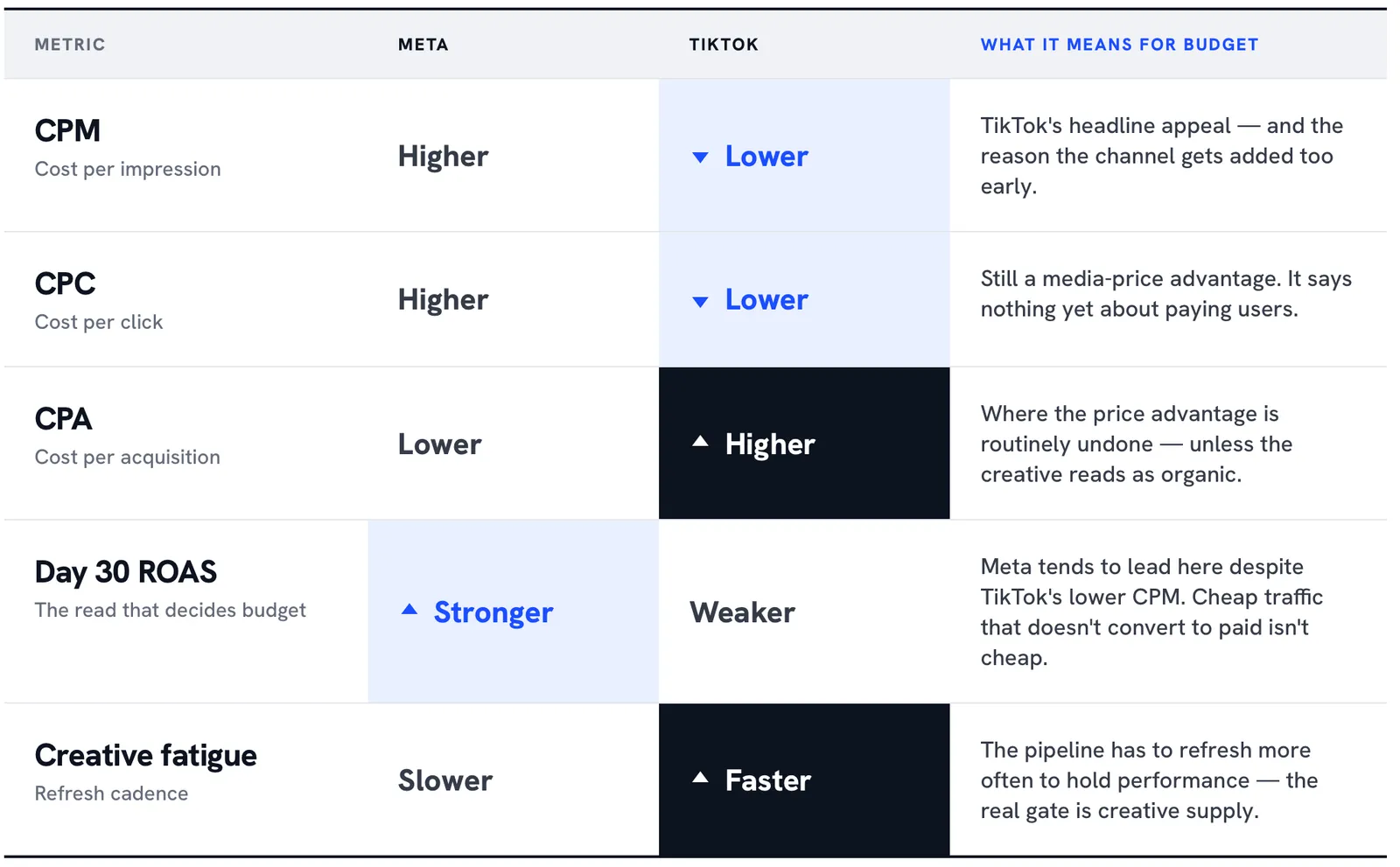
The trap is easy to walk into. In our experience running both channels for subscription apps, Meta tends to deliver stronger Day 30 ROAS despite TikTok's lower cost per impression, and TikTok creative fatigues faster, so the content pipeline has to refresh more often to hold performance. The principle underneath is simple: cheap traffic that does not convert to paid is not cheap, and a low CPM tells you nothing until you have seen the trial-to-paid rate sitting behind it.
That is why the gate is creative capacity, not budget. TikTok rewards volume and velocity of native content, which is why creative strategy has become the primary growth lever in performance marketing, and why an app without a native content engine should hold off. If you cannot feed TikTok a steady stream of platform-native creative, the higher CPA will eat the lower CPM, and the channel will look like a failure when the real gap was creative supply.
Where do programmatic DSPs fit?
Programmatic demand-side platforms are the last diversification layer, not a starting point. Channels such as Moloco and Liftoff open access to inventory beyond the walled gardens, and they can meaningfully extend reach and efficiency, but they make sense only once Apple Ads, Meta, and where relevant TikTok are running near their ceilings. They are how you diversify a working machine, not how you build one.
The sequencing logic is the same one that governs every earlier gate. A DSP needs strong conversion signal and a clear picture of your unit economics to optimise well, and you only have that picture after the walled gardens have taught you what a good user costs and is worth. Meaningful diversification is a scaled-budget move: you reach for DSPs when concentration has stopped paying and the walled gardens can no longer absorb more budget efficiently, not before.
The metric that actually ranks your channels: trial-to-paid by channel
Here is the part most channel guides miss. The metric that ranks your channels is not cost per install and it is not even cost per trial. For a subscription app it is trial-to-paid conversion by channel, the downstream truth check that reveals whether the users a channel delivers actually pay.
Start with the right acquisition metric for your funnel. If you run a free trial, judge channels on cost per trial start; if you run a hard paywall, judge them on cost per paying user. Keep these distinct from one another and from CPI, CPA, and ROAS, because silently swapping one for another is how teams talk themselves into a bad channel. A channel can look brilliant on cost per install and terrible on cost per paying user, and only the second number pays your bills. General subscription context helps calibrate expectations here, and both the RevenueCat State of Subscription Apps report and Business of Apps trial benchmarks are worth reading for where healthy trial and conversion rates sit.
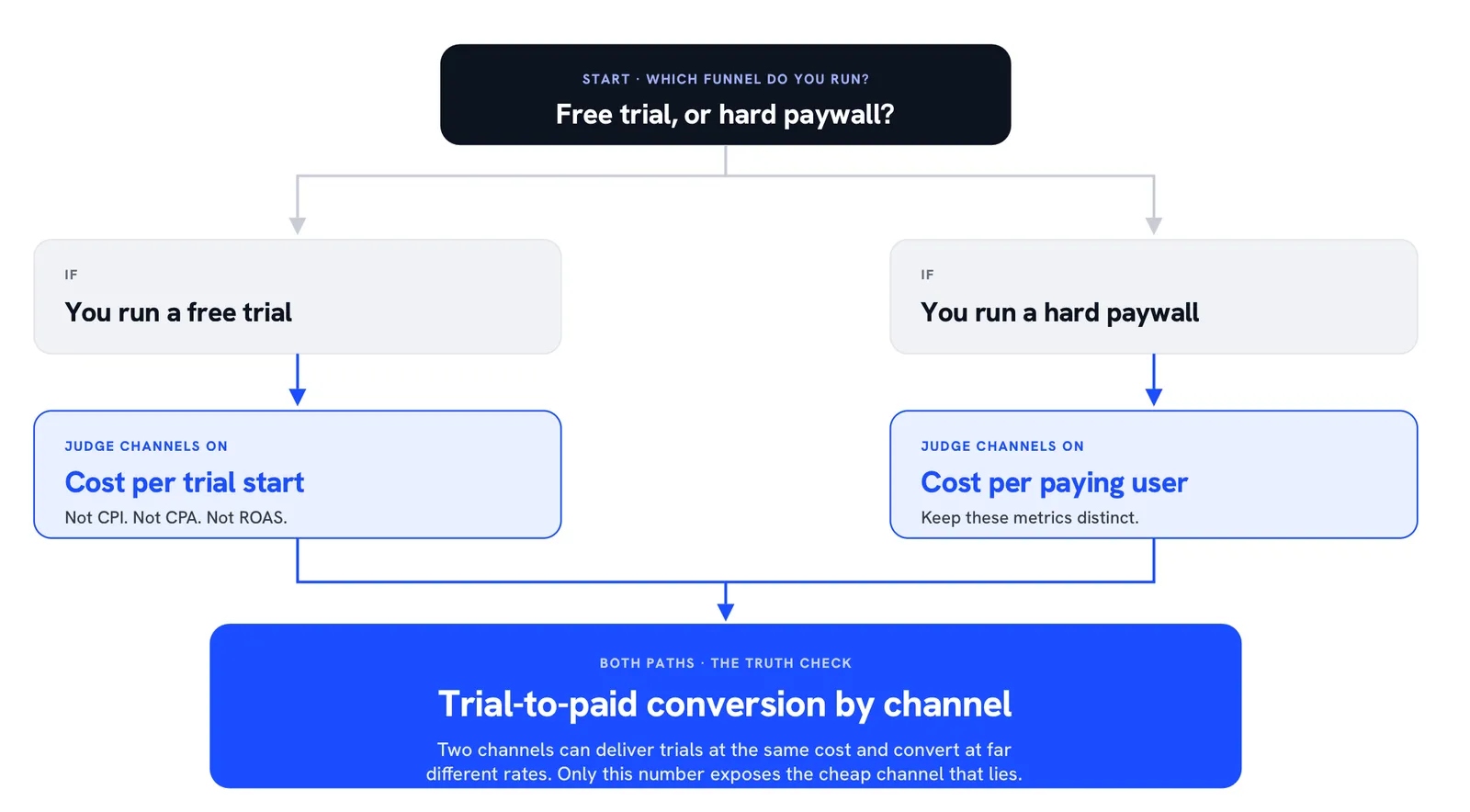
Then apply the truth check. Two channels can deliver trials at the same cost while one converts those trials to paid subscriptions at a far higher rate, and the cheaper-looking channel can be the worse investment. This is the cheap channel that lies: it fills your dashboard with low-cost trials that never turn into revenue, and cost per trial alone will never expose it. Only trial-to-paid by channel does. Measuring it reliably depends on clean event data and disciplined analysis, which is the whole point of pairing acquisition with rigorous A/B testing and data analysis rather than trusting platform-reported conversions at face value.
Illustrative table: equal cost per trial but different trial-to-paid conversion
| Channel | Spend | Trial starts | Cost per trial | Trial → Paid | Paid subscribers | Cost per paid subscriber |
|---|---|---|---|---|---|---|
| Channel A | $10,000 | 500 | $20 | 40% | 200 | $50 |
| Channel B | $10,000 | 500 | $20 | 20% | 100 | $100 |
This is also where the sequence and the metric reinforce each other. Consider a composite pattern we see repeatedly: an app runs ASA first, proves that its store-search trials convert to paid at a healthy rate, then graduates Meta once ASA has exited learning and hit its ceiling, and watches Meta's trial-to-paid closely because feed-sourced trials often convert at a different rate than search-sourced ones. Sequencing gives you a clean baseline from your highest-intent channel; trial-to-paid by channel tells you how far each subsequent channel drifts from it. Together they stop you from scaling a channel that was only ever cheap on the surface.
Conclusion
The order you activate channels in is not a formality; it is the strategy. Start on Apple Search Ads because it is the highest-intent, deterministic, cleanest-signal channel you have, and prove you can convert existing iOS demand into paying users before you pay to create new demand. Graduate to Meta when ASA is stable, efficient, and capped, layer in TikTok only when your creative is genuinely native, and hold programmatic DSPs for last. At every step, judge channels on the earliest reliable paying-intent signal and then on trial-to-paid by channel, because that is what separates a cheap channel from a valuable one.
Paid channel sequencing for a subscription app is a sequence of proof, not a ranking of channels. Sequence, do not spread, and let each channel earn the next. If your paid mix is currently running three channels at once and none of them is clearly profitable, that is the first thing to fix. Explore a performance marketing audit with Applica to see which channel has actually earned your next dollar.