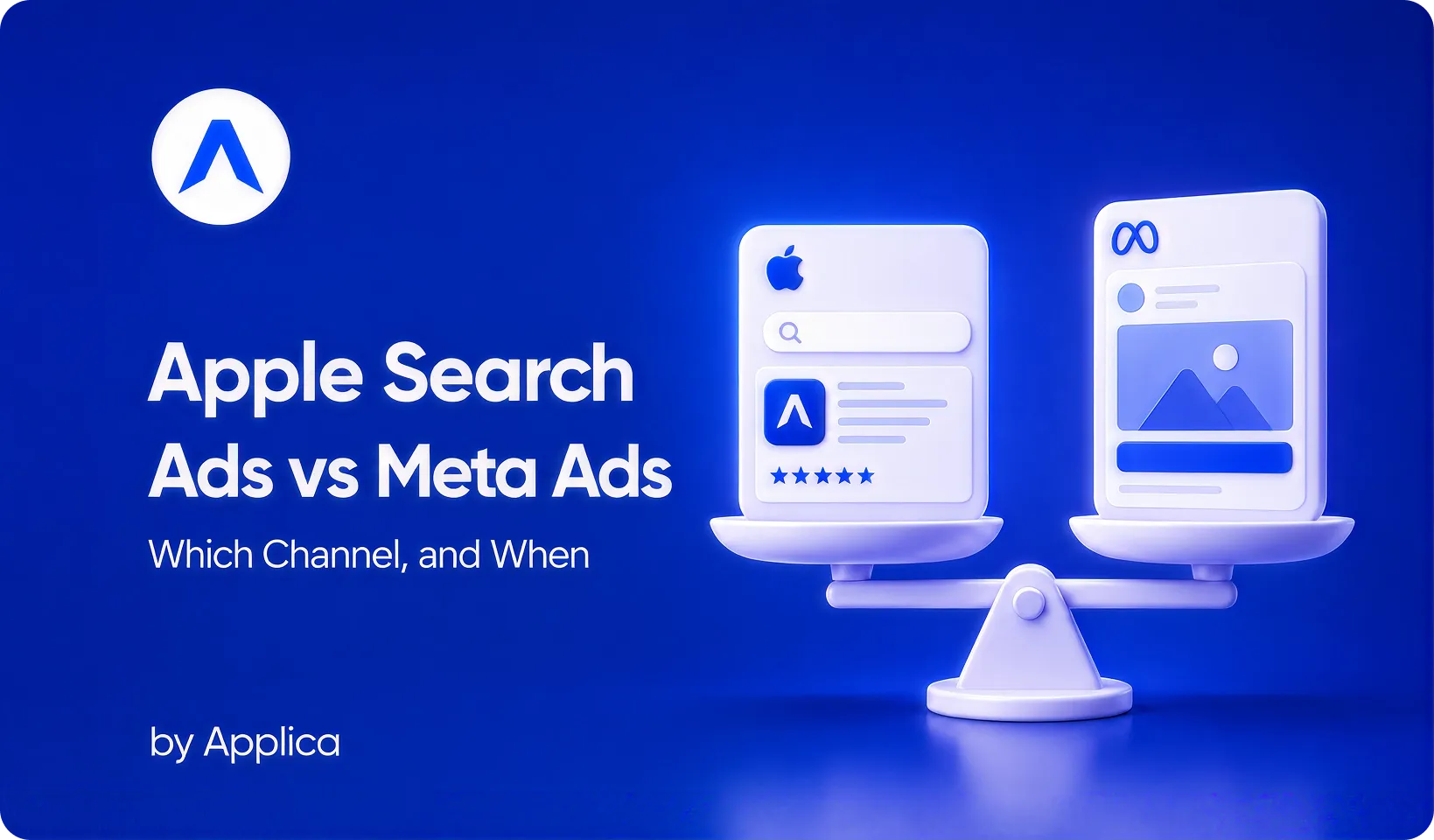
If you run a small app, the Apple Search Ads vs Meta Ads question usually arrives as a budget question: which channel deserves the next dollar, and when? On 3 March 2026, Apple made that decision sharper. It began showing more than one ad in App Store search results, starting in the UK and Japan and reaching all Apple Ads markets by the end of the month, on devices running iOS and iPadOS 26.2 and later. Two ads can now surface on a single search where only one used to, and Apple Ads already operates in 91 countries and regions. Meta is not standing still either: its ad costs have kept climbing into 2026 and its buying has become more automated, leaving founders with less manual control over where budget actually lands. Getting this channel choice wrong is simply more expensive than it was a year ago.
Here is the trap most teams fall into. Apple Search Ads and Meta Ads are actually two different games, not two lines in one budget: search captures intent that already exists while social has to create it, and managing them identically is the hidden driver of rising CAC (customer acquisition cost, the full cost of turning a stranger into a paying user). This piece gives you the practical comparison first, then explains why the two channels need different metrics and expectations, and closes on the counter-intuitive move most founders at zero to 50K MRR skip: defending your own brand.
What's the difference between Apple Search Ads and Meta Ads?
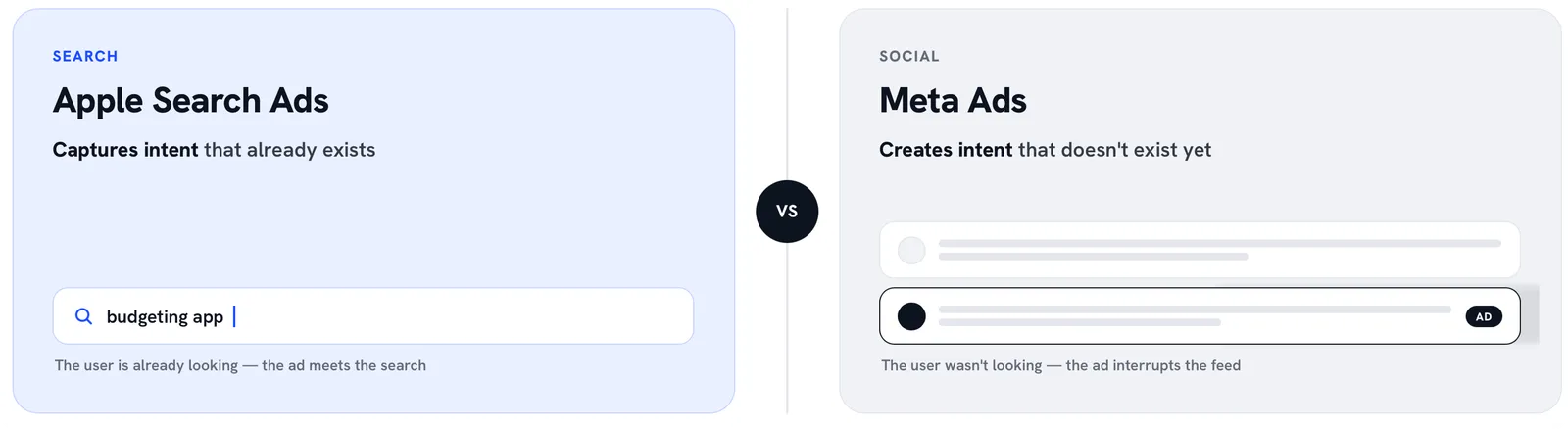
Apple Search Ads places your app at the top of App Store search results when someone types a query, so it reaches users who are already looking. Meta Ads places your app inside Facebook and Instagram feeds, in front of users who were not searching for anything. One channel harvests demand that exists; the other has to create it. That single difference shapes almost everything downstream.
On Apple Search Ads, the person has already typed a need. Apple has long cited that around 65% of App Store downloads happen after a search, a figure it first shared in 2017 and 2018, so treat it as directional rather than a fresh 2026 benchmark. The broader point holds: App Store search is where a large share of intentful discovery happens, and independent data likewise shows search driving a substantial slice of downloads. On Meta, you are buying attention from someone mid-scroll, so the creative has to generate interest that did not exist a second earlier.
Same budget, two different jobs: demand capture vs demand generation.
| Apple Search Ads | Meta Ads | |
|---|---|---|
| Demand type | Captures existing intent | Creates new interest |
| Where it appears | App Store search results | Facebook and Instagram feeds and Reels |
| Targeting | Keywords a user typed | Interests, behaviour, lookalikes |
| Creative unit | App Store listing or custom product page | Video and image ads in feed |
| Intent at click | High | Low to medium |
| Best-fit job | Convert people already looking; defend your brand | Build awareness and volume at scale |
Two metrics run through this whole comparison. eCPI (effective cost per install, your total spend divided by installs) tells you what a download costs. ROAS (return on ad spend, revenue divided by spend) tells you what that download is worth. The gap between those two is where channel decisions are actually won or lost. For the wider view of where these two sit among every paid channel worth running this year, we mapped the full landscape in our guide to the best performance marketing channels for mobile apps in 2026. Apple's own Apple Search Ads mechanics reward keyword and listing relevance, which is a different discipline from winning attention in a feed.
Intent vs interruption: why search and social are two different games
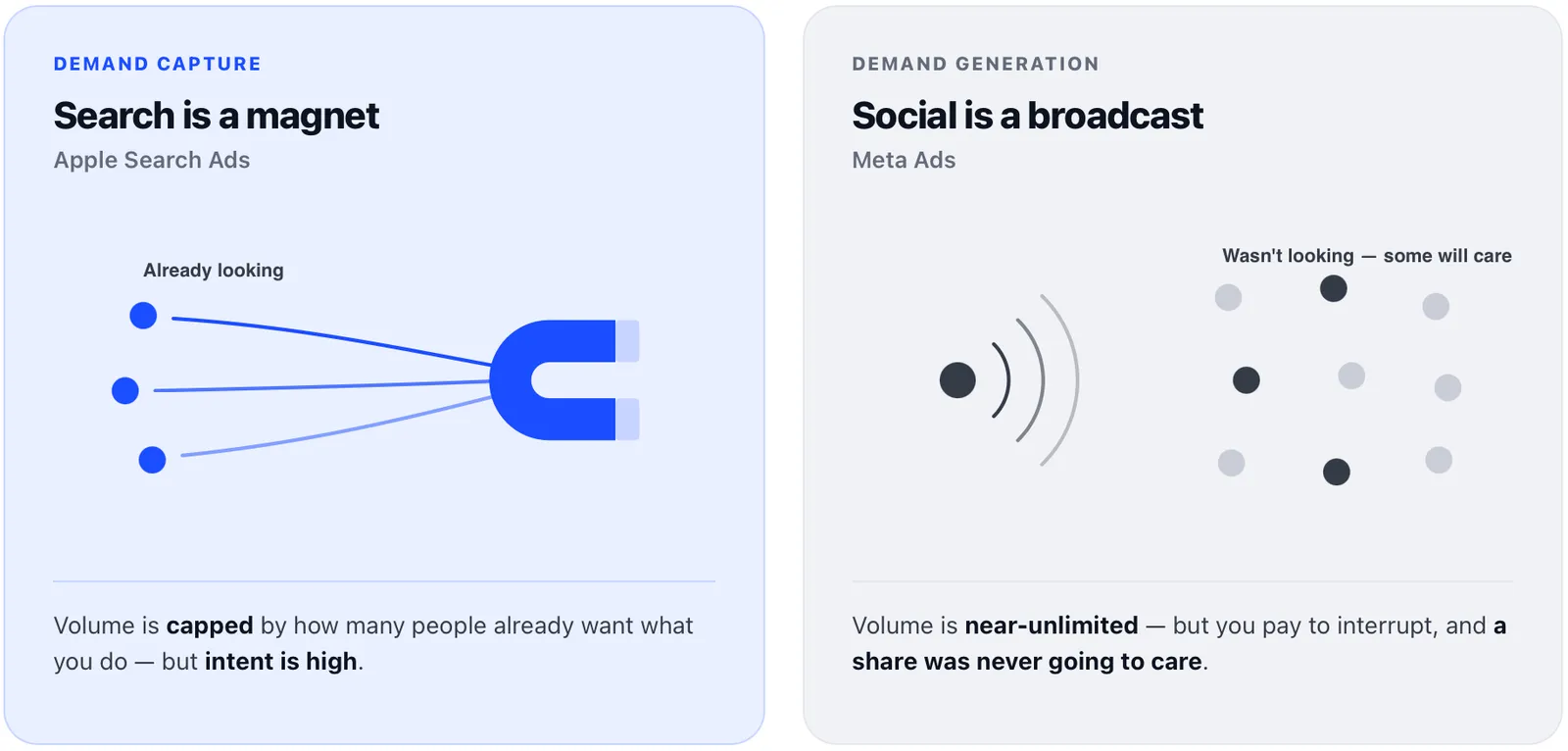
The cleanest way to hold the two channels in your head is an old marketing distinction: demand capture versus demand generation. Search is demand capture. Social is demand generation. Apple Search Ads and Meta Ads are actually two different games, not two lines in one budget: search captures intent that already exists while social has to create it, and managing them identically is the hidden driver of rising CAC.
Because the two channels do different jobs, they cannot be judged by the same yardstick. Search volume is capped by how many people are already looking for what you do, so its ceiling is real but its intent is high. Social volume is close to unlimited, but you are paying to interrupt, so a share of every audience was never going to care. Ask Meta to match search-level intent and you will conclude it is broken; ask Apple Search Ads to match social-level scale and you will conclude it is too small. Both conclusions come from using one scoreboard for two different games, and both quietly push blended acquisition costs upward over time.
The divergence shows up further down the funnel too. The same paywall can win on organic traffic and lose on Meta, because the two audiences arrive with different intent and convert at different rates. If you optimise one creative or one price for a blended average, you are optimising for a user who does not exist.
Why identical install costs can hide very different value
Two channels can report almost the same cost per install and still deliver completely different amounts of revenue. Install cost measures what you pay at the door. It says nothing about what the user does once inside. That is why cost per install, read on its own, is one of the most misleading numbers in mobile growth.
CPI (cost per install) is simply what you pay for each download. It is easy to measure and easy to over-trust. The number that actually matters is LTV (lifetime value, the total revenue a user generates over their time in the app), because two users acquired at the same price can be worth very different amounts depending on whether they subscribe, renew, or churn.
Here is one worked example from a single subscription app we ran, over one period, with volume too thin to be conclusive. Read it as illustrative of direction only, not a benchmark. In that account, Meta and Apple Search Ads landed at almost identical install economics: an eCPI of about €2.45 on Meta and €2.39 on Apple Search Ads. On install cost alone, the two channels looked interchangeable. Downstream, they were not. The Apple Search Ads users, arriving from a typed query, moved further toward trials and subscriptions at a lower CPT (cost per trial, what you pay for each free-trial start), while the Meta users converted less efficiently despite the matching install price. Same door price, different value inside.
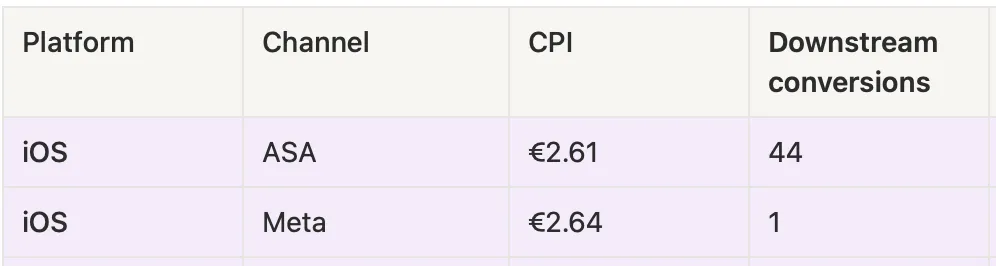
State that plainly: this is a single-account illustration, not a rule. The mechanism generalises, since identical install costs really can hide very different downstream value. The magnitudes do not generalise. The only way to know your own numbers is to measure trials, subscriptions, and retention by channel in your own account, not just installs. Measuring this cleanly on Meta is genuinely harder than on search, which is part of why so many iOS campaigns misjudge quality; we wrote about the measurement setup we use instead in our breakdown of why iOS app campaigns are broken.
This is why the framing matters more than the tooling. As Diana Daniuk, User Acquisition Manager at Applica, puts it:
Teams get so focused on Meta that they treat every paid channel the same. But social and search capture different demand: social must create interest, while search captures intent that already exists. Never manage social like search, or search like social.
© Diana Daniuk, User Acquisition Manager at Applica
Should you bid on your own brand keywords?
For most small apps, yes, but for a reason founders often miss. Bidding on your own brand name is not cannibalising traffic you would get for free. It is defending high-intent traffic from competitors who can now appear on your branded search. Apple's 2026 expansion of App Store search ads just raised the cost of leaving that traffic undefended.
The instinct to skip it is reasonable, and the evidence is genuinely mixed. In one well-known holdback test on web search, a brand paused its branded bidding and watched paid brand clicks fall while organic clicks rose to replace most of them, which suggested the paid spend had not been very incremental. If your organic listing already owns the top slot and nobody is bidding against you, brand defence can indeed be money spent to reach people you already had.
Two things change that calculus on the App Store, especially for a smaller app. First, competitors can and do bid on your brand terms, and Apple's move to show two ads per query means there is now more room for a rival to sit directly on your name. Second, a young app rarely owns an unshakeable organic position, so the assumption that organic will simply recapture the click is weaker than it is for an established brand. When a competitor can occupy an ad slot on your own name and your organic listing is not yet dominant, brand bidding stops being cannibalisation and becomes defence.
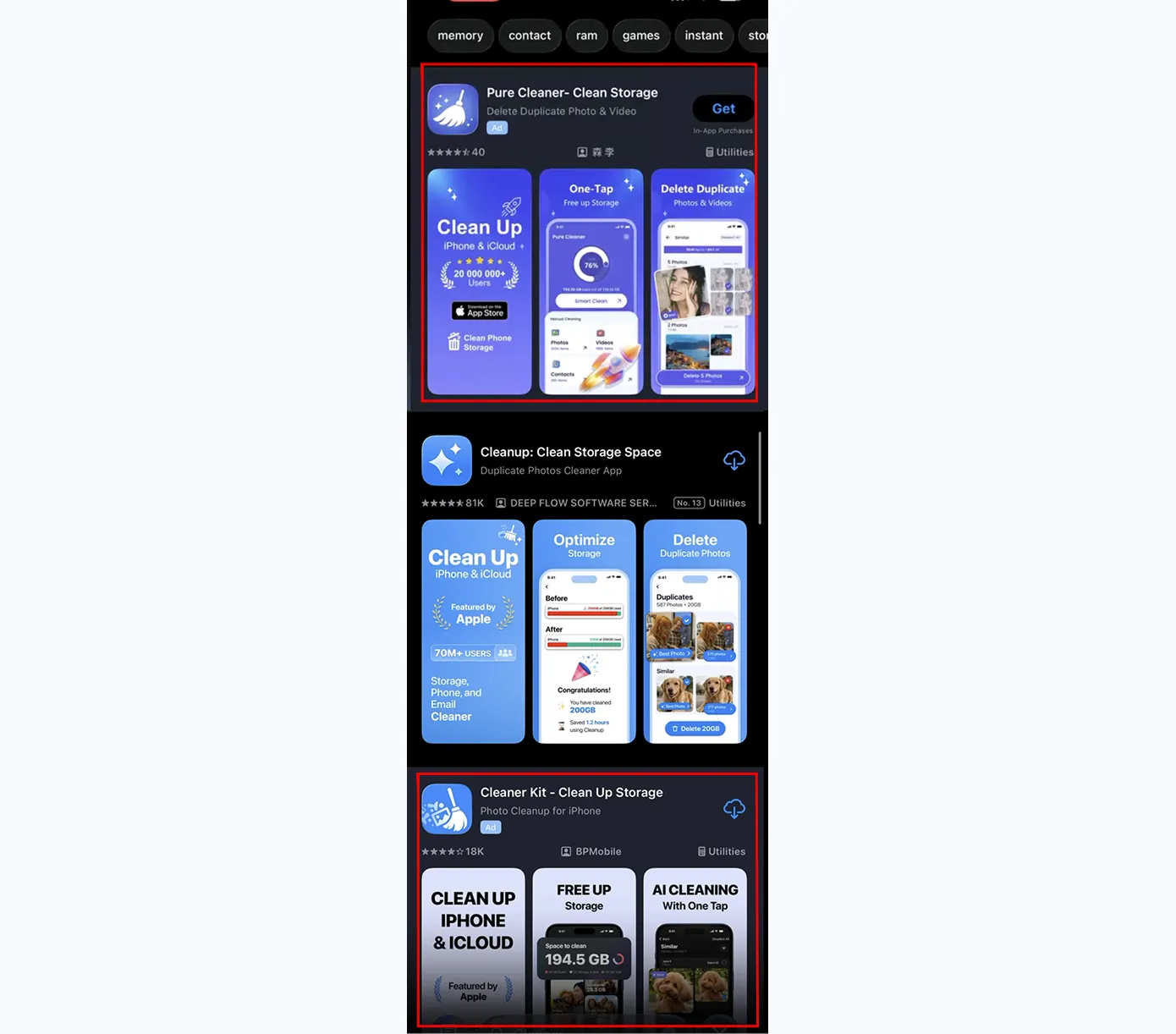
In the same single account, when brand bidding was switched off, paid SoV (share of voice, the proportion of ad impressions you hold) on the brand terms collapsed from near total toward zero almost immediately. One account, one period, not a benchmark, but the direction is intuitive: if you stop showing up on your own name, someone else can. Test it the same way on your own account before deciding. How you structure brand and non-brand campaigns to do this well is its own topic; we treat App Store Optimization and Apple Search Ads as one system, not two channels, and the campaign structure lives in that guide.

The same logic points outward, too. If a competitor is not defending their brand on Apple Ads, their branded traffic is often cheap and high-intent to buy, which is one of the more underrated moves available to a small challenger.
How should a small app split its budget between Apple Search Ads and Meta Ads?
Start where intent already exists, then buy scale deliberately. For an app at zero to 50K MRR, Apple Search Ads usually earns the first dollar because it converts existing demand efficiently, including your own brand terms. Meta earns the next dollar once you need volume beyond what search demand can supply, and once you can measure what that volume is actually worth.
A workable sequence looks like this: defend your brand on Apple Search Ads first, then capture generic and category search intent, then layer Meta for scale with structured creative testing, and judge each channel on its own metric. Search should be judged on intent and cost per trial or subscription. Social should be judged on reach, blended payback, and downstream value. The mistake is not choosing one channel over the other. It is running through a single dashboard that rewards whichever report has the lower install cost, which quietly pushes the budget toward the channel that looks cheap rather than the one that pays back.
Put plainly, the social ads vs search ads question is not which is better. It is the job you are hiring each one to do.
The takeaway
Apple Search Ads and Meta Ads are actually two different strategies, not the same approach in one budget: search captures intent that already exists while social has to create it, and managing them identically is the hidden driver of rising CAC. Three things follow. First, judge each channel on its own metric: intent and cost per trial for search, scale and downstream value for social. Second, never trust the install cost alone, because identical eCPIs can hide very different lifetime values. Third, defend your brand, because Apple's 2026 second ad slot means undefended branded traffic is now easier for a competitor to take.
If your Apple Search Ads and Meta budgets are being judged by the same install-cost dashboard, that is the first place to look. Explore where your paid channels are actually paying back with a structured performance marketing review.