In March 2026, Meta tightened the rules for anyone advertising money. Financial-services advertisers now have to verify their business and individual identity on top of any regulatory authorization they already hold, and — per Meta's Transparency Center financial-services policy — that authorization is now explicitly subject to Meta's own review. The stakes behind the shift are structural, not cosmetic: as The Record reported, Meta wants 90% of its ad revenue to come from verified advertisers by the end of 2026, up from roughly 70%. Verification is tightening around every financial-services advertiser on the platform, legitimate FinTech apps included, not because they are the problem, but because the entire category now sits inside a stricter gate.
For growth teams, this reframes an old assumption. FinTech ad creative compliance is actually a testing-velocity advantage, not a brake, because baking compliance into the creative brief lets you test more variants, not fewer, without wrecking your ad-account approval rate. Most teams still treat compliance as a review-queue problem: produce creatives, submit them, wait, absorb the rejections. That sequence quietly caps how fast you can learn. This article lays out the operating model that inverts it, where compliance is an input to the brief, and approval rate becomes a creative key performance indicator (KPI) you manage on purpose.
Why FinTech creative testing breaks most playbooks
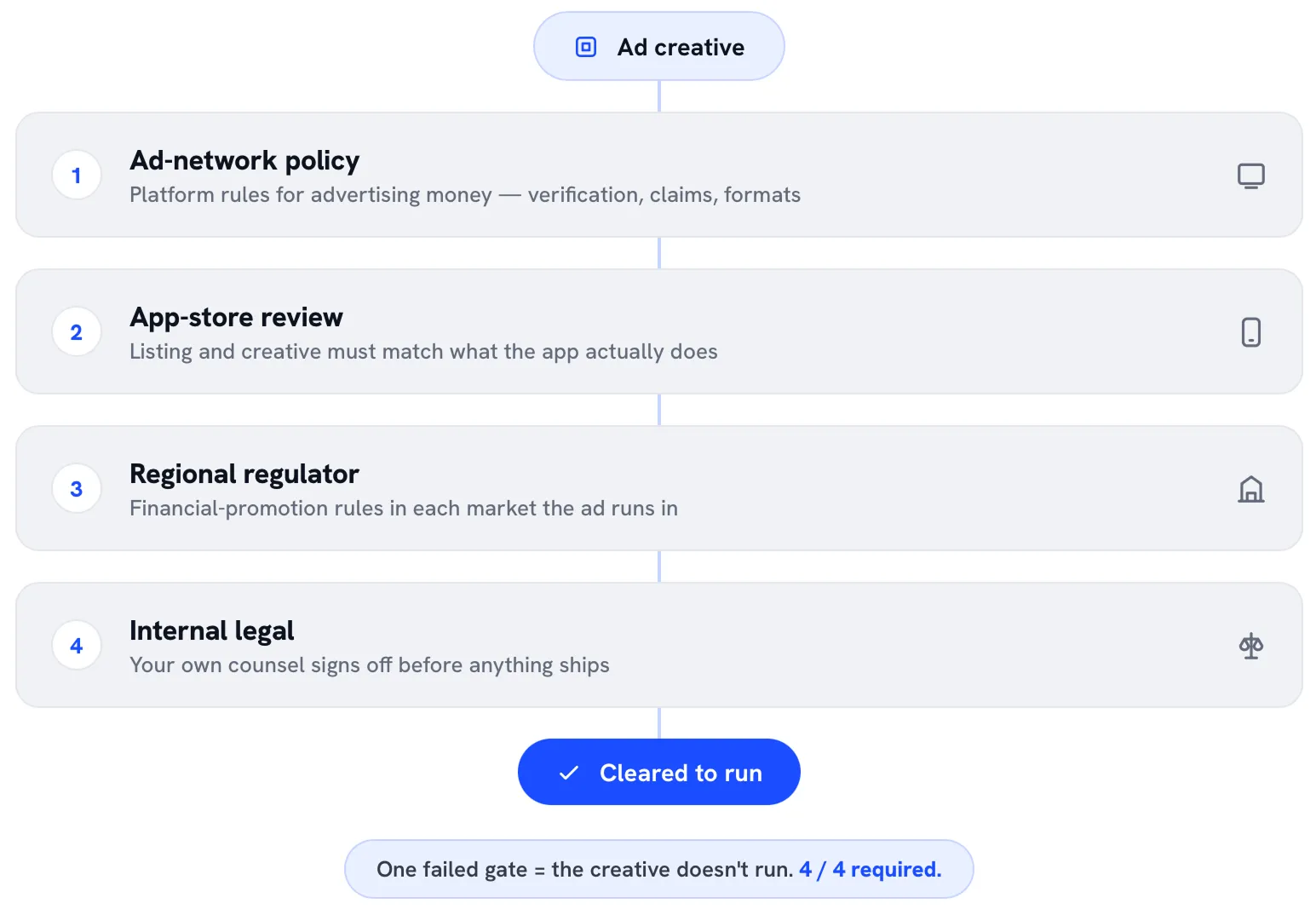
The standard performance-creative playbook assumes a two-party negotiation: your creative and the algorithm. In regulated FinTech, that assumption is wrong. Every creative has to satisfy a stack of approvers before it ever competes for a click, and each layer can reject you for different reasons.
The constraint stack
There are four layers, and they don't share a rulebook. Ad-network policy governs what Meta, Google, TikTok, or Apple Ads will run. App-store review governs how your product page and store-side creative can present the offer. Regional regulators govern what you can claim to whom: the Financial Conduct Authority (FCA) in the UK, EEA-level rules, and US state-by-state constraints. And internal legal governs what your own compliance team will sign off before anything ships. A creative that clears three layers and fails the fourth is still a dead creative.
This is why scaling paid acquisition in finance is a different discipline from scaling a wellness or utility app, a point we've made before in our breakdown of how to scale a finance app without overspending. The constraint stack is the environment, not an obstacle inside it.
Why Special Category Campaigns raise the stakes on creative
In several markets, financial-services ads on Meta run inside the Special Ad Category, and that changes the mechanics beyond approvals. Special Category Campaigns strip out much of the targeting toolkit: Lookalike Audiences, detailed interest and behaviour targeting, and granular age, gender, and location controls are restricted or unavailable. If your acquisition playbook leans on lookalikes and tight audience segmentation, those levers may simply not be there. The effect is to push even more of the performance burden onto the creative itself, which is why a compliance-first creative system matters more inside this category, not less. When you can't target your way to efficiency, the creative has to do the work.
Why "move fast and break things" produces penalties, not learnings
In most verticals, a rejected ad is a non-event: you tweak and resubmit. In FinTech, a pattern of rejections is a signal to the platform that your account is high-risk, and the cost escalates from a declined creative to restricted advertising privileges or account-level penalties. The failure mode isn't losing one test; it's losing the account that runs all your tests. The legal exposure runs deeper still, as we explored in our teardown of subscription funnels in Subscriptions Without Lawsuits.
How approval volatility taxes testing velocity
The hidden cost is time. Restricted verticals sit in longer review windows, and every variant that gets stuck, or bounced, is a learning you didn't get this week. When approval is unpredictable, teams compensate by testing less aggressively, narrowing to "safe" variants they're confident will clear. That's the real damage: not the rejected creative, but the shrinking of the test space itself. Approval volatility doesn't just slow you down; it quietly makes you more conservative than the data warrants.
What is creative compliance, and why is it a creative input?
Creative compliance is the practice of designing an ad to satisfy every approval layer (ad network, app store, regulator, and internal legal) before it enters production, rather than discovering violations after submission. Treated as a creative input, it is a set of constraints written into the brief; treated as an afterthought, it is a rejection you absorb downstream.
The distinction decides your testing velocity. When compliance lives in the review queue, every variant is a gamble: you find out whether it was allowed only after you've spent the production time to build it. When compliance lives in the brief, the illegal variants are never built, so every creative you produce is a creative that can actually run and actually teach you something.
A compliance checklist embedded in the creative brief, mapped to the common rejection triggers: income claims, urgency, and missing risk disclosures.
| Check | What the brief must specify | Common rejection trigger | Before production |
|---|---|---|---|
| Income and return claims | Approved wording, supporting evidence, and any required qualifier. | Guaranteed earnings, “typical” returns without evidence, or effortless-profit language. | Verify the claim source and approve the exact wording. |
| Urgency | The real event creating the deadline and when the offer expires. | Fake or resetting countdowns and unjustified “act now” pressure. | Confirm that the deadline is genuine and verifiable. |
| Risk disclosure | Approved wording for the product, region, and legal entity, plus its placement. | Missing, incorrect, buried, or low-contrast disclosure text. | Confirm the correct version is clearly legible in the creative. |
Building the compliance checklist into the brief
The mechanism is a standing compliance checklist attached to the creative brief, maintained per platform and per region, that every concept is written against. It specifies what claims are permissible, which disclosures are mandatory, and which visual and copy patterns trigger review. At Applica Agency, our operating sequence treats this checklist as a first-class part of the brief: not a legal sign-off bolted on at the end, but a design constraint the concept is built around from the first frame.
The common policy traps
Three patterns account for most avoidable rejections in finance. Income and return claims (anything implying guaranteed or typical earnings) are the most reliable way to get flagged. Manufactured urgency (countdowns, "act now" pressure on a financial decision) reads as predatory to reviewers. And missing or buried risk disclosures turn an otherwise compliant ad into a violation. Writing these three constraints into the brief removes an entire class of failed tests before production starts.
Creative testing frameworks that survive compliance
The objection to compliance-first creative is that it kills volume. In practice, the opposite holds: a fixed compliance structure is what lets you test at volume safely, because you're varying the elements that drive performance while holding the elements that drive rejection constant.
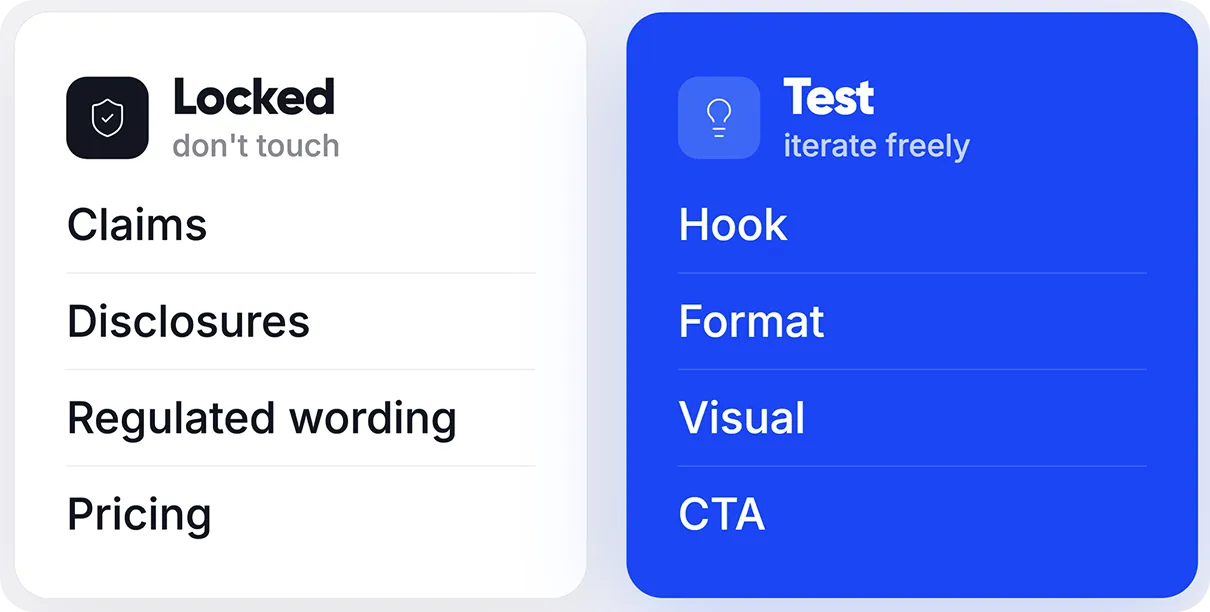
High-volume testing inside a fixed claims structure
Think of the brief as defining two zones. The compliance-critical zone (the claims, the disclosures, the regulated language) stays locked. The performance zone (hook, format, visual treatment, pacing, social proof, call-to-action framing) is where you run high-volume iteration. Because the locked zone is genuinely locked, you can generate dozens of variants in the performance zone without any of them re-entering the risk pool. This is the same discipline that makes structured A/B testing of creatives reliable rather than noisy: isolate what you're changing, hold everything else fixed.
The 80/20: which variables generate learnings without triggering re-approval
Not every variable carries equal compliance risk. Format, opening hook, and visual style rarely touch regulated language, which means they can be tested freely and rebuilt often. Claims, pricing representations, and disclosure wording almost always require re-review, so they change rarely and deliberately. The practical rule: spend your testing velocity on the low-risk, high-learning variables, and treat the compliance-critical elements as a stable foundation you revisit on a slower cadence. That's how you keep effective testing velocity high inside a regulated vertical: you test more variants, not fewer, without wrecking your approval rate.
That inversion is the whole argument, and it's worth stating plainly from the people who run it.
Most teams treat compliance as the thing that slows creative down. It's the opposite. When compliance lives in the brief instead of the review queue, you stop burning test cycles on variants that were never going to run, and your effective testing velocity goes up, not down.
© Artem Kuzmych, CEO at Applica
How do you design ad creative around required disclosures?
You design around disclosures by treating them as fixed layout elements from the first draft, allocating space, contrast, and hierarchy to them before the hook is finalised, rather than pasting them in at the end. The disclosure is a structural constraint, like a safe area or a logo lockup, not a caption you squeeze in later.
This matters because platforms are explicit about how disclosures must appear. Google's financial-products disclosure policy requires that required disclosures be clearly and immediately visible: they can't be hidden behind roll-over text, a separate tab, or a click. Apple's advertising policies similarly require ad content to comply with all applicable laws and regulations in each region you advertise in. A disclosure bolted on after the creative is designed almost always violates the visibility standard, which means a redesign, which means a lost test cycle.
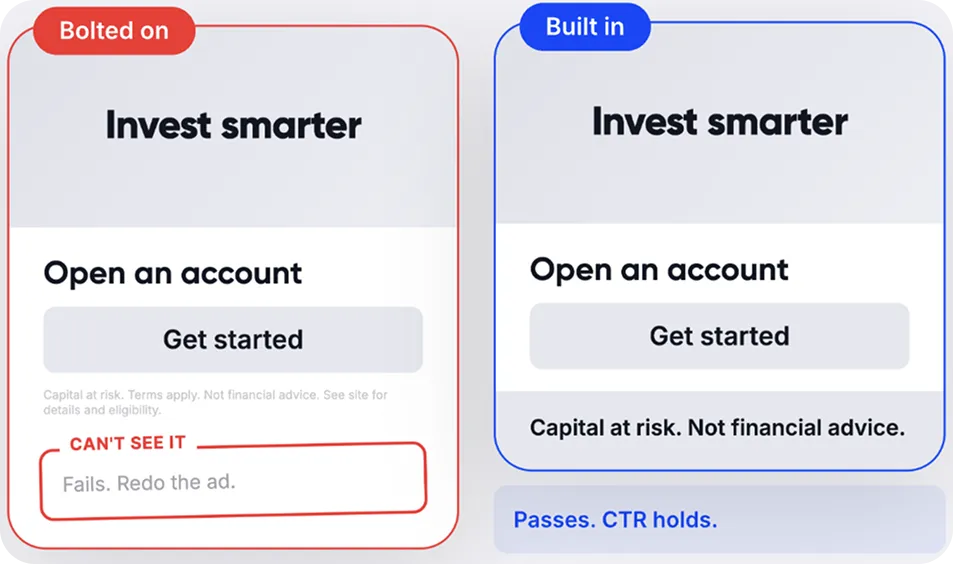
Visual hierarchy that preserves CTR while staying compliant
The tension teams fear, that disclosures kill click-through rate (CTR), is usually a design failure, not a law of nature. A disclosure that is legible and immediately visible does not have to dominate the frame; it has to occupy a reserved, consistent position with enough contrast to satisfy the standard. When the layout reserves that space from the start, the performance elements are designed around it and CTR holds. When the disclosure is an afterthought, it fights the hook for attention and both lose.
Disclaimer libraries by region and product
The scalable version of this is a disclaimer library: a maintained set of approved disclosure blocks, indexed by region and product type, that creatives pull from rather than draft fresh. This removes the single most common source of last-minute rejection and lets the creative team move at volume, because the compliant language is a component they select, not copy they have to get re-approved every time.
Trust-first messaging in regulated FinTech
Compliance-first creative changes not just what you can say but what you should say, and in regulated finance, the compliant message and the effective message are usually the same message. Aspirational "get rich" framing underperforms in trading and investing for two reasons at once: it draws regulatory and platform scrutiny, and it attracts low-intent users who don't convert into funded, retained customers.
From "get rich" to "get informed"
The stronger position is informational and confidence-building rather than aspirational. Messaging that helps a prospective user understand a product, its costs, and its risks tends to clear review and attract higher-intent users. That gap in acquisition dynamics between a WellTech, FinTech, or EdTech app is one we mapped in our structural comparison of subscription monetisation across these verticals. In FinTech specifically, trust is the conversion lever, and trust is built by informing, not by promising.
The proof: scaling a regulated FinTech account without efficiency loss
This is where the operating model earns its keep. Working with Nemo, a FinTech product scaling paid acquisition under regulatory constraints, we cut the cost per first-time deposit by 4x while scaling a six-figure monthly budget over five months. The relevant point for this argument isn't a single creative. It's that a regulated financial-services account can scale efficiently rather than stall, provided the creative operation is built to run inside the constraint stack instead of colliding with it. Efficient scaling in a regulated vertical is evidence that the constraint stack is navigable by design.
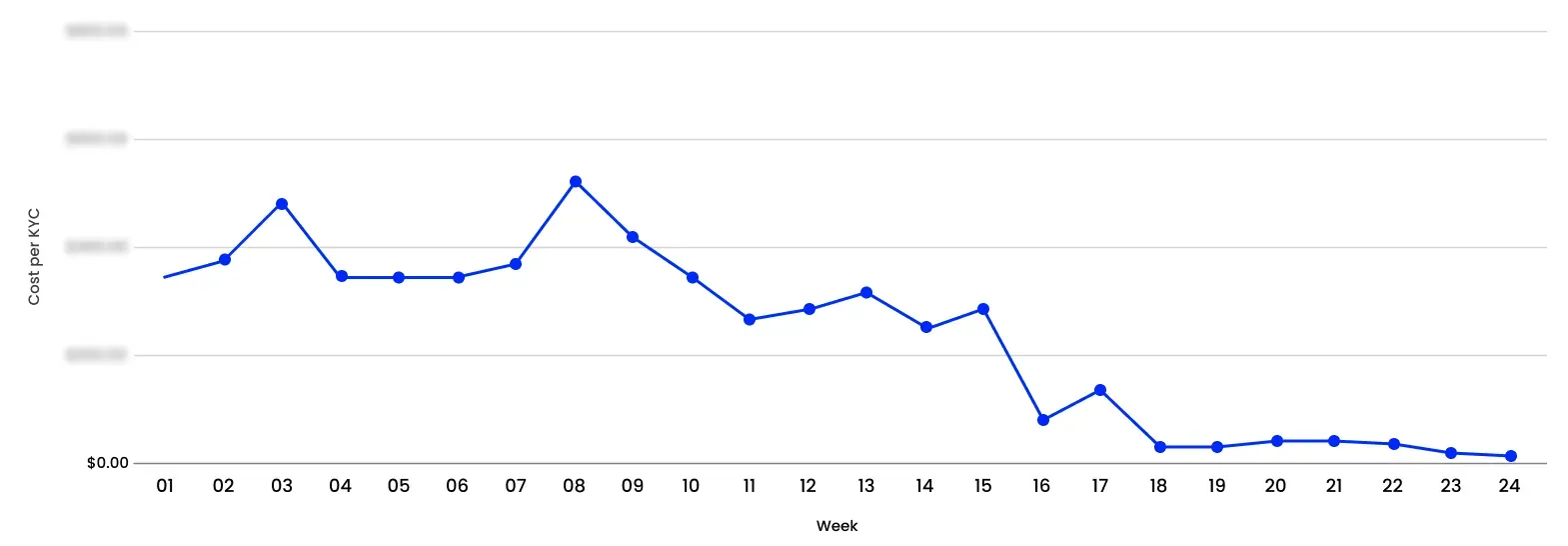
Why approval rate is a creative KPI, not a legal afterthought
Most performance teams can recite their CTR, cost per install (CPI), and return on ad spend by heart, but not their approval rate: the share of submitted creatives that clear review on first pass. That omission is exactly why approval volatility keeps taxing them. What you don't measure, you can't manage; and approval rate is a measurable, improvable creative metric.
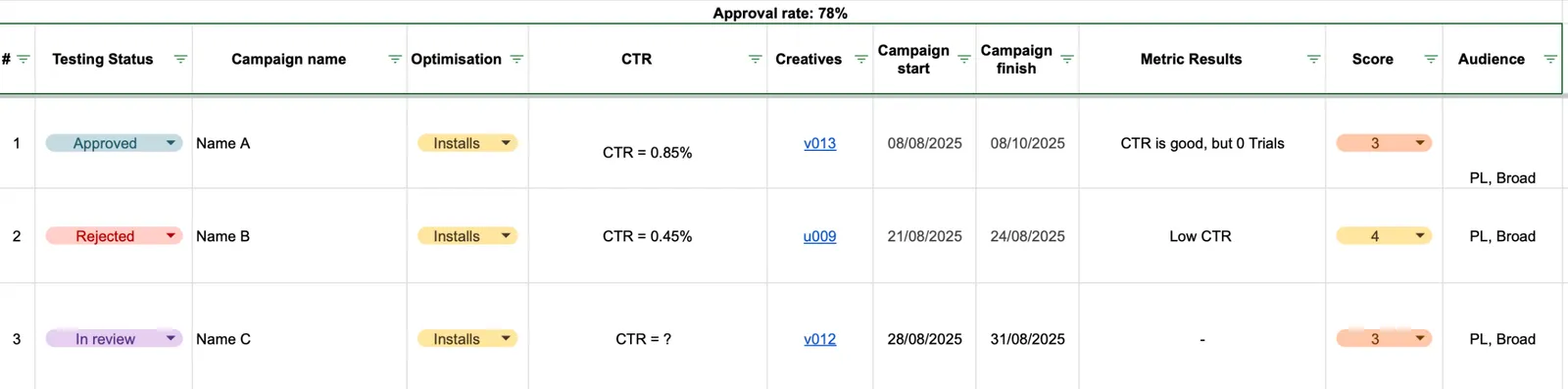
What a healthy approval rate looks like and why teams don't track it
A healthy approval rate is high and stable: most creatives clearing on first submission, with predictable behaviour when they don't. Teams don't track it because it feels like a legal or operational metric rather than a creative one, so it falls between functions. The creative team owns CTR, the ops team owns submission, and nobody owns the number that connects them. Once a team assigns approval rate to the creative function and reviews it alongside CTR, the behaviour changes fast.
Approval rate is a creative KPI, not a legal one. The moment we started measuring it like CTR, our teams stopped shipping creatives that got the account flagged.
© Artem Kuzmych, CEO at Applica
How approval volatility compounds against testing velocity
Low, unpredictable approval rates compound in the wrong direction. Every bounced creative is a delayed learning, and a pattern of bounces pushes the account toward tighter scrutiny and longer review windows, which delays the next round of learnings further. A high, stable approval rate does the reverse: it keeps the review pipeline fast, protects the account's standing, and lets you sustain the testing cadence that actually drives performance. Managing approval rate as a KPI is how you protect testing velocity over time, which is the same discipline that underpins durable performance marketing in any regulated category.
Building a creative system, not a creative pipeline
The teams that win in regulated FinTech don't have a faster creative pipeline; they have a different structure. Compliance is baked into the brief, the compliance-critical zone is held stable while the performance zone iterates at volume, and approval rate is measured and managed like any other creative number. The result is the claim we started with, restated: FinTech ad creative compliance is a testing-velocity advantage, not a brake, because baking compliance into the brief lets you test more variants, not fewer, without wrecking your approval rate.
Three takeaways to act on Monday. First, move compliance from the review queue into the brief: a standing, per-platform, per-region checklist that every concept is written against. Second, separate the compliance-critical zone from the performance zone, and spend your testing velocity on the latter. Third, start measuring approval rate as a creative KPI, reviewed alongside CTR.
If your FinTech creatives keep getting flagged and your testing velocity is paying for it, that's a production-system problem, not a bad-luck problem, and it's what our Creatives Production team is built to fix. Let's talk!