Paid user acquisition is getting structurally more expensive, and the teams feeling it first are the ones who scaled on cheap media without fixing what sat underneath. AppsFlyer projects global app-install ad spend to exceed $95 billion, with pricing inflation concentrated in finance and utility categories, and its benchmarks now put iOS non-gaming cost per install (CPI) at roughly $1.50 to $3.50. As cost per mille (CPM) and cost per acquisition (CPA) climb, sharpest in crowded categories like AI apps, the margin for a messy setup disappears.
Paid user acquisition costs have risen across platforms and categories heading into 2026
| Platform / cost metric | 2023 benchmark | 2024 benchmark or forecast | Change | Latest signal heading into 2026 |
|---|---|---|---|---|
| iOS cost per install (CPI) | $4.50 | $4.70 | +4.4% | iOS user-acquisition spend increased 35% YoY in 2025, indicating greater competition for iOS users. |
| Android cost per install (CPI) | $3.20 | $3.40 | +6.3% | Android user-acquisition spend was broadly flat in 2025 at −1% YoY, suggesting more stable pricing pressure than on iOS. |
| Meta/Facebook CPM | $14.00 | $15.00 | +7.1% | No comparable 2025 platform-wide CPM was published, but AppsFlyer expects attention scarcity to drive media-cost inflation in 2026. |
| Google Ads CPM | $10.50 | $11.00–$12.00 | +4.8% to +14.3% | No comparable 2025 platform-wide CPM was published; growing competition for mobile attention points to continued upward pressure. |
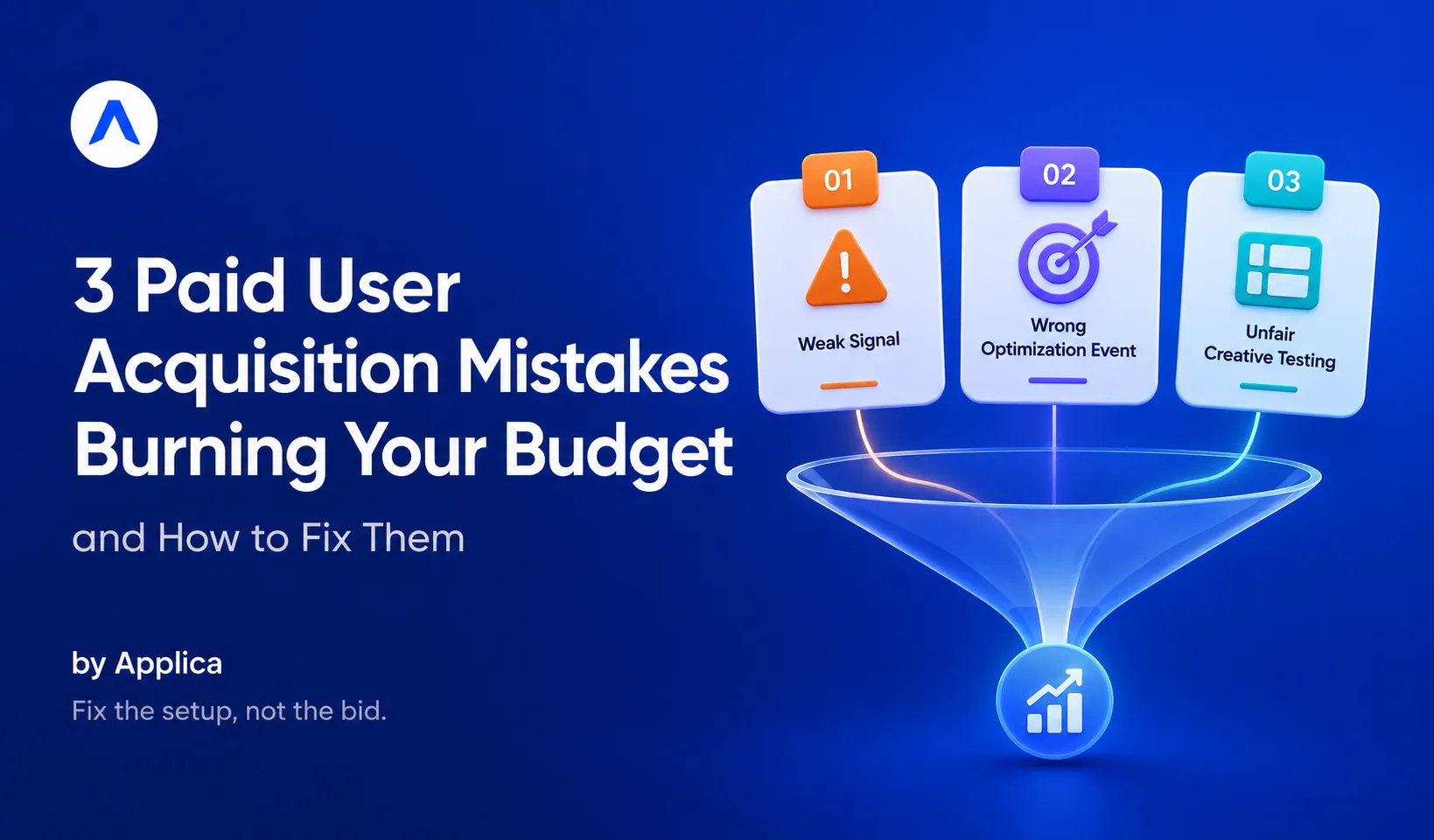
Here is the uncomfortable part: efficiency in paid user acquisition is largely decided before the auction ever runs. It's set by three things you control: the quality of the signal you send the platform, how your campaigns and optimization events are structured, and whether your creative tests are actually fair. Paid user acquisition is actually won or lost before the auction, because Meta's algorithm can only optimize on the signal quality, optimization events, and creative tests you feed it, and it won't fix a weak foundation for you.
Below are the three mistakes that quietly burn budget, and the operational fix for each.
Mistake 1: Weak tracking and poor signal quality
A large share of paid budget is wasted before a single impression is served, because the tracking foundation is feeding the platform bad data. Missing events, duplicated events, or events mapped to the wrong action all teach the algorithm the wrong lesson, and it optimizes confidently toward the wrong users. This is a problem Applica Agency has written about at length: event definitions drift silently, and confidently wrong data is more dangerous than missing data because nobody stops to question it.
What is signal quality in paid user acquisition?
Signal quality is how accurately, quickly, and completely your conversion events reach the ad platform so its algorithm can optimize toward valuable users rather than cheap ones. High signal quality means the events are correctly defined, deduplicated, consistently mapped across systems, and delivered fast enough to be useful. Low signal quality means the platform is guessing, and paying full price to guess.
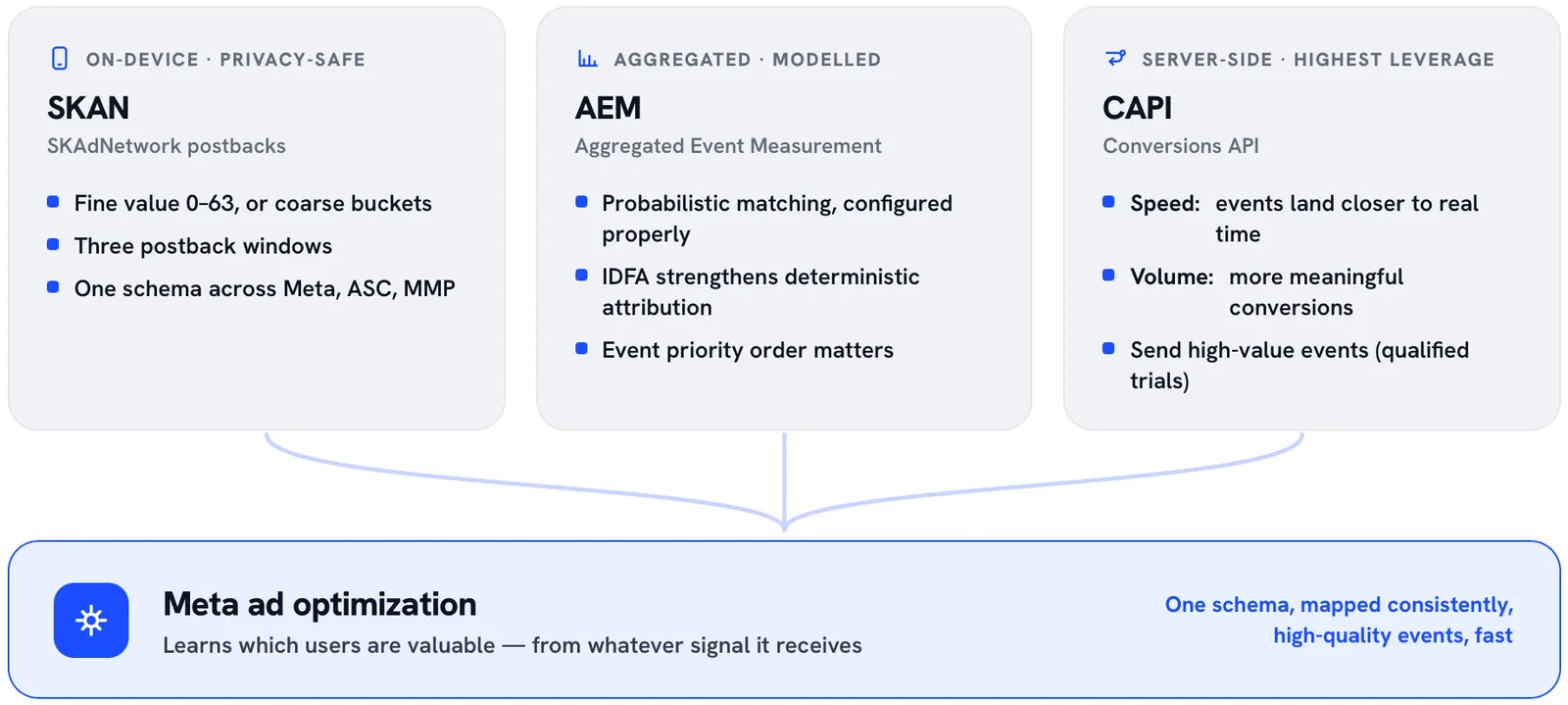
For app campaigns, the most common breakage is an inconsistent SKAdNetwork (SKAN) conversion schema across Meta, App Store Connect, and the mobile measurement partner (MMP). SKAN 4 encodes behavior into a fine conversion value (a 6-bit integer, 0-63) or coarse buckets, delivered across three postback windows, so if the schema isn't mapped identically everywhere, the platform receives weak or contradictory signal. Getting this right is exactly what structured SKAN conversion mapping is for.
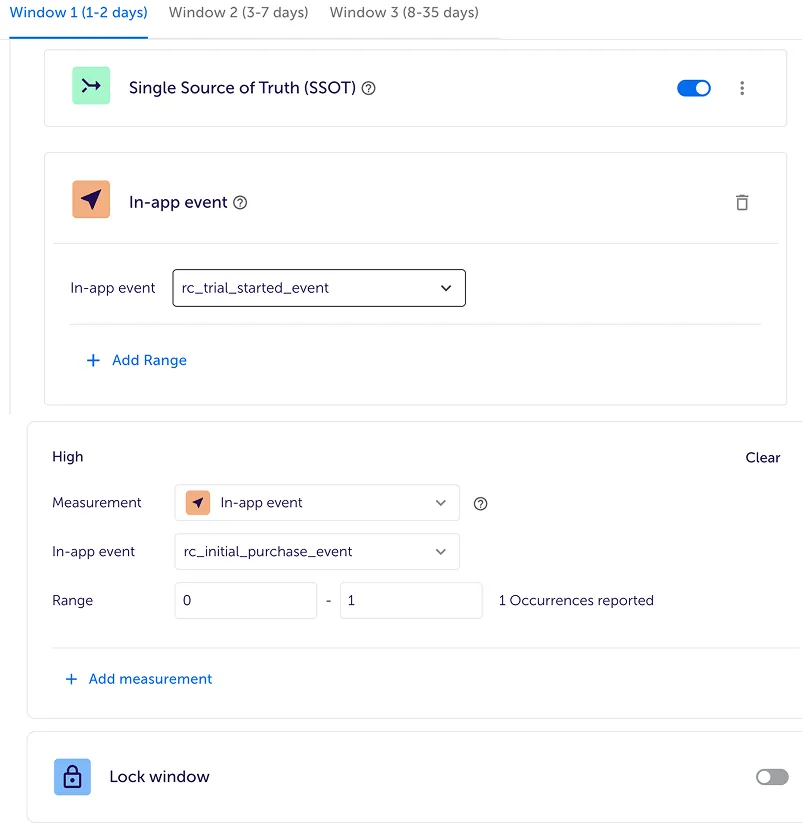
If you're running Aggregated Event Measurement (AEM) rather than SKAN, the schema isn't the main constraint, but signal quality still is: probabilistic matching should be configured properly, and where available, the identifier for advertisers (IDFA) strengthens deterministic attribution. On top of that, Meta's Conversions API (CAPI) is the highest-leverage signal upgrade most teams haven't finished. Used well, it doesn't just fire basic events, it sends higher-value ones like qualified trials, solving two problems at once:
Speed:
the event reaches Meta faster after it happens, so the algorithm learns in closer to real time.
Volume:
Meta receives more meaningful conversion signals to optimize against, which matters enormously once device-level data is restricted.
The fix isn't a new tool. It's treating measurement as infrastructure: one schema, mapped consistently, sending high-quality events fast. If your attribution itself is the bottleneck, a Direct App Campaign setup that combines web-style tracking with app-store installs often recovers signal that standard iOS app campaigns lose to modelled attribution.
Mistake 2: Poor campaign setup and the wrong optimization event
The second mistake is asking the algorithm to optimize toward an event it will never see enough of. Meta's own guidance is that an ad set needs roughly 50 optimization events per week to exit the learning phase; below that, variance is too high for the system to separate signal from noise, and the campaign stalls in "Learning Limited." Choosing the wrong optimization event is the single most common reason campaigns get stuck there.

Optimize for the event you can actually feed
If a campaign doesn't have the budget to generate around 50 conversions a week, optimizing for purchases is often the wrong call. Trials usually carry far more volume, so optimizing for trials first gives the platform enough data to learn, and you graduate to purchase optimization once the volume supports it. The principle is simple: optimize for the highest-value event you can reliably supply in volume, not the one you wish you could.
This is precisely where structure changes outcomes. Nemo, a FinTech app, cut its cost per first-time deposit (CFD) by 4x while scaling a six-figure monthly budget, not by bidding differently, but by re-architecting campaign structure around deposit events rather than installs. The optimization event was the lever.
Split testing from scaling, and structure by geo tier
Campaign architecture matters as much as the event. There should be a clean split between testing campaigns and evergreen or business-as-usual (BAU) campaigns. Mixing them makes it impossible to read what's actually working and disrupts the learning phase for both. Geo structure is the other silent leak: run a multi-geo campaign spanning different market tiers, and the cheaper countries will absorb most of the spend. You'll see cheap early conversions, but lower quality and weaker lifetime value (LTV), a campaign that looks efficient this month and erodes performance next quarter. This is the same dynamic behind why every pricing or structural change resets Meta's learning phase and quietly re-prices your delivery.
Teams keep asking the algorithm to bail out a weak setup. It won't. Meta optimizes against the signal you send it, if your events are noisy, your optimization event is wrong, or your creatives never get a fair test, scaling just buys you more of the same inefficiency, faster.
Artem Kuzmych – CEO & Co-founder at Applica
Mistake 3: A creative testing process that never gives ads a fair test
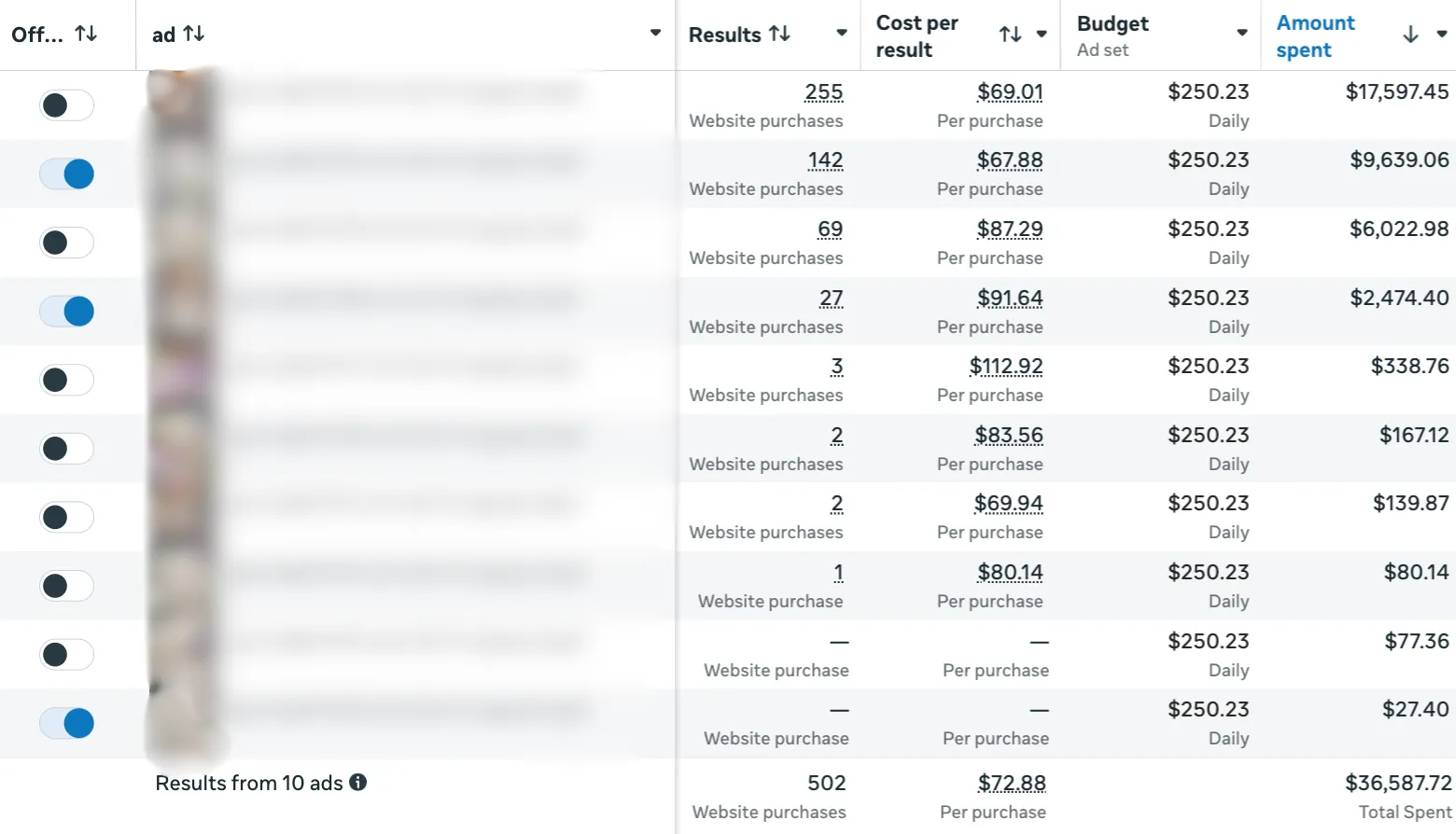
Paid user acquisition is won or lost before the auction, and creative testing is where that principle breaks most often in practice. Creative testing fails not because teams don't test, but because the test never gives every ad a fair chance to spend. Even in ad set budget optimization (ABO) or campaign budget optimization (CBO) setups, Meta tends to push most of the budget toward one or two ads early, while the rest barely deliver. The result: you can't tell which creatives are genuinely strong and which simply never got enough exposure to prove themselves.
How do you test creatives fairly on Meta?
You test creatives fairly by controlling spend distribution with automation rules, so every variant reaches a minimum spend threshold before you judge it. Fair testing means each ad gets enough delivery to produce a statistically honest read, weak ads are paused only after they've had that chance, and budget doesn't silently collapse onto an early front-runner that happened to spend first. Without those rules, "the algorithm decided" is doing a lot of hidden work, and it's usually deciding on too little data.
Get this right and the compounding is real. Drops UA scaled non-organic acquisition 40x in three months, but the growth was downstream of the infrastructure: a scalable creative testing framework and fixed measurement came first, and the scale followed. Without fair testing, the opposite happens: the creative team never gets clean learnings, testing cycles slow down, more budget is needed to reach conclusions, and Meta keeps spending on the same two ads instead of teaching you which angles, hooks, and concepts actually work.
Fix the foundation before you scale paid user acquisition
When media was cheap, a weak setup could hide for a while. As CPMs and CPAs keep rising, every weak point gets more expensive, and no amount of incrementality testing or algorithmic sophistication repairs broken event mapping, the wrong optimization event, or an unfair creative test. Incrementality can measure impact, but it can't teach the platform what to optimize for.
So sequence the work: fix signal quality first so the algorithm learns from clean data, fix campaign structure and the optimization event next so it learns from enough of the right data, and fix creative testing last so your best concepts get discovered rather than starved. That order is what turns paid user acquisition from a budget leak into a growth system.
If your paid user acquisition is scaling faster than your tracking, structure, and creative testing can support, that's where the efficiency is leaking, and where to start. Let's pressure-test your setup with Applica Agency's performance marketing team.