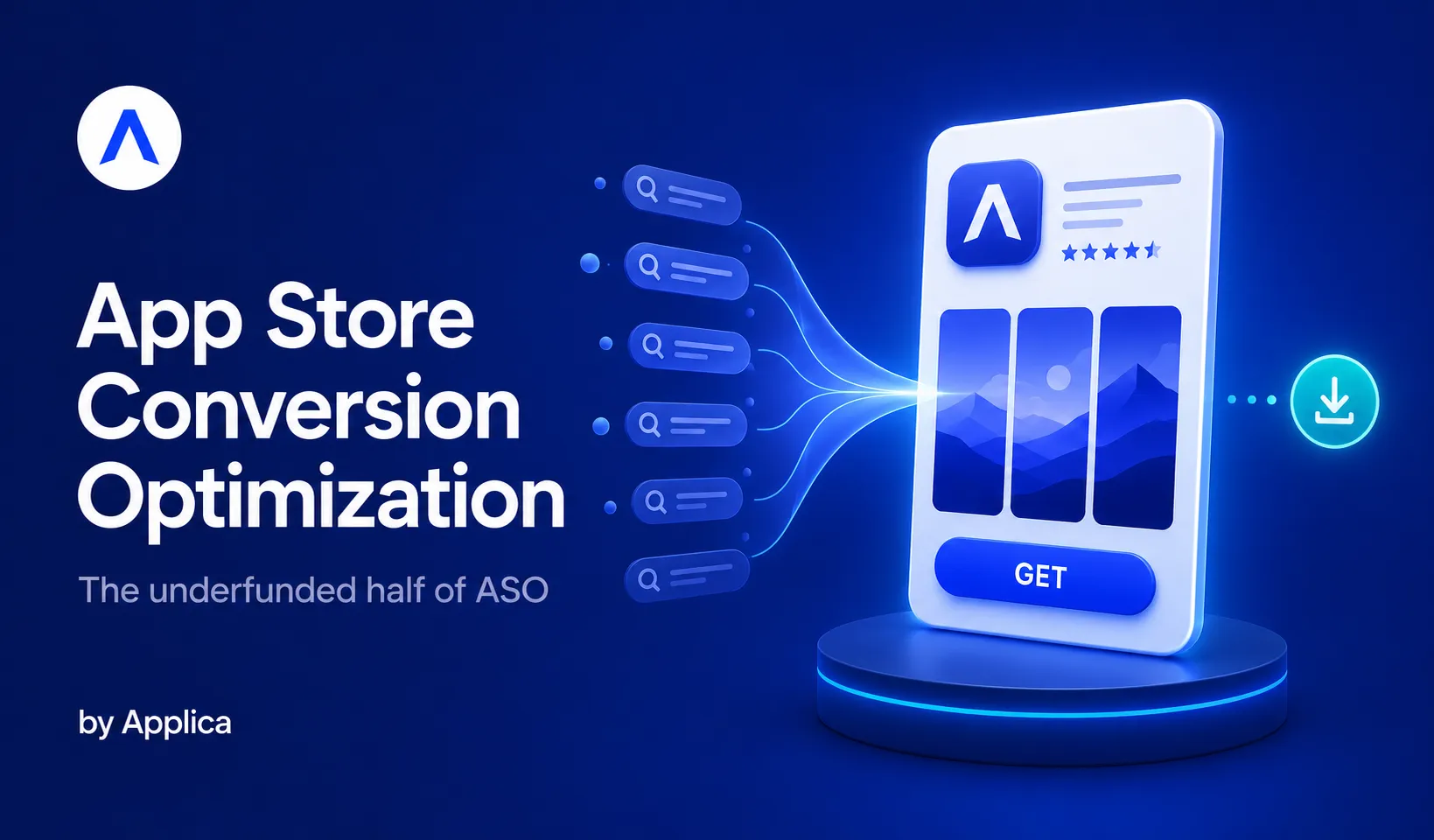
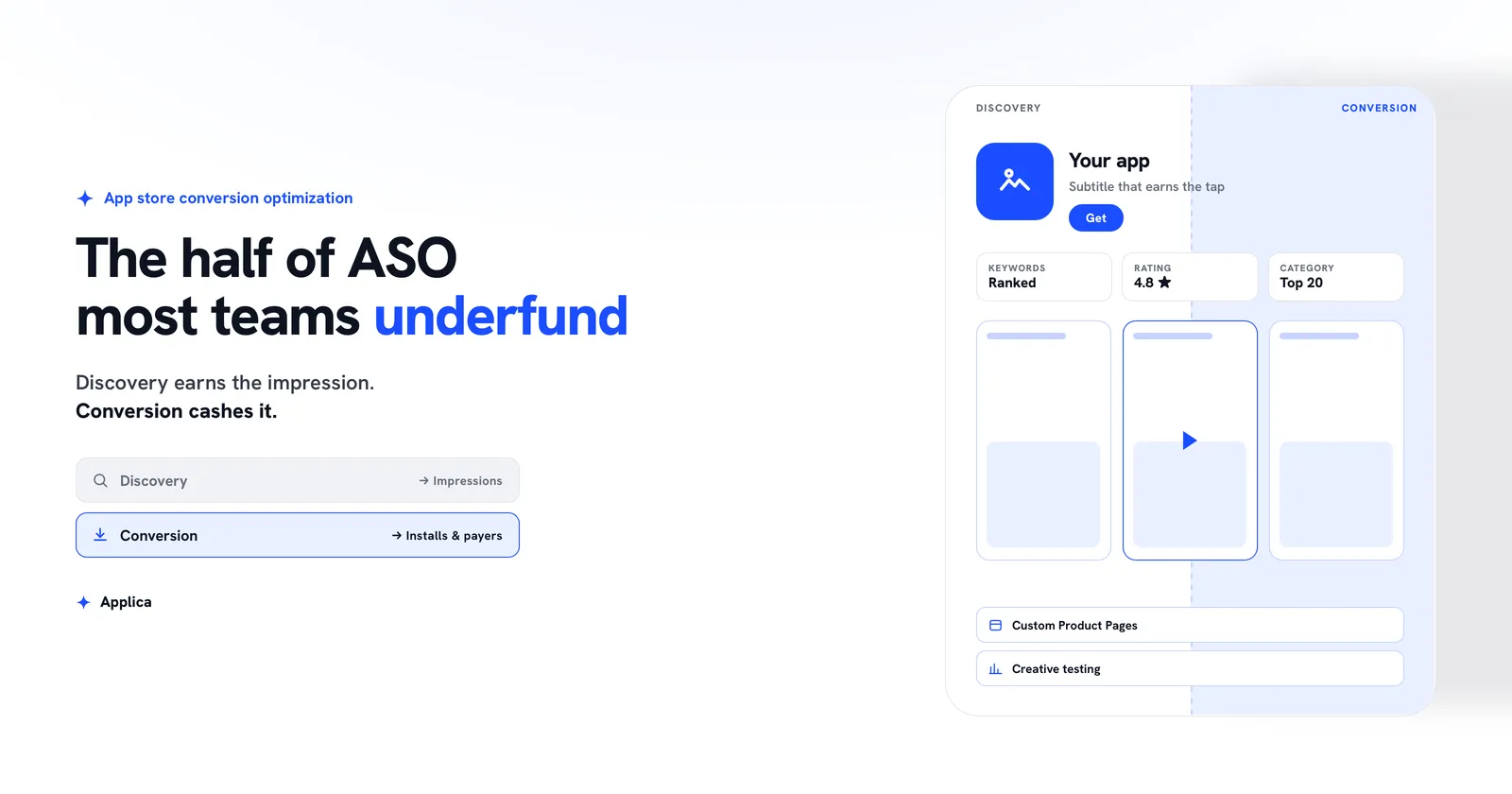
Most growth teams spend months earning an impression. They fund keyword research, tune metadata, bid on rankings, and buy paid traffic that drives users to their product page. Then they hand that hard-won impression to a store listing nobody has tested in a year. That handoff is where app store conversion optimization lives, and it is the part of the funnel most paid-heavy teams never staff.
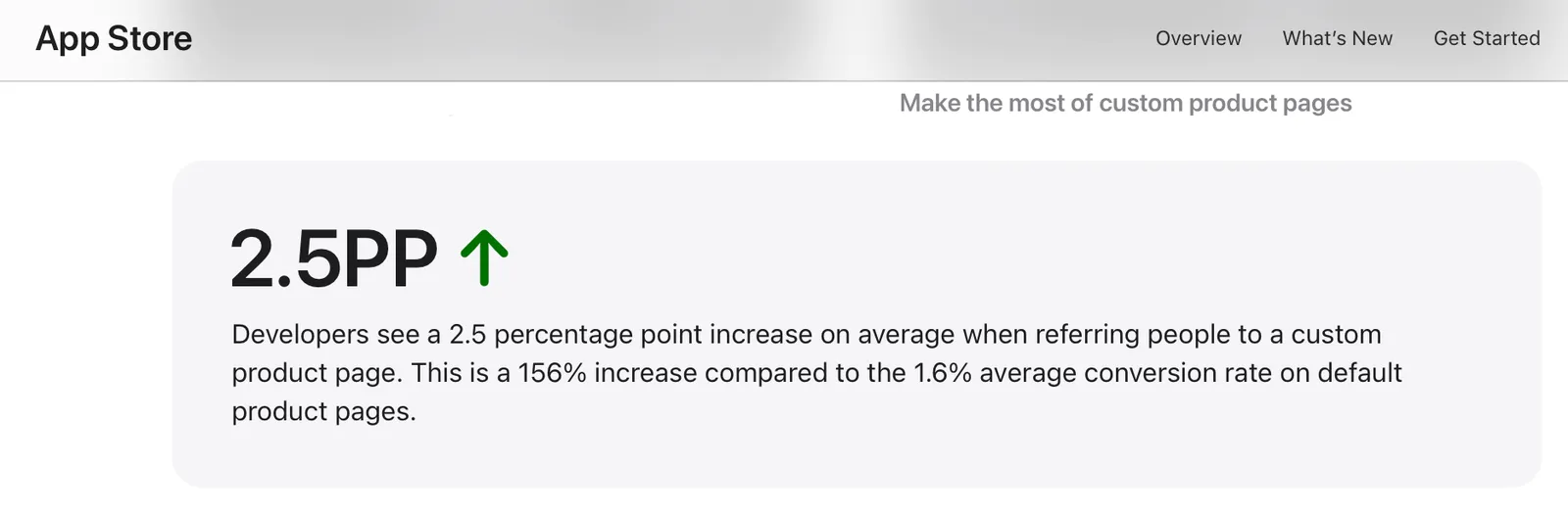
The numbers make the gap hard to defend. Apple's own data shows that referring users to a custom product page rather than a default listing lifts conversion by 2.5 percentage points on average, which Apple frames as a 156% increase over the 1.6% conversion rate of a default page. Yet across the top apps and games, most listings have never run a single test on the assets that drive that lift.
ASO has an underrated layer that decides everything: app store conversion optimization, the store-listing CRO layer that determines whether your paid and organic traffic converts, and it's not just a keyword/ranking game, because rankings only deliver impressions and the listing is what turns them into installs and paying users. This piece makes the case for treating that layer as the priority it already earns, explains why most teams underfund it, and maps what a conversion-led ASO engagement actually covers.
What app store conversion optimization actually is
App store conversion optimization is the store-listing CRO layer of ASO: the discipline of turning impressions into installs and installs into paying users by testing the creative and metadata that make up your product page. It is the second half of a system whose first half, discovery, gets nearly all the attention.
Think of ASO as two halves that operate as one engine. The discovery half covers keywords, metadata, category, and rankings. Its job is to generate impressions, to get your app in front of the right person at the right query. That half is well understood and, in most organisations, well budgeted. The conversion half covers the icon, screenshots, preview video, subtitle, Custom Product Pages, and the testing discipline around all of them. Its job is to convert the impression the first half earned.
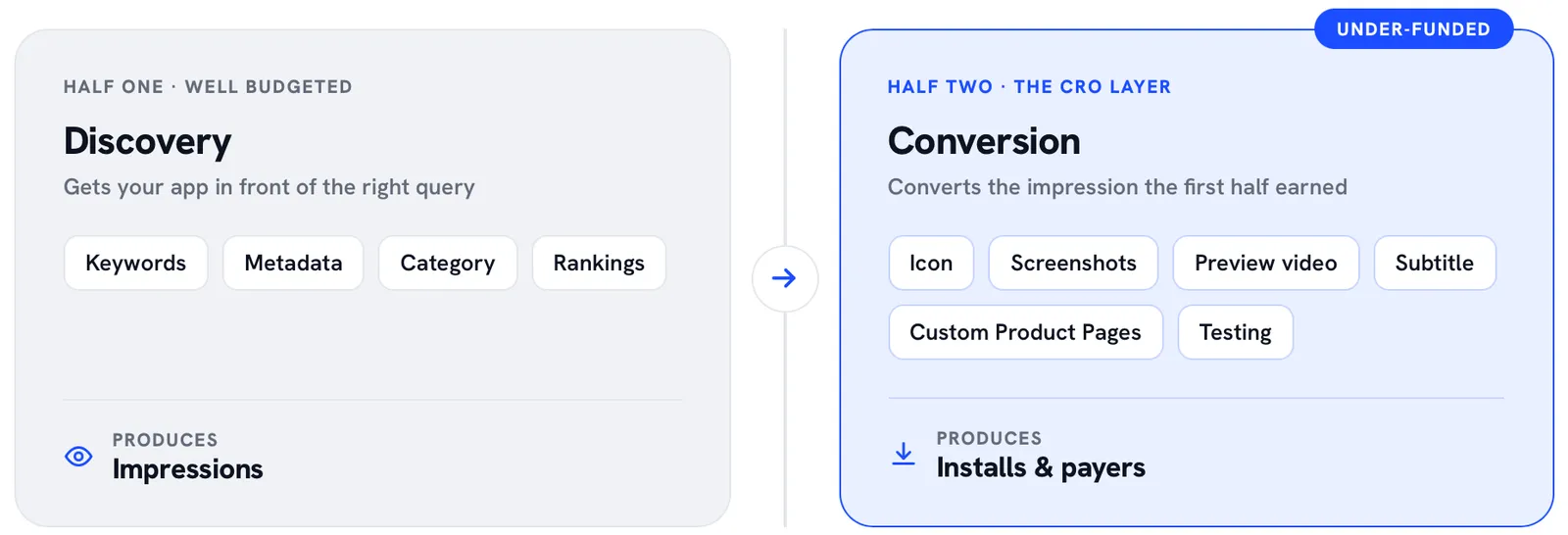
This is a both/and, not an either/or. The argument here is not that discovery is wrong or that rankings no longer matter. Rankings and metadata remain foundational, and an app that cannot be found cannot convert anyone. The point is narrower and more actionable: the conversion half is systematically under-weighted relative to the value it creates. When AppTweak measured store-listing conversion across markets, it found App Store listings converting page views to installs at roughly 8.6% in the US and Google Play at about 16.2%, with enormous variance by category. Every point of that rate multiplies against all the traffic both halves send. A listing that converts better does not just win more organic installs; it lowers the effective cost of every paid one. The mechanics of moving that rate through creative testing are covered in depth in our guide to A/B testing creatives for ASO.
Why is the conversion half of ASO chronically underfunded?
The shortfall is not a skills gap and it is not a tooling gap. Native testing tools are free, and the talent to run them is increasingly common. The real cause is organisational: it is a filing-cabinet problem.
When ASO sits in the "organic" or "SEO" column of the growth org, its conversion work never competes for budget against paid. Paid teams justify spend with ROAS and CPI. Organic teams justify effort with rankings and impressions. Because store-listing conversion has been filed under organic, it inherits the organic team's metrics and the organic team's budget ceiling, even though the asset it optimises, the product page, is the exact surface that every paid dollar also pays to reach. The result is predictable. Teams spending heavily on user acquisition (UA) pour traffic into a page they have never tested, because testing that page was somebody else's line item in a different column.
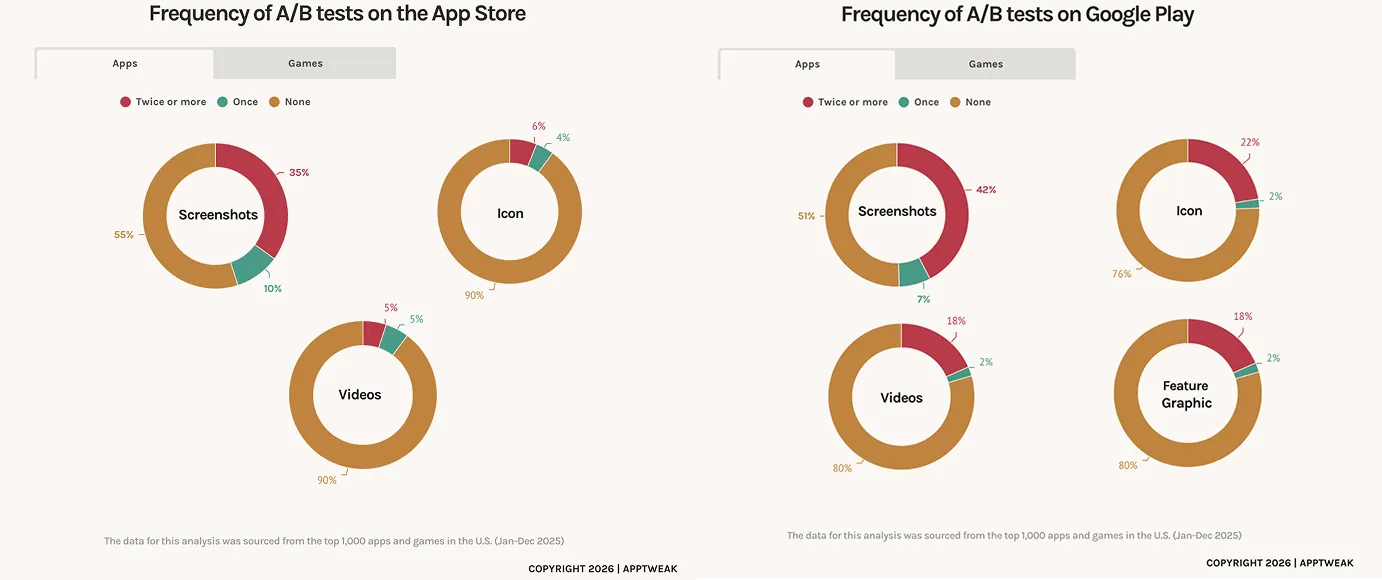
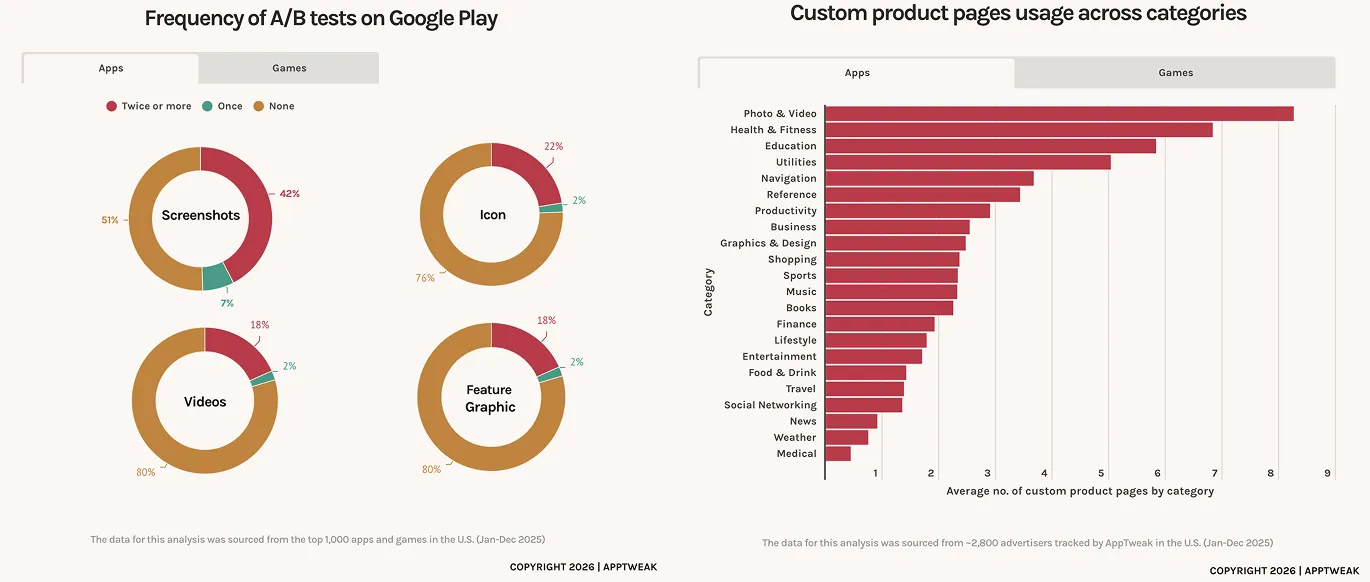
The adoption data shows exactly this pattern. According to AppTweak's ASO Trends and Benchmarks study, on the App Store only about 35% of apps and 33% of games ran two or more screenshot tests, while roughly 90% never tested their icon or a preview video at all. Google Play teams tested more, with 42% of apps and 52% of games running two or more screenshot tests, but even there most skipped icon and feature-graphic testing entirely. Custom Product Pages (CPPs) tell the same story: AppTweak found that around 69% of the top apps and 74% of the top games ran no Apple Ads campaign using a CPP, despite a measurable conversion payoff for those that did.
Mladen Crnomarković, Performance Creative Strategist at Applica, frames the diagnosis this way:
A store listing is doing two jobs at once: getting your app found, and converting the people who actually find it. Most teams stop at the first one, keywords and rankings. We're focused on the second: does the creative turn that tap into an install, and does the install actually pay? It's the last creative surface in the funnel, and the one most UA teams never test.
© Mladen Crnomarković, Performance Creative Strategist at Applica
That is the mechanism no competing article names. And it is why the reframe matters commercially. ASO has an underrated layer that decides everything: app store conversion optimization, the store-listing CRO layer that determines whether your paid and organic traffic converts, and it's not just a keyword/ranking game, because rankings only deliver impressions and the listing is what turns them into installs and paying users. Once a team sees the conversion half as a CRO responsibility rather than an SEO afterthought, the budget logic changes and the highest-ROI work stops being invisible.
What the under-funded half actually contains
Naming the conversion half is one thing; knowing what sits inside it is another. This is the inventory most paid-led teams have never audited, because they have never thought of the store listing as a creative surface they control.
The creative surfaces you own
Apple is explicit that every element of the product page shapes the download decision. The icon is the first thing a user sees and carries the first impression of quality and purpose. Screenshots, of which the first one to three appear directly in search results, carry the value proposition before a user ever taps through. App preview videos, up to three and autoplaying muted, demonstrate the product in motion. The subtitle and the first line of the description frame the promise in words. These are not static compliance assets to be filled in once at launch. They are conversion levers, and strong visual storytelling in screenshots is one of the most direct ways to lift install rate.
Custom Product Pages as the paid-to-organic bridge
Custom Product Pages are where the conversion half and the paid half meet. A CPP is an alternate version of your listing, and Apple lets you publish up to 70 additional versions, each with its own URL, so a specific ad or audience lands on a page built for that intent rather than on your generic default. Apple's published figures make the case: beyond the 2.5 percentage point average lift, it cites developer results such as a 20% conversion increase for one sports app and a 33% conversion increase alongside a 14% reduction in cost per install for a strategy game. Keep the units straight here, because these figures circulate in two forms: Apple's 2.5 points is a percentage-point gain on the base conversion rate, while AppTweak's study reports its own cut of CPP lift at roughly 3.2 points for apps and 2.8 points for games, and other sources publish relative percentages. The mechanism is the reason CPPs matter: they let paid and organic stop fighting over one compromise page, a logic we unpack in why ASO and Apple Search Ads are one system, not two channels.
None of this displaces the discovery half. The metadata that earns the impression still has to be right, and getting it right is its own discipline, covered in our best practices for app metadata. The conversion half simply refuses to let a well-ranked impression die on an untested page.
How do you test the conversion properly?
You test the conversion half with native store experiments judged on statistical confidence, not opinion. Both platforms ship the tooling for free: Apple's Product Page Optimization (PPO) and Google Play's store listing experiments. The discipline is running structured tests on real store traffic and reading the result at a defined confidence threshold, rather than shipping a redesign because a stakeholder preferred it.
On the App Store, PPO lets you test treatments of your icon, screenshots, and preview video against your live page and reports an estimated conversion rate and an estimated relative lift, flagging a variant as performing better or worse once it reaches 90% confidence. On Google Play, store listing experiments cover the icon, screenshots, feature graphic, and video, with the guidance to change one asset at a time and run long enough to absorb weekday and weekend patterns. Google Play also offers custom store listings, its analogue to CPPs, so the both/and applies across both stores. This is the testing velocity that compounds: each validated change raises the base rate that all future traffic converts against.
What this piece deliberately does not do is re-teach the step-by-step mechanics of running those tests, because Applica already documents that in detail in App Store Conversion Rate Optimization: how to improve CTR with creative A/B testing. Treat that as the tactical companion to this strategic reframe: this article argues why the work deserves funding; that one shows how to execute it.
Why app store conversion optimization is where installs and revenue are won
Conversion rate is the one lever that compounds against everything else you do. Every impression the discovery half earns and every tap the paid half buys passes through the same page, so a single point of conversion improvement multiplies across both traffic sources at once. That is why the conversion half deserves to compete for budget on equal footing: not because discovery is less important, but because the return on optimising the shared bottleneck is unusually high.
The compounding does not stop at the install, either. The second question in Mladen's framing, whether the install actually pays, is where store-listing conversion connects to monetization. A listing that sets an accurate, compelling expectation attracts users who convert further down the funnel, not just users who tap install and churn. RevenueCat's benchmarks put the stakes in perspective: in its State of Subscription Apps analysis, median download-to-paid conversion by day 35 sat near 2.2% for freemium apps and around 12% for apps behind a hard paywall, with the top decile far above both. When only a small share of installs ever pay, the quality of the users your listing selects for matters as much as the quantity it converts, and that selection is a creative decision made on the product page.
This is also why the reframe is a both/and rather than a takeover. As industry analyses of where ASO is heading make clear, discovery and conversion are converging into one practice, sharpened by AI-driven store surfaces and richer signals. The discovery half feeds the conversion half its traffic; the conversion half feeds the discovery half its winning creative concepts, the feedback loop between UA and ASO that turns paid learnings into organic gains. Underfunding either one starves the system. The point is only that, today, it is almost always the conversion half that is starved, a pattern visible in the broader app store optimization benchmarks for the year and in the practical levers that move store-listing conversion.
The audit worth running this quarter
Three takeaways for a team deciding where to put its next unit of effort. First, ASO is both halves working as one system: discovery earns the impression, conversion turns it into an install and a subscriber, and neither succeeds alone. Second, the conversion half is under-funded not because it fails to work but because of where it sits in the org chart; filed under organic, it never competes for the budget its ROI justifies. Third, the fix starts with a question you can answer this week: of the two halves, which one have you actually been funding?
The app store conversion funding gap in three numbers
2.5pp
average CPP lift (Apple)
~90%
of apps never test icon or video
~69%
of top apps run no CPP campaign.
ASO has an underrated layer that decides everything: app store conversion optimization, the store-listing CRO layer that determines whether your paid and organic traffic converts, and it's not just a keyword/ranking game, because rankings only deliver impressions and the listing is what turns them into installs and paying users. If your product page has not been tested in the last 90 days, that is where the leak is. Explore where your store listing is losing conversions with a structured App Store Optimization audit, so both halves of the system are funded like the growth engine they are.