






01
Audit, weeks 1 to 2
Ad accounts, MMP and SKAN setup, unit economics by channel, creatives, store pages and the funnel.
Deliverable: audit report
Product growth
Applica is a mobile user acquisition agency for subscription apps in FinTech, WellTech and EdTech. Its UA team plans and runs paid media on Meta Ads, Apple Ads, Google App Campaigns and TikTok Ads, produces the ad creatives in-house, and scales budgets by cost per paying user and payback period. Applica has managed $100M+ in ad spend and produced 10,000+ ads for apps such as NEMO, TouchRetouch and Drops.
Most agencies will tell you what an install costs. Far fewer will tell you what a paying user costs, and almost none will move budget on that number weekly. That is the job we take.
A senior UA lead reviews your channels, creatives, and measurement, and names the first three changes.
Clutch 5.0
19 reviews
$100M+
ad spend managed
10,000+
ads produced
Business of Apps, Top App Marketing Company 2024
Four examples of our app user acquisition services, each with the numbers the client used to judge them.

Almost the entire Apple Ads budget was defending the brand. We rebuilt the account around non-brand search and custom product pages. Non-brand share of spend went from 5.8% to 31.2%, installs rose 52.2%, revenue rose 41.3% and cost per trial fell 21.3%, comparing 1 March to 15 May 2026 against 15 December 2025 to 28 February 2026.

A fintech app scaling in the Middle East and Nigeria, where installs grew but deposits did not. We fixed iOS attribution first, then rebuilt the creative pipeline around cost per deposit. Cost per deposit fell 4x overall, 8x on Meta and 3x on Google Ads, with 700+ creatives produced. FinTech app marketing

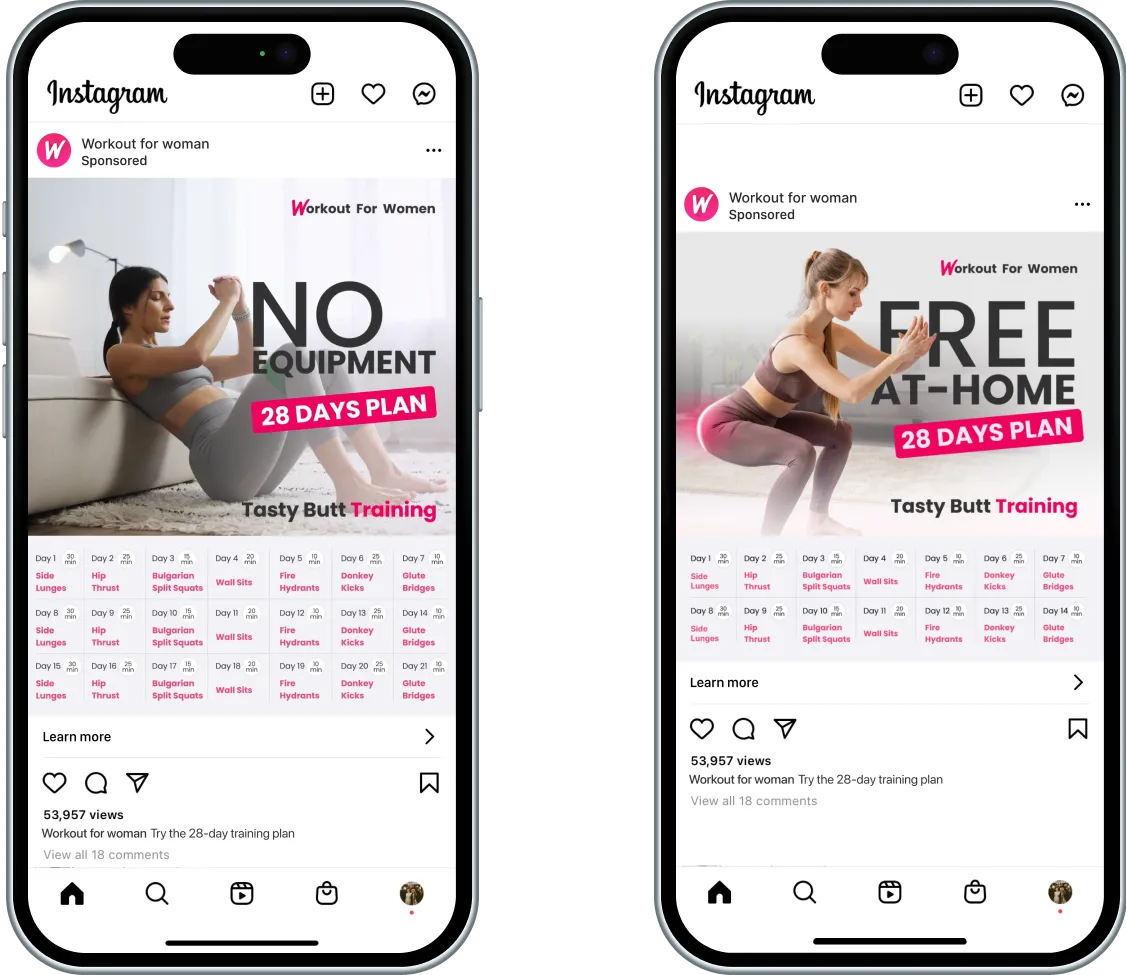
Growth had hit a ceiling: one funnel, one creative approach. We combined Meta campaigns with web funnels and a weekly creative cycle. Subscriptions grew 27x, cost per acquisition on the web funnels fell 5x, and 200+ creatives were produced between July and October 2024. WellTech app marketing

A language learning app that needed non-organic growth without losing return on spend. We rebuilt the SKAN model in Singular first, then scaled. Non-organic users grew 40% quarter over quarter, non-organic ARPU rose 62%, average ROAS held at 130% and above, across 70+ creative concepts. EdTech app marketing
Paid growth rarely stops because the budget ran out. It stops because one part of the system cannot take more money. Five breakpoints cause most of it.
The business cost is the same in every case: cost per payer rises, payback stretches, and budgets get cut before campaigns finish learning.
The market is not getting easier. AppsFlyer's Top 5 Data Trends Report found that non-gaming apps spent $53B on paid user acquisition in 2025, up 18% year over year, and that iOS spend inside non-gaming grew about 40%. More money is competing for the same users. Source: AppsFlyer, Top 5 Data Trends Report.
We fix the system first: channels, creatives, store pages and measurement. Then we add budget.
Book a strategy callOne channel carries the spend
Meta takes 80% of the budget and sets the blended CAC. Every budget increase buys a worse user, because the channel is already deep into its own audience. There is nowhere to move money to, so the only lever left is bidding.
Apple Ads budget goes to your own brand
Brand keywords look efficient because those users were going to find you anyway. When we took over TouchRetouch, 94.2% of Apple Ads spend was going to brand terms. Non-brand search, where new users actually are, had 5.8%.
Creatives fatigue faster than the team replaces them
One concept carries the account, frequency climbs, CPA follows. Without a pipeline producing and reading tests every week, the team is always reacting to a decline that started two weeks ago.
iOS measurement hides the real cost per payer
After ATT, the ad platform, the MMP and your revenue data disagree. Campaigns get judged on CPI because cost per trial is not trustworthy, and the wrong campaigns get scaled.
Paid traffic lands on a page built for someone else
The ad promises one thing, the store listing was written for organic search, and the web funnel was built for a different audience. A third of the money is spent before the user reaches the product.
Our mobile app user acquisition services help subscription apps buy installs that turn into trials and paying users. They cover channel strategy, campaign management, ad creative production, custom product pages, web-to-app funnels, measurement and weekly budget reallocation. The methodology behind them lives on our performance marketing for mobile apps page.
Most apps scale one channel until it stops working. We set the channel mix, the geos, the budget split and the KPI targets up front, so the second and third channels are ready before the first one saturates.
Daily optimisation against CAC, ROAS and payback rather than against CPI. Budget moves by marginal return: the question is never what performed best last month, but where the next dollar earns most.
UGC, statics and video produced by our own team, tested in structured batches. Read more: ad creative production.
The store page is the last screen before the install, and most paid traffic lands on one written for organic search. We build custom product pages that match the ad the user just saw.
For Meta and TikTok traffic, a web onboarding and checkout step can both lift conversion and restore first-party data. Read more: web-to-app funnel.
MMP setup and audit, SKAN conversion values, Meta AEM, and one reconciled revenue view. Read more: A/B testing and data analysis.
Weekly decisions, documented. You see which cohorts paid back, what we moved and why, before the next week starts.
As a mobile app user acquisition agency we run four core channels and test beyond them once the economics hold.
| Channel | Role in the mix | Best for | Main KPI |
|---|---|---|---|
| Meta (Facebook, Instagram) | Main scaling channel, broad targeting led by creative | Volume at a controlled cost per trial | Cost per trial or purchase |
| Apple Ads | High-intent App Store search, brand defence plus non-brand growth | Users already searching your category | Cost per trial, ROAS |
| Google App Campaigns | Android scale and iOS reach across Search, YouTube and Google Play | Breadth beyond social | Cost per in-app event |
| TikTok | Younger audiences, UGC-led creatives | New creative angles that travel back to Meta | CPA |
| Snapchat Ads, Reddit Ads, Pinterest | Tests for specific audiences | Niche verticals and communities | CPA |
| Moloco, Unity | Programmatic scale once core channels saturate | Incremental volume at target ROAS | ROAS |
Which channel comes first depends on your platform split, your price point and how much creative your team can feed. We wrote the sequencing logic here: which paid channels to run first, and the Apple Ads against Meta comparison here: Apple Search Ads vs Meta Ads.
On Meta and TikTok, creative is the targeting. Our creative team sits inside the mobile UA agency work rather than next to it, so the people reading the test results brief the next batch.
How it runs: 10,000+ ads produced to date, 3 to 4 variations per concept, first read after 24 to 48 hours, new batch every week. Formats are UGC, statics and video.
Creative learnings travel across channels. On a navigation app we ran, a video that won on Meta became the first screenshot of an Apple Ads custom product page. Cost per purchase fell 64% and CPM fell 45%.
Read more: ad creative production and how to test ad creatives on Meta.
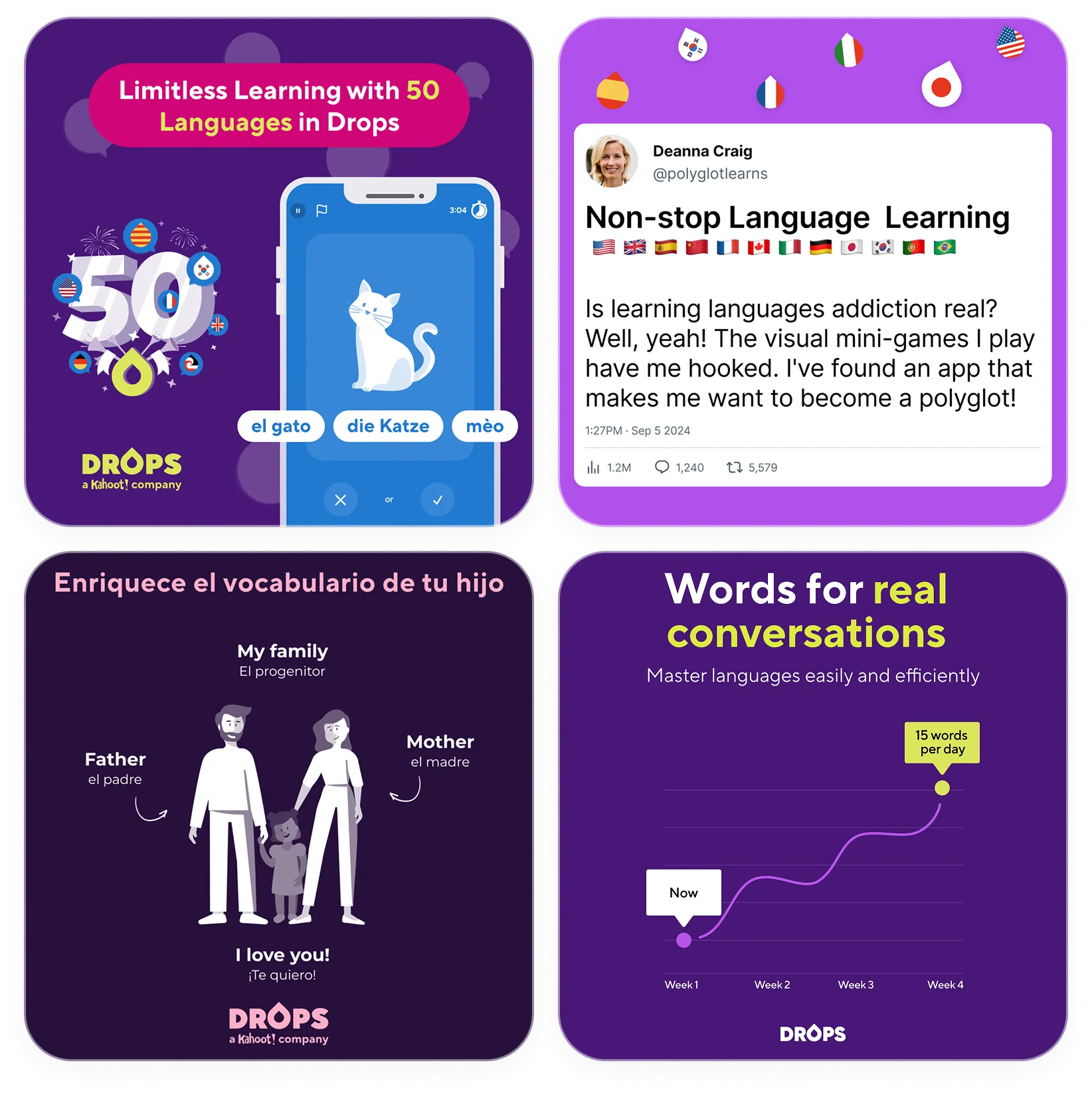
If you no longer trust your channel dashboards, you are right not to. Any app UA agency should rebuild measurement before adding budget. We do it in the first two weeks.
The experiment design behind this sits in A/B testing and data analysis.
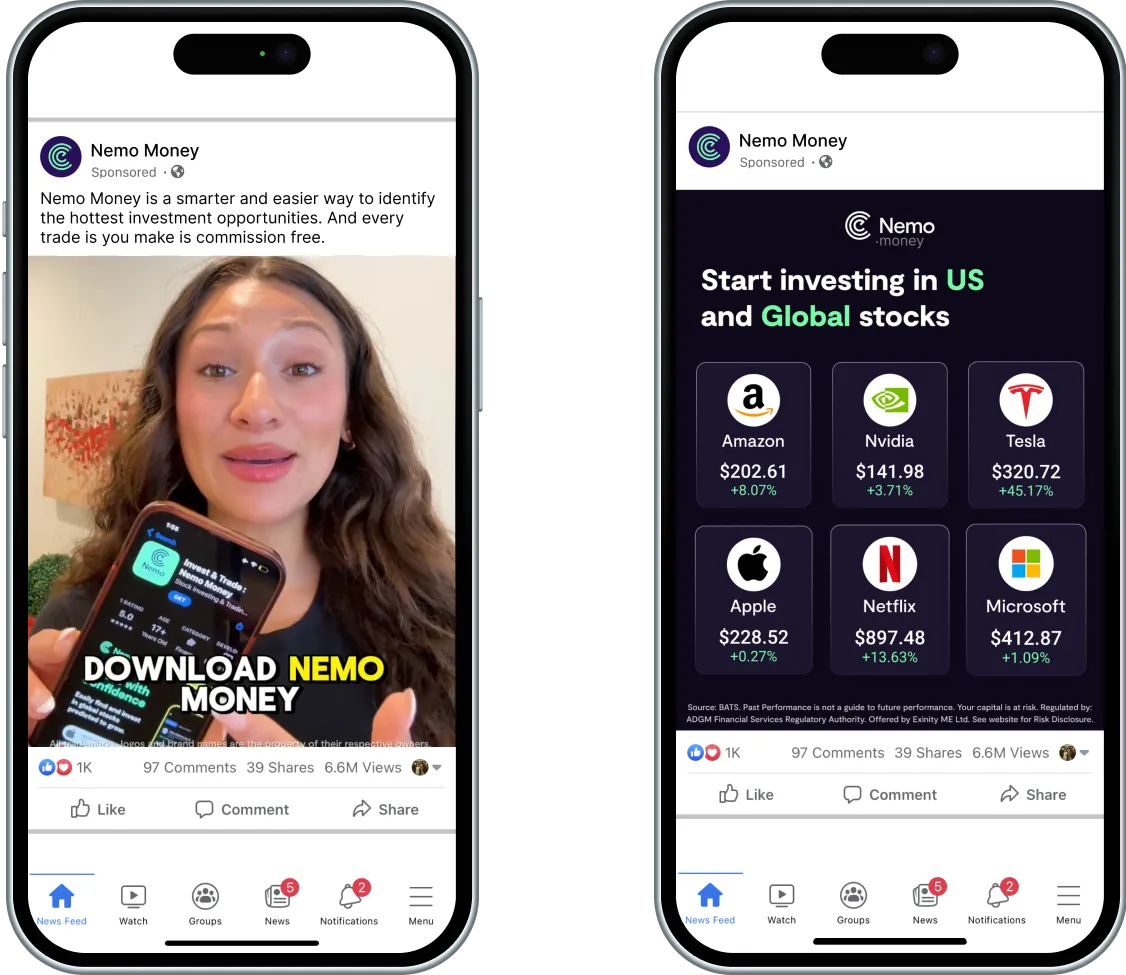
For NEMO we fixed iOS attribution problems that were inflating CPAs before touching the budget. For Drops we rebuilt the SKAN model in Singular before scaling Meta, Google and Apple Ads.
MMP audit and setup: AppsFlyer, Adjust, Singular
SKAN conversion value schema and Meta AEM
Probabilistic modelling combined with SKAN and AEM in one view
Reconciling ad platform, MMP, RevenueCat and product analytics data. Read more: reconcile Mixpanel, RevenueCat and Stripe data
Cohort reporting: cost per trial, cost per payer, ROAS on day 7 and day 30, payback
Three ways to run paid acquisition, and each fits a different stage.
An in-house UA team gives you the most control and keeps every learning in the company. It works when you can staff UA, creative and analytics, and spend enough to keep all three busy.
A freelance media buying specialist is the cheapest way to run one channel well. The model breaks when the problem sits between channels, creative and measurement, because nobody owns the number in the middle.
A user acquisition agency gives you several channels, creative volume and measurement at once, from a team that has already made these mistakes on other apps.
| Criteria | In-house UA team | Freelance buyer | UA agency |
|---|---|---|---|
| Time to launch | 2 to 4 months of hiring | 1 to 2 weeks | 2 to 3 weeks |
| Monthly cost structure | Fixed salaries | Hourly or per channel | Retainer, plus a share of spend at scale |
| Channel coverage | Limited by headcount | One channel | Four or more in parallel |
| Creative capacity | Depends on a designer | Usually none | Weekly batches in-house |
| Measurement expertise | Depends on the data hire | Rare | Built in |
| Knowledge retention | Stays in the company | Leaves with the contract | Documented and handed over |
| Main risk | Slow to assemble, expensive to be wrong | No owner of the full funnel | Weak fit if the agency is channel-only |
Our take: build in-house when you can staff all three roles and keep them busy. Use a freelancer when the gap is one channel. Bring in an agency when you need channels, creative volume and measurement at the same time.
We also work next to an in-house UA manager rather than replacing them, taking the channels or the creative volume the team cannot cover. We do not work as outstaff.
What stays yours. The ad accounts, the MMP, the creative files and all the data belong to you. We work inside your accounts. Where it helps scaling, for example to get past new-account limits on Meta, we can also run spend through our own accounts.
Our mobile user acquisition services are priced on one model. Our fee is a fixed monthly retainer. Once monthly ad spend passes $30,000, we add a percentage of that spend on top, so the fee follows the budget we manage rather than the hours we log.
What sets the retainer: how many channels you run, how many markets, how much creative volume you need each month, and whether we also take the store page and the funnel.
On budget: meaningful creative testing on a social channel like Meta needs roughly $10,000 a month per funnel, which is the practical floor for readable results. Most of the apps we work with spend $30,000 a month or more.
Before any of that, check the maths yourself with our LTV:CAC calculator.
Full UA management across all channels
UA plus ad creative production
Working next to your in-house UA manager, taking the channels or creative volume the team cannot cover
This is how work with an app user acquisition agency should start: diagnosis before spend.
More on how we run engagements: how we work.

This is how work with an app user acquisition agency should start: diagnosis before spend.
More on how we run engagements: how we work.
01
Ad accounts, MMP and SKAN setup, unit economics by channel, creatives, store pages and the funnel.
02
Targets for cost per trial, cost per payer, ROAS and payback, plus the rules for scaling and cutting spend.
03
Account structure rebuilt, first creative batch live, measurement fixes shipped.
04
Budget moves to the winning channels, geos and creatives. Custom product page tests start.
05
A new channel or a new market, a web-to-app funnel, and a review with your team.
Tell us what you spend each month, which channels you run, and what a paying user costs you today. We will tell you which part of the system is capping the budget and what we would change first.
A senior UA lead replies within one business day. The first call is a working session on your accounts, not a pitch.
We are not looking to run one more campaign. We are looking for apps where fixing channels, creatives, store pages and measurement together moves the cost per payer.
They showed a good blend of experience in the team setup, and the quick turnaround in activating campaigns was impressive.
 Pras Murukesvan Growth Marketing Head at Nemo Money
As a mobile app user acquisition company we sit inside a wider growth team. The full picture is on our app marketing agency page.
The same company runs your paywall and onboarding experiments, 500+ of them to date. Cheaper installs cannot hide weak conversion when one team owns both ends.
10,000+ ads produced, 3 to 4 variations per concept, a new batch every week. No waiting on an external studio between tests.
Search term data from Apple Ads feeds the store page, and store page tests feed the ad creative. On TouchRetouch those syncs ran every two weeks.
$100M+ in ad spend managed across Meta, Apple Ads, Google App Campaigns and TikTok.
FinTech, WellTech and EdTech, 50+ apps in Tier-1 markets. We do not run mobile games or e-commerce, so every benchmark we hold comes from apps with trials, paywalls and renewals.
Business of Apps, Top App Marketing Company 2024. Clutch 5.0 from 19 reviews.
A mobile user acquisition agency plans, buys and optimises paid media so an app gets users who pay. That covers channel strategy, campaign management on Meta, Apple Ads, Google App Campaigns and TikTok, ad creative production and testing, and the measurement underneath. A good one is judged on cost per paying user and payback, not on installs.
We set up measurement before scaling spend: an MMP audit, a SKAN conversion value schema, Meta AEM, and probabilistic modelling read together in one view. Then we reconcile ad platform, MMP, RevenueCat and product analytics data, and report by cohort: cost per trial, cost per payer, ROAS on day 7 and day 30.
It depends on your platform split, price point and creative capacity. Meta usually comes first for iOS subscription apps because creative volume moves it fastest. Apple Ads comes early when category search demand is real. Google App Campaigns leads on Android. We rarely recommend starting with more than two.
UA services are the acquisition half: buying installs and first conversions across paid channels. Performance marketing is the wider discipline, including retention campaigns, web funnels and the measurement model around them. Our methodology sits on the performance marketing page, while this page is the UA offer itself.
We charge a fixed monthly retainer, and once monthly ad spend passes $30,000 we add a percentage of that spend on top. The retainer is set by how many channels and markets you run and how much creative volume you need. Most of the apps we work with spend $30,000 a month or more on media.
There is no hard minimum. In practice, meaningful creative testing on a social channel such as Meta needs about $10,000 a month per funnel, so that is the practical floor. Most of the apps we work with spend $30,000 a month or more, which is also where our fee starts including a percentage of spend.
Yes, in-house. Our creative team works inside the UA team, producing UGC, statics and video in batches of 3 to 4 variations per concept, every week. We have produced 10,000+ ads and ship a new batch every week. If you have an internal creative team, we brief them instead and keep the testing cadence.
You do. The ad accounts, the MMP, the creative files and all campaign data stay yours, and we work inside your accounts. Where it helps scaling, for example to get past new-account spend limits on Meta, we can also run budget through our own accounts alongside yours.
Two to three weeks from kickoff in most cases. Weeks one and two cover the audit, the KPI model and the measurement fixes, and the first restructured campaigns with a fresh creative batch launch in weeks three and four. Where accounts and tracking are already clean, it is faster.
Yes, and it is a common setup. We take the channels or the creative volume your team cannot cover and work from the same KPI model, with one shared reporting view. Everything we build is documented and handed over. We do not work as outstaff.
Client feedback
The quality of their work is the best I’ve seen. Thanks to Applica, I've seen a 30% increase in product page views and downloads, as well as great improvements in revenue.

Morgan Trudeau
CEO at Magnify Technologies
Client feedback
Applica has a quality team that truly wants to be an extension of our business.

Andy McBride
Owner at Meal Plan App
Client feedback
Applica Agency is more knowledgeable in this area than most other providers we've used in the past.

Michael Brandon
CEO of Slumber Group
Let’s work together
Client feedback
The quality of their work is the best I’ve seen. Thanks to Applica, I've seen a 30% increase in product page views and downloads, as well as great improvements in revenue.
Morgan Trudeau
CEO at Magnify Technologies
Client feedback
Applica has a quality team that truly wants to be an extension of our business.
Andy McBride
Owner at Meal Plan App
Client feedback
Applica Agency is more knowledgeable in this area than most other providers we've used in the past.
Michael Brandon
CEO of Slumber Group
Paid acquisition on Meta, Apple Ads, Google and TikTok, scaled against payback rather than install volume.
Ad creatives briefed from user research, produced and tested until the winners cut your cost per subscriber.
More organic installs from the App Store, Google Play and AI assistants, measured in search downloads rather than keyword positions.
Thank you for subscription
to Applica Digest!
The latest mobile growth insights will be
delivered straight to your inbox
