Meta's Andromeda update quietly changed what a creative test is for. When the retrieval engine started reading the creative to decide who sees an ad, the unit of a test stopped being a cosmetic tweak and became a distinct concept. That is the context every operator needs before asking how to test ad creatives on Meta, because the old habit no longer produces a read. Launching eight near-identical variants, same scene, swapped font, two words changed, is not a test. It is one idea wearing eight outfits, and near-duplicates now teach the delivery system very little about what actually resonates.
The stakes are practical. Creative is the primary lever the algorithm judges, and the minimum viable volume of distinct creative you need is now a function of your monthly spend, not a fixed number. So here is the position this piece defends: testing ad creatives on Meta is actually a structure problem, not a volume problem, because isolating one distinct concept per broad ad set and waiting for mature trial data is what produces a real read, not launching fifty variants and guessing. What follows is a five-step methodology, plus the operating discipline that makes the read trustworthy: a pre-committed kill threshold and the patience to harvest winners from mature data.
Why Andromeda changed what a creative test even is
Andromeda is Meta's machine-learning retrieval engine: the first stage of ad delivery, which narrows tens of millions of eligible ads down to a few thousand candidates before the auction runs. In Meta's own description, it was built to learn higher-order interactions between people and ads, and to handle the exponential growth of creatives that automation and generative tools produce. The operational consequence is the part that reorders your priorities: the creative is now a primary input the system reads to decide who is a match, which is the same shift we unpacked in why creative strategy is now the growth lever.
This is where the numbers get fragile, and where discipline matters. Several agency analyses, led by TheOptimizer's Andromeda playbook and echoed by admetrics.io and Recharm, describe a "Creative Similarity Score" above roughly 60% triggering retrieval suppression, and suggest something like 8 to 12 distinct concepts a month as a baseline output under modest budgets. Treat those as third-party estimates, not platform fact. Meta does not publish a Creative Similarity Score or a 60% threshold in its Andromeda documentation, so quoting the figure as Meta's own would be a fabrication. The qualitative point survives without the number: near-duplicate creatives compete for the same slot and reveal little, so distinct concepts, not variations, are what a post-Andromeda test should contain.
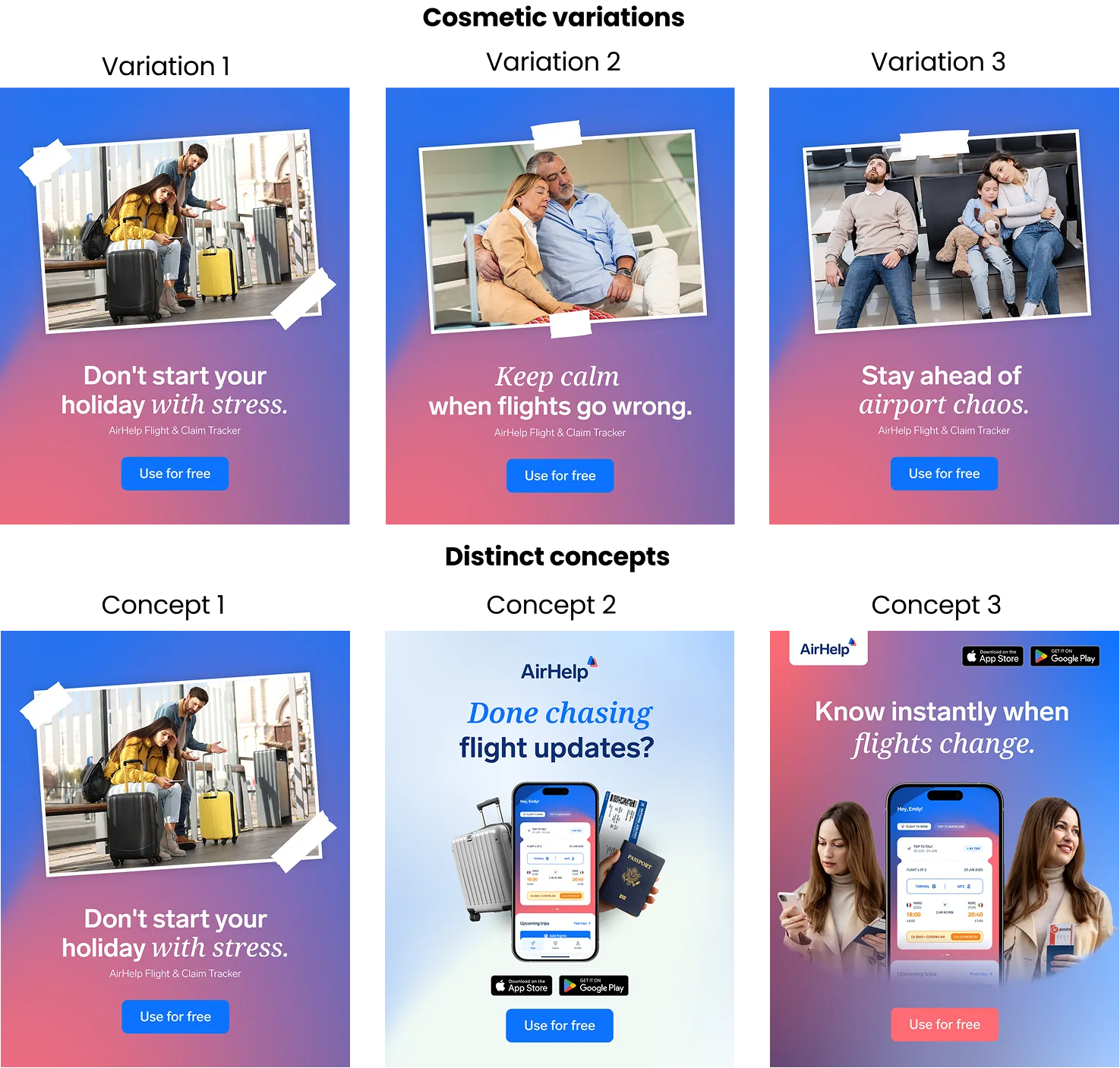
That distinction is the whole game. A test is only as good as the difference between the things you are comparing.
How do you test ad creatives on Meta?
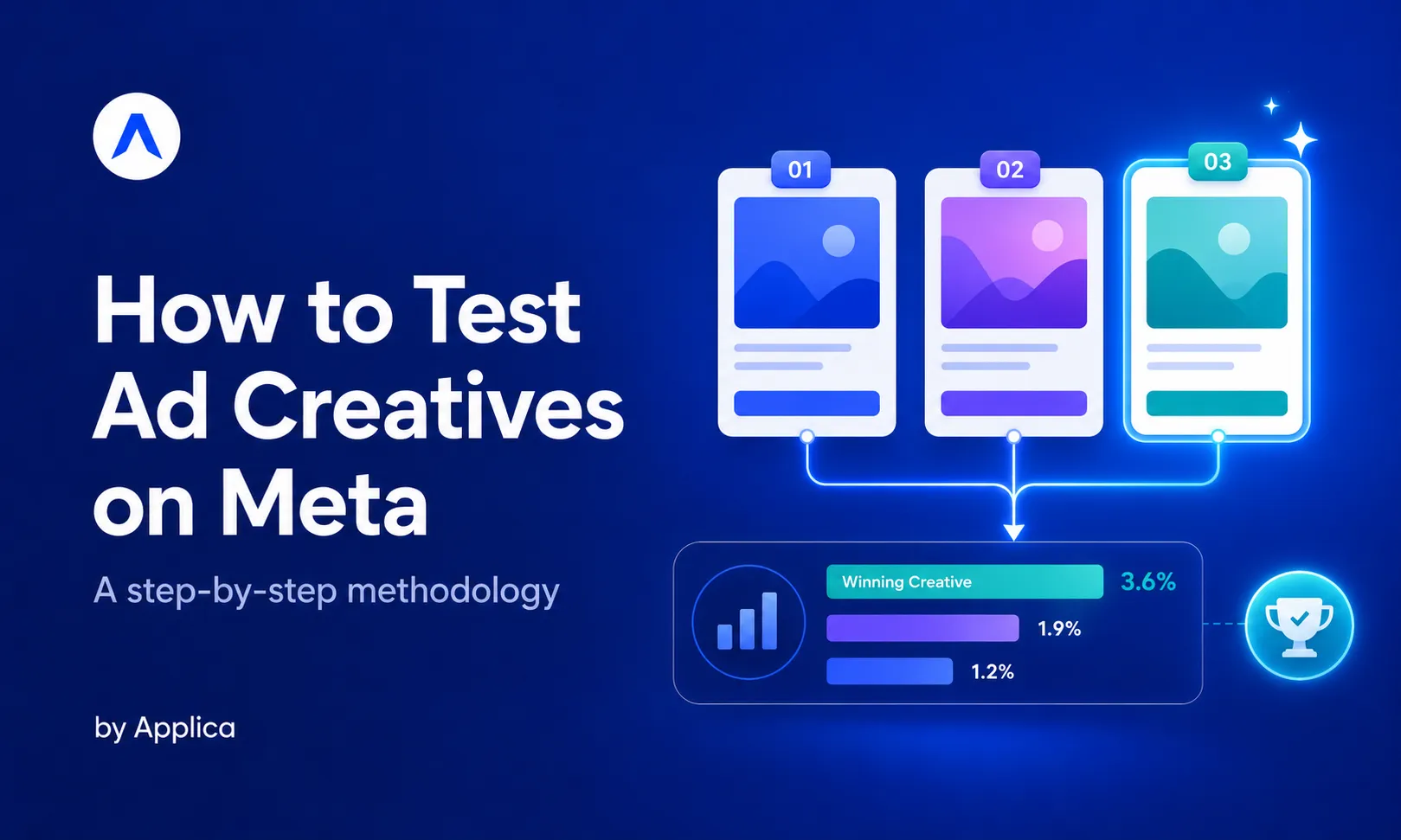
You test ad creatives on Meta by turning each creative into a hypothesis, giving every distinct concept its own broad-targeted ad set inside the live campaign, funding each concept to a minimum spend so it gets a fair read, judging results across the whole funnel rather than on early engagement, and killing losers at a pre-committed spend threshold so winners are harvested from mature data. Five steps, one principle underneath them: isolate the creative as the single variable, then let enough data accumulate to trust the result.
This is the point worth restating plainly, because it is the difference between learning something and burning budget: testing ad creatives on Meta is actually a structure problem, not a volume problem, because isolating one distinct concept per broad ad set and waiting for mature trial data is what produces a real read, not launching fifty variants and guessing. The steps below build that structure.
How to test ad creatives on Meta, step by step
Step 1: Start from a hypothesis, test concepts not variations
Every creative you put into a test should answer a question you have written down first. Does this audience respond to a time-saving angle or a status angle? To a problem-first hook or a result-first one? To a founder's voice or a customer's? A concept is a hypothesis made visible; a variation is the same hypothesis restyled. Producing 30 executions of one idea is production. Producing 10 genuinely different concepts, each testing a specific belief about your buyer, is a test.
The reason this matters more now is corroborated from outside the platform. Nielsen's analysis of advertising effectiveness found creative to be the single largest driver of sales impact, well ahead of targeting. That is cross-industry data rather than mobile proof, so treat it as directional, but the hierarchy it points to is the one Andromeda now enforces mechanically. Building a steady pipeline of distinct concepts is also a compounding advantage in regulated categories, where creative compliance becomes a testing-velocity edge rather than a brake.
Step 2: One concept per broad ad set, inside the live campaign
To read the creative as the single variable, you have to hold everything else constant. That means one concept per ad set, with broad targeting only: no lookalikes, no custom audiences, no detailed interest stacks. Meta has made broad, Advantage+ style audiences the default precisely because the delivery system now finds the audience from the creative signal. If you layer manual audiences on top, you reintroduce a second variable and can no longer attribute a result to the concept.
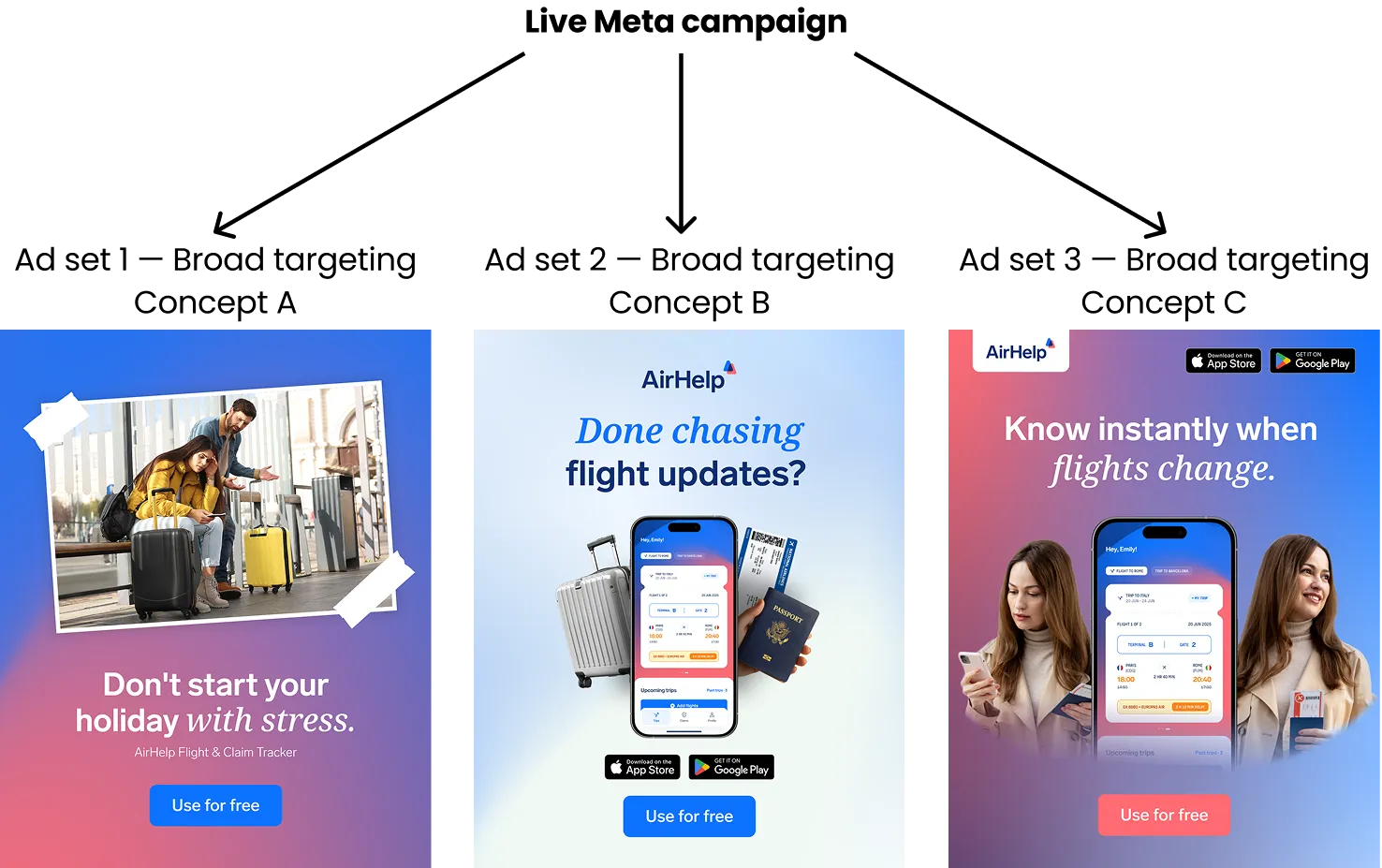
The structural call that separates a disciplined test from a wasteful one is where the ad sets live. Rather than quarantining tests in a separate low-budget campaign, run each concept inside the live campaign environment where the delivery system already has signal and budget to work with. Consolidated budget out-learns fragmented budget: a handful of well-funded concepts reach a conclusion faster than a dozen starved ones, which is the same fair-testing logic behind three paid acquisition mistakes that quietly burn budget. The goal is not to protect the test from spend. It is to give each concept enough spend to prove itself.
Step 3: Enforce a minimum spend per concept
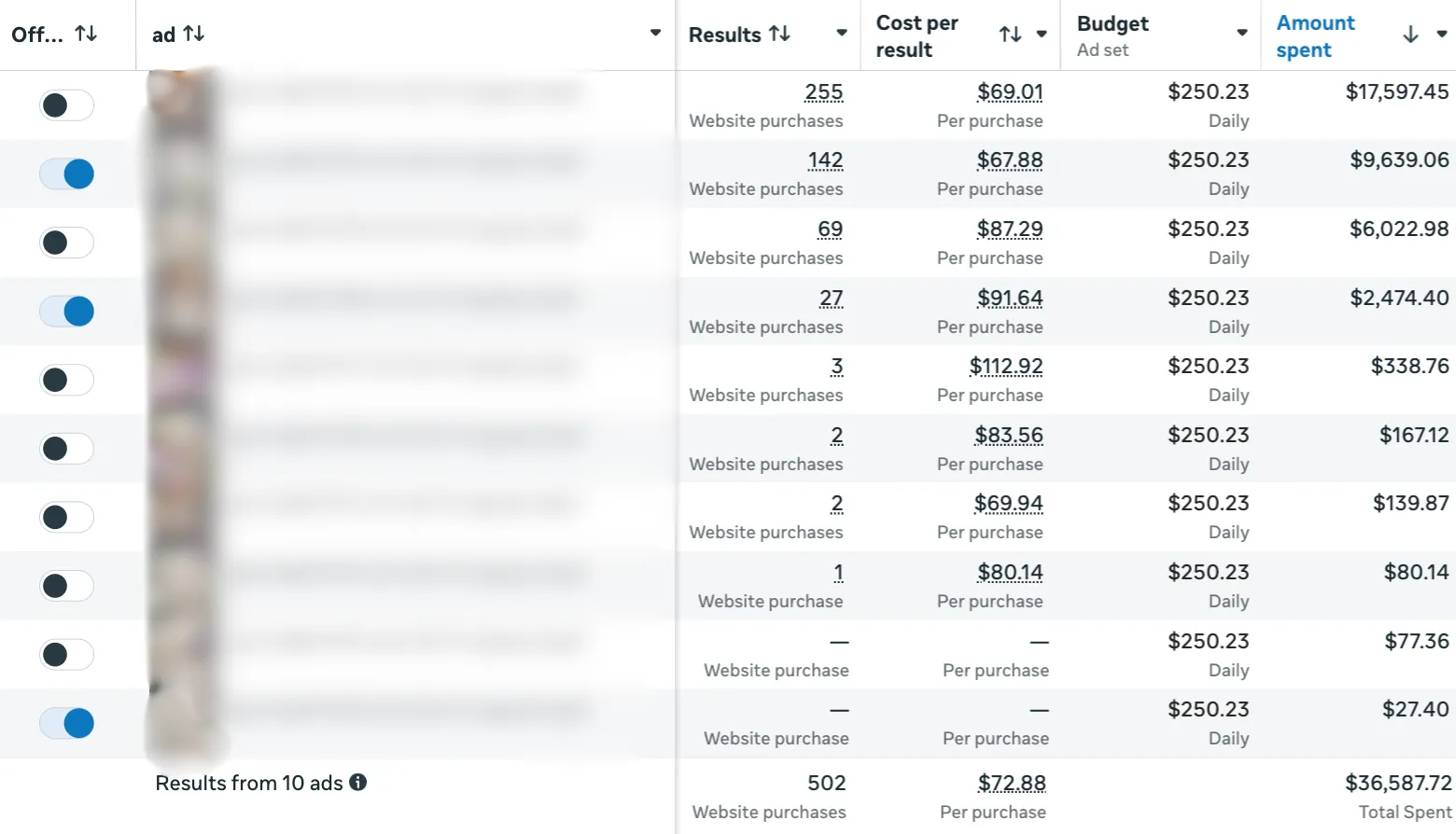
Left alone, Meta concentrates delivery on whichever ad spends first, and the rest barely register. That is not the system telling you which concept is best; it is the system telling you which concept it sampled first. A fair test requires that every concept clears a minimum spend before you judge it, enforced rather than hoped for.
The floor is set by data volume, not by patience. Meta's own guidance is that an ad set needs roughly 50 optimisation events a week to exit the learning phase, below which variance is too high to separate signal from noise. The same principle governs creative reads: a concept that has driven only a handful of conversions has not earned a verdict, whatever its click metrics suggest. Standard A/B testing sample-size logic applies here too, so decide the minimum spend and event count per concept before launch, and hold the line on it.
How long should a Meta creative test run, and what should you judge?
A Meta creative test should run until each concept has accumulated enough downstream conversions to read reliably, which for a subscription app usually means judging on cost per trial rather than on early engagement, and typically takes longer than the day or two most teams wait. Early metrics move first and mislead most; the metric that matters is the one closest to revenue that you can still gather in volume.
Step 4: Read the whole funnel, because thumbstop is a false positive if it does not convert
The most common way a creative test goes wrong is stopping at the top of the funnel. Thumbstop rate, the share of impressions that survive the first few seconds, is a real signal of attention, and it is not the same metric as click-through rate, trial starts, or cost per acquisition. Attention that does not convert is a false positive, not a win. A creative can stop the scroll, earn a strong click-through rate, and still deliver your worst cost per trial, because it attracted the wrong attention.
A high thumbstop rate can be a false positive when attention fails to convert into efficient trials (numbers are illustrative)
| Creative concept | Thumbstop rate | CTR | Trial rate | Cost per trial | Read |
|---|---|---|---|---|---|
| Concept A | 46% | 0.7% | 4.8% | $58 | ⚠️ False positive |
| Concept B | 32% | 1.4% | 14.2% | $23 | Strongest |
| Concept C | 37% | 1.1% | 10.6% | $31 | Promising |
Consider a pattern we see often: a subscription app running a creative test finds that its highest-thumbstop concept, the one everyone in the room liked, carries the weakest cost per trial of the set, while a quieter concept with an unremarkable hook rate produces trials at the lowest cost. Had the team judged on thumbstop, they would have scaled the expensive one. This is why the read has to run to the event that maps to value. For subscription products that is cost per trial, given how trial-to-paid economics dominate subscription-app performance; for a non-trial app, it is cost per activation or first purchase. The principle behind reading results at the right depth, rather than the shallowest available metric, is the same one behind why the same paywall wins on organic and loses on Meta: the surface number and the real number often disagree.
The discipline most tests are missing: automate the kill, harvest from mature data
Here is the operating discipline that separates a methodology from a checklist, and it is the part competitors' step-by-step guides tend to skip. The steps above tell you how to structure a fair test. This tells you how to end one honestly.
Step 5: Pre-commit the kill threshold, then let the trial signal mature
Before a single concept goes live, decide the spend cap at which a non-performing concept is cut, and enforce that cap with an automated rule rather than a human watching a dashboard. Pre-committing the threshold removes the two biases that corrupt live creative decisions: the temptation to rescue a favourite that is underperforming, and the temptation to crown an early front-runner that has not yet been tested against real downstream data. When the kill is automated, the concept either clears its bar on the metric that matters or it is retired, and no one relitigates it at 9am on day two.
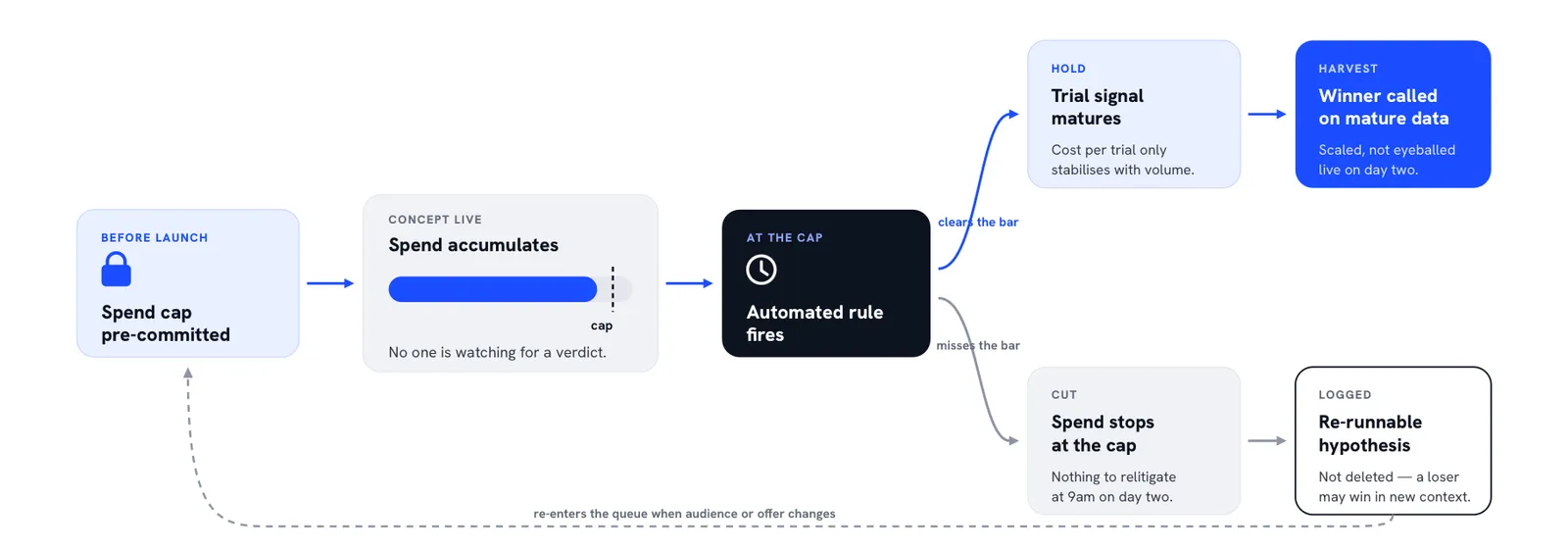
The counterpart to the automated kill is patience on the winners. Early dashboard numbers are noisy, and statistical significance takes time and volume to establish, so a concept's true cost per trial only stabilises once the trial signal has matured. That is why winners are harvested from mature data, not eyeballed live, and why losers are not deleted but logged as re-runnable hypotheses: a concept that lost this month against one audience or offer may win when the context changes.
The dashboard on day two is a liar. Automate the kill, let the trial data mature, and only then decide what won.
© Diana Daniuk, UA Manager at Applica
On the threshold itself, we keep the number private, because a tuned kill rule is an operating edge and publishing it would hand it to competitors. The point is not any particular figure; an illustrative cap might sit anywhere depending on your cost per trial and margin. The point is the discipline: automate the kill, wait for the trial signal to mature, harvest the winners, log the losers. That is what turns creative testing into a measurement system that compounds rather than a monthly guess.
How many creatives should you test at once?
You should test as many distinct concepts at once as your budget can fund to a fair read, and no more, because a concept that cannot clear its minimum spend produces no usable signal. The right number is a function of monthly spend divided by the minimum spend per concept, not a fixed target. Testing more variations of a single idea does not raise the number of tests you are running; it raises the number of ways you are asking the same question.
As an external reference point, the agency analyses cited earlier suggest something like 8 to 12 distinct concepts a month under modest budgets, again a third-party estimate rather than a platform rule, and one that scales with spend. Larger accounts fund more concepts because they can afford to read each one properly. Smaller accounts are better served by fewer, sharper hypotheses than by a wide field of underfunded ads that never reach a verdict. In every case the ceiling is set by fair reads, not by production capacity.
The bottom line
Structure, not volume, is what makes a Meta creative test trustworthy after Andromeda. Testing ad creatives on Meta is actually a structure problem, not a volume problem, because isolating one distinct concept per broad ad set and waiting for mature trial data is what produces a real read, not launching fifty variants and guessing. Three decisions carry the method: isolate the creative as the only variable by giving each distinct concept its own broad-targeted ad set inside the live campaign; fund each concept to a fair read and judge it on the whole funnel, not on thumbstop; and pre-commit the kill so winners are harvested from mature data instead of chosen live.
If your creative tests keep coming back inconclusive, the fix is rarely more ads. It is a structure that isolates the variable and the patience to let the data mature. That is the discipline our Creatives Production team builds into every account. If your last test left you guessing, that is the place to start.