Production value used to be treated as an advantage almost by default. On Meta, that assumption is increasingly breaking down. Polished creative is now easier to produce and scale than ever, through both traditional production pipelines and generative AI, while audiences have become increasingly fluent at recognizing the visual language of advertising. That is the shift worth planning around: as Meta's delivery gets more automated and creative becomes the main lever left to pull, ugly ads, native and unpolished by design, increasingly outperform the polished brand creative that used to win in-feed.
Here is why it matters commercially. Across the Meta accounts we manage, native-looking creative consistently outperforms highly polished executions. Video UGC-style concepts show a directional overall performance advantage of roughly 40 to 50% versus highly polished executions when we look across CTR, CPA and downstream conversion together, with the exact uplift varying by metric and account. Static, phone-shot, feed-native executions show a smaller but still meaningful directional overall performance advantage of roughly 25 to 30% versus highly polished brand statics. These are cross-account directional benchmarks, not controlled causal measurements, and the gap varies by product, category and audience. The direction, though, has held long enough across enough accounts to treat it as a planning assumption rather than a novelty.
So this is the argument, stated plainly: 'ugly' ads on Meta are a friction-reduction tactic, not a production-quality downgrade, because a native, human-looking execution lands the value proposition before the user classifies it as an ad. Ugly ads are not a licence to ship bad work. Understanding why the distinction holds is the key to the difference between copying a trend and building a durable creative advantage.
What is an 'ugly' ad on Meta?
An 'ugly' ad on Meta is a creative that looks native to the feed rather than produced for it: phone-shot footage, a talking-head hook, plain captions, an unbranded frame, a screenshot. It reads as something a person made, not something a marketing department signed off. Low production quality is not the point, nor is it an advantage. "Ugly" describes how the ad feels in context, human and unmanufactured, not how much effort went into it.
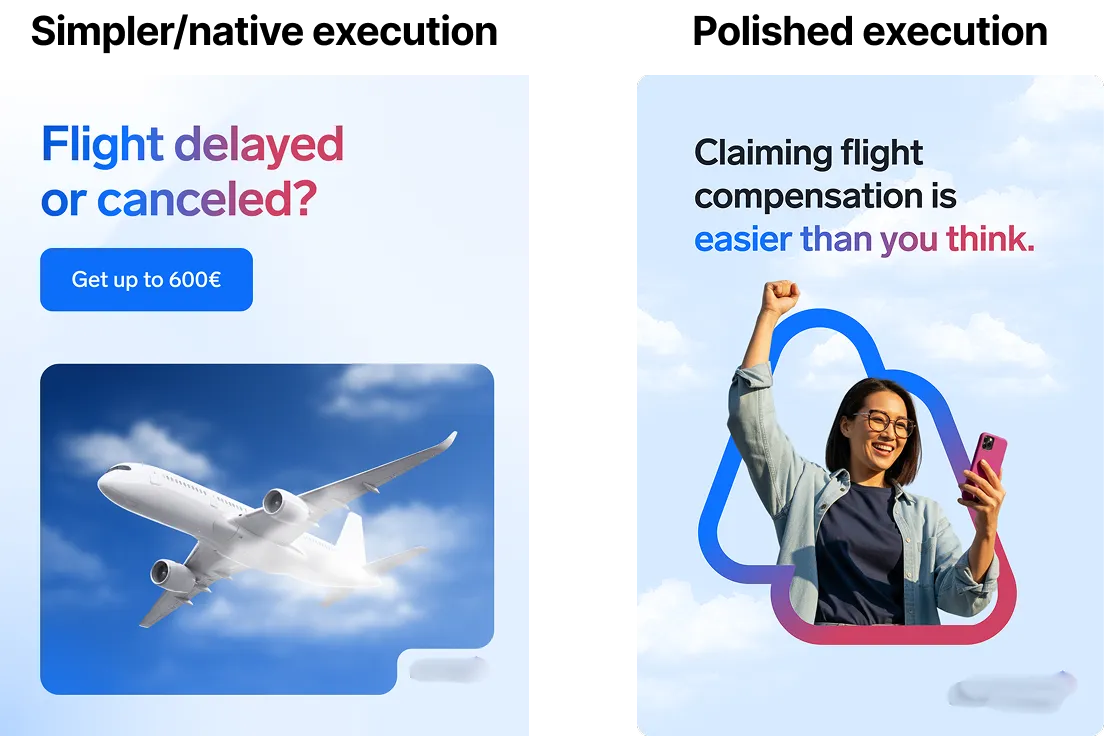
This is why "ugly" is not a format. You cannot brief a designer to "make it ugly" and expect a lift, because the same phone-shot aesthetic can read as authentic in one execution and as lazy in the next. The variable that moves performance is not roughness. It is whether the execution feels native enough to buy the message a few seconds of attention before the user's ad radar switches on. Our Creative Lead frames it directly:
'Ugly' does not win because it looks worse. It wins when it feels more native, more human and less manufactured. On Meta, the best-performing creative is often the one that gets the message across before the user has time to classify it as an ad.
© Dmytro Lapytskyi, Creative Lead at Applica
That framing is the whole thesis in one sentence, and everything below is the mechanism and the discipline behind it.
Why polished creative gets classified as an ad before the message lands
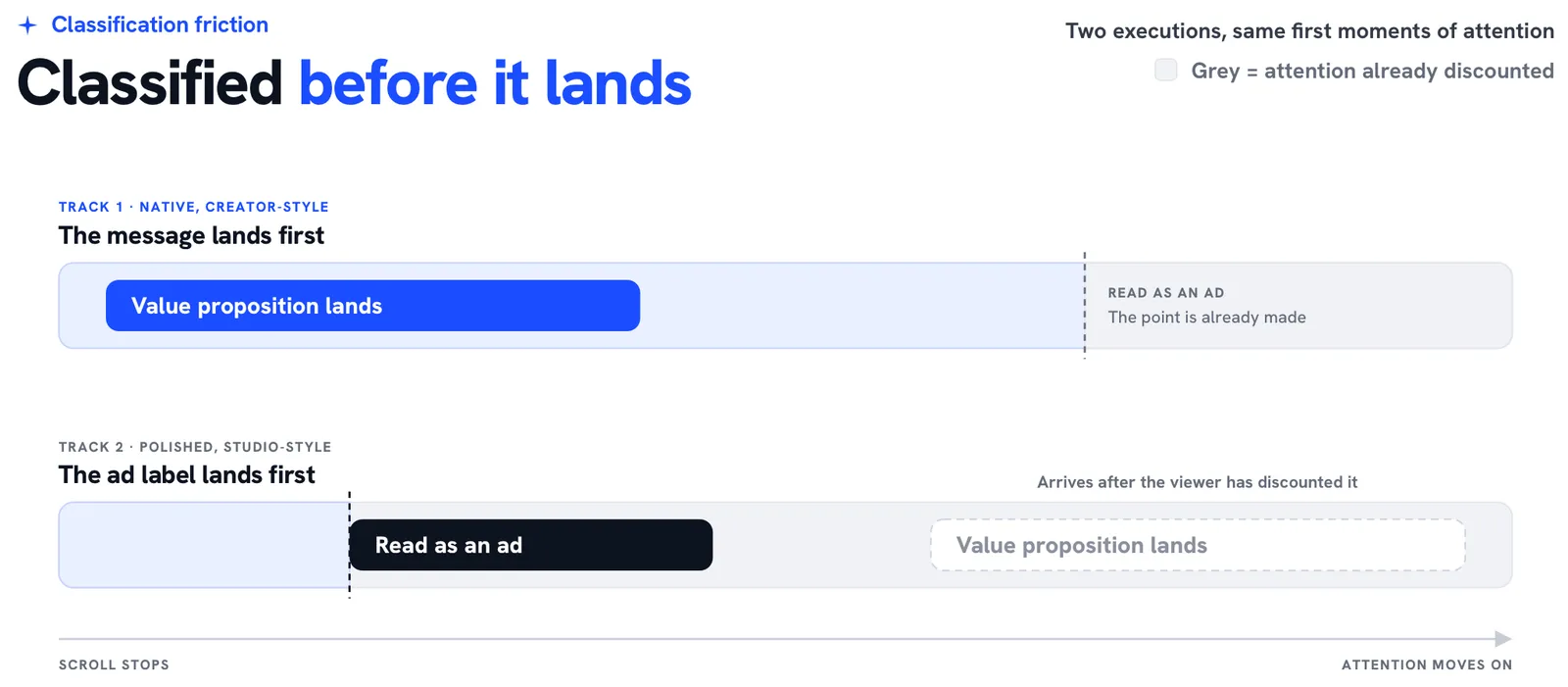
'Ugly' ads on Meta work as a friction-reduction tactic, not a production-quality downgrade, because a native execution lands the value proposition before the user classifies it as an ad. Polished creative does the opposite: heavy branding, colour-graded footage and obvious design are the exact cues people have learned to associate with advertising, so the classification happens early and the message competes against skepticism instead of landing clean.
The classification-friction problem
People carry what advertising researchers call persuasion knowledge: a learned ability to recognise when they are being sold to, and to discount the message accordingly. The disclosure and ad-cue research on social native advertising shows that visible advertising cues change how content is evaluated once they are recognised, and that recognition shifts the reader from absorbing a message to defending against one. Related work on behaviourally targeted native advertisingpoints the same way: the moment an execution is filed as "ad," a different, more critical mode of processing takes over.
Treat this as a behavioural observation, not a neuroscience law. The point is not that polished creative is invisible or that native creative escapes recognition entirely. Eye-tracking work on Facebook actually found that native ads draw more visual attention than banner formats, and that longer viewing tends to increase, not decrease, the odds a viewer recognises the ad as an ad. Native creative does not hide its commercial nature forever. It changes the order of events. The message gets a few seconds to register before classification kicks in, and on Meta those few seconds are most of the game.
Why native creative buys the message time
The advantage here is user-driven, and it is worth being precise about that. Meta's delivery system does not reward low production quality as a category, and framing it that way is one of the most common errors in the "ugly ads" discussion. Its delivery systems optimise toward predicted outcomes and user response, which means native creative benefits only when that execution actually produces stronger performance signals. In our experience, native-looking creative is often better at generating those signals because it reduces the friction between the user and the message. The advantage is not "ugly" itself; it is the response that the execution is able to produce. As targeting and delivery become more automated, creative increasingly becomes one of the main areas where advertisers can still create meaningful performance differentiation, which is where the performance marketing advantage now lives.
What the cross-account pattern actually shows
Across our managed Meta accounts, native-looking creative outperforms highly polished executions on the metrics that matter, but the size of the gap depends on format. Video UGC-style concepts show a directional advantage of roughly 40 to 50% across CTR, CPA and downstream conversion. Static, phone-shot, feed-native executions show a directional advantage of roughly 25 to 30% over highly polished brand statics. These are directional, cross-account benchmarks, not causal measurements, and they vary by product, category and audience.
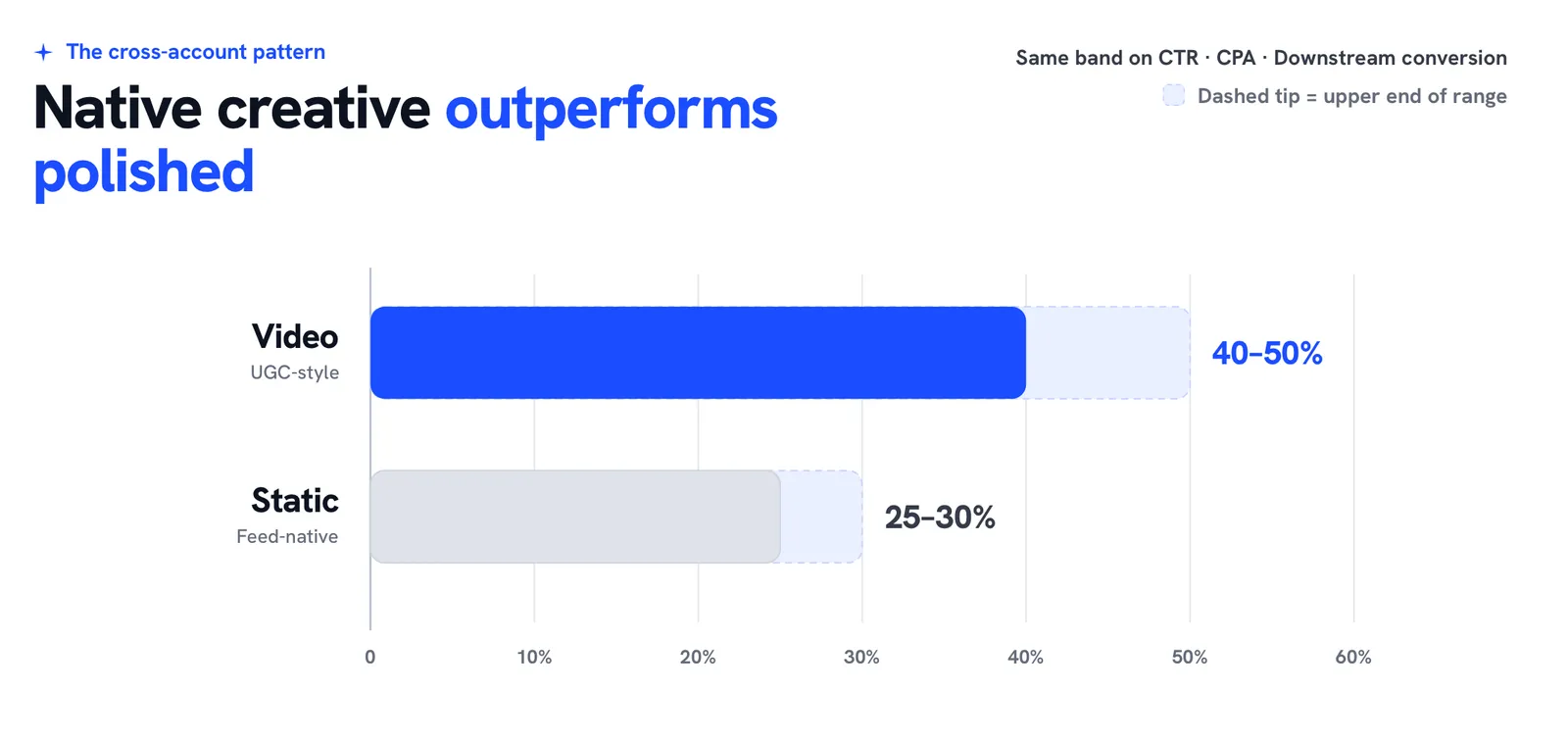
Keep the metrics distinct, because collapsing them into a single "ugly ads convert 50% better" line is where this argument usually goes wrong. A higher CTR means the hook earned the click. A lower CPA means the funnel converted efficiently. A better install-to-subscription or trial-to-subscription rate means the users who came through actually monetised. A native execution can win on all three, but they are separate outcomes, and a creative that wins attention while losing downstream conversion is a false positive, not a success.
Why the gap is wider for video than static
The video advantage tends to run larger than the static one, although we do not have enough evidence to attribute that gap to a single mechanism. One plausible explanation is that native video has more dimensions through which credibility can be communicated (face, voice, pacing, environment and delivery style), while static creative has fewer signals available to create the same effect. This may give native video more ways to feel human and credible, which could help explain why the performance gap versus polished creative is often larger than it is for static. It is consistent across the accounts we see, and it matches the broader market pattern where UGC-style ads earn materially higher engagement than studio-produced creative. Independent surveys point the same way: roughly 60% of consumers say user-generated content feels authentic against only about 16% for branded content, and authenticity is precisely the property that buys attention in-feed.
Why 'ugly' is not a licence to ship bad work
Here is where most "UGC wins" advice falls apart, and where the discipline actually lives. Low production quality is not the advantage. Imperfection only helps when it increases credibility without reducing clarity. A native execution that is genuinely hard to follow, where the hook is buried, the audio is unusable or the value proposition never lands, does not beat polished creative. It just fails in a cheaper-looking way.
The failure mode: mistaking sloppy for native
The trap is treating "ugly" as the goal instead of a side effect. Native creative works because it feels human and unmanufactured while still communicating a sharp message fast, which is why the strongest Meta creative strategies in 2026 pair native execution with a disciplined hook rather than chasing roughness for its own sake. Sloppy creative feels human and communicates nothing. The two look similar in a thumbnail and behave nothing alike in an auction. The distinction between raw creative that performs and low-effort creative that does not is the entire craft: keep the hook clear, the message legible and the value proposition unmistakable, then let the execution look native rather than produced. Not polish for its own sake, but clarity without the cues that trigger classification. That is a harder brief than "make a beautiful ad," not an easier one.
Do ugly ads always beat polished creative? When does polished still win?
No. Ugly ads do not always beat polished creative, and treating native execution as a universal rule is as lazy as defaulting to production value. Polished creative still wins in three specific situations, and the job is to assign it the right role rather than abandon it.
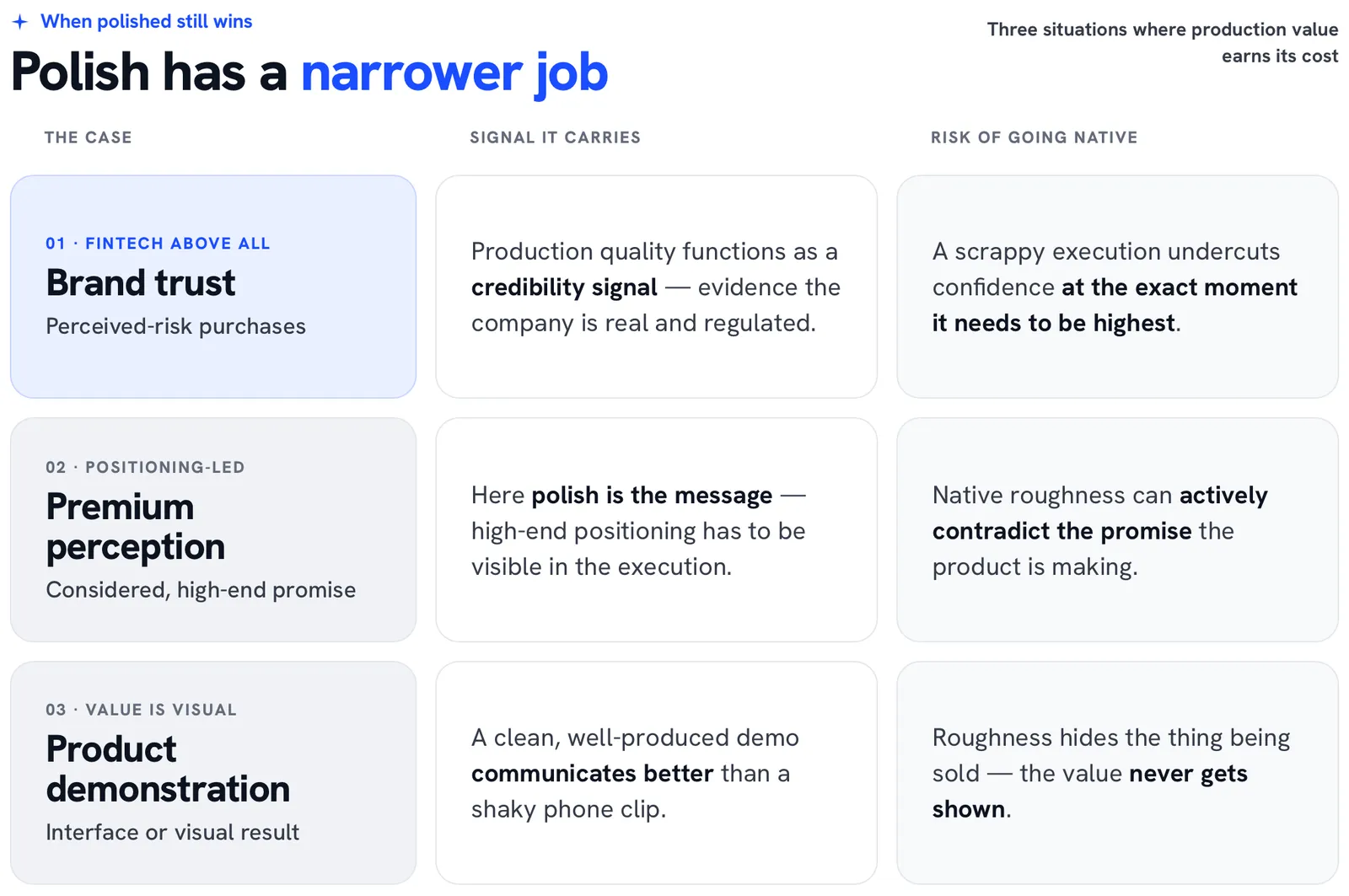
The first is brand trust. In categories where the purchase carries perceived risk, FinTech above all, production quality functions as a credibility signal. A user handing over financial details reads polish as evidence that the company is real and regulated, and a scrappy execution can undercut confidence at the exact moment it needs to be highest. The second is premium perception. If the product's positioning depends on feeling considered and high-end, native roughness can actively contradict the promise, and here polish is the message. The third is product demonstration. When the value is in the interface or the visual result, a clean, well-produced demo communicates better than a shaky phone clip. Even seasoned practitioners note that UGC has clear conditions where it works and where it does not, and that the choice between UGC and branded creative is contextual rather than absolute. Context, in this case, also means placement: the same asset behaves differently by source, which is why a creative that wins in one environment can lose in another. Polished creative is not the enemy. It is a tool with a narrower, more deliberate job than it used to have.
How to test native creative against polished on Meta
The decision rule is simple: test it, do not assume it. The directional advantage is a reason to put native executions into the auction against your polished control, not a reason to retire polish on faith. A disciplined test isolates the creative as the single variable and reads the whole funnel before calling a winner.
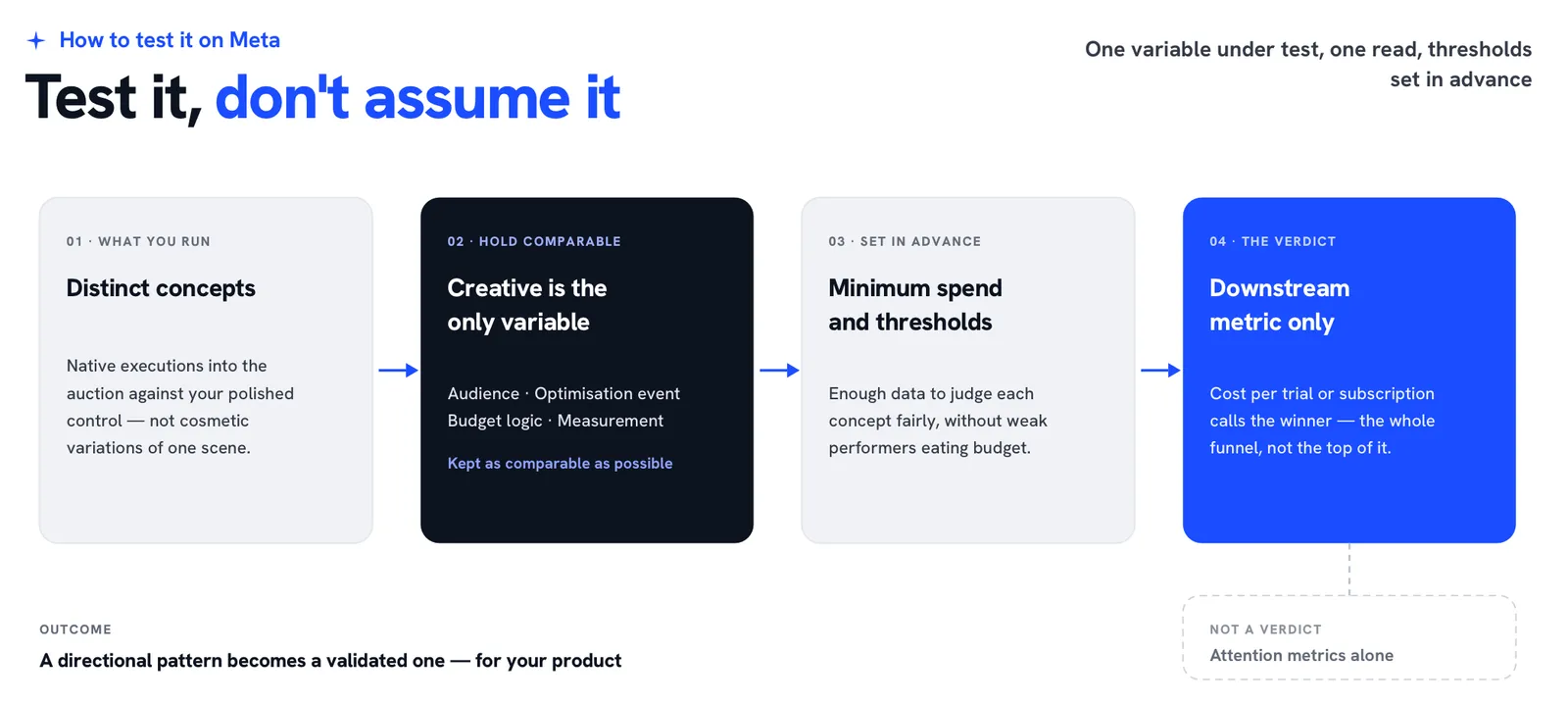
Run distinct concepts rather than cosmetic variations, because swapping a font on the same polished scene teaches you nothing about native versus polished, and Meta's current delivery rewards conceptually distinct creative rather than near-duplicates. Keep audience, optimisation event, budget logic and measurement conditions as comparable as possible so creative remains the primary variable under test. Define minimum spend and decision thresholds in advance so each concept receives enough data to be evaluated fairly without allowing weak performers to consume disproportionate budget. Most importantly, judge the result on the downstream metric that matters, such as cost per trial or subscription, rather than declaring a winner based on attention metrics alone. This is the same creative A/B testing method that separates a real read from a guess, and it is where most budgets leak, because testing native against polished unfairly is one of the quiet mistakes that burns spend. A structured A/B testing and data analysis approach turns the directional pattern into a validated one for your specific product, which is the only version that should change your budget.
The takeaway
The 2026 shift is not that ugly is good and polished is bad. It is that production value stopped being a free in-feed advantage the moment AI made it cheap and audiences learned to read it as an ad. 'Ugly' ads on Meta win as a friction-reduction tactic, not a production-quality downgrade, because a native, human-looking execution lands the value proposition before the user classifies it as an ad.
Three things to carry into your next creative sprint. First, the advantage is friction, not roughness, so brief for native clarity, not for low quality. Second, the discipline is what separates native creative that performs from sloppy creative that just looks cheap, so keep the hook and the value proposition sharp. Third, polished creative still has a defined role in trust, premium perception and demonstration, so assign it that role and test native executions against it rather than defaulting to either one.
If your Meta creative has been optimised for how it looks rather than how fast it lands, that gap is where efficiency is leaking. Explore where native executions could outperform your current control with a creatives production audit, and let the test, not the assumption, decide.