
Most app growth strategies are a channel list with a budget attached. That worked when you could see what every channel did. You cannot any more, and the strategies that survive now are built differently: around systems that feed each other rather than channels that report separately.
What Is an App Growth Strategy?
An app growth strategy is the plan that decides which number your app grows toward and which systems you improve to move it. In practice, it answers three questions, in order:
What is the one number that tells you growth is working? Not installs. For a subscription app it is usually payback period or net revenue retention. If different teams would answer differently, you do not have a strategy, you have departments.
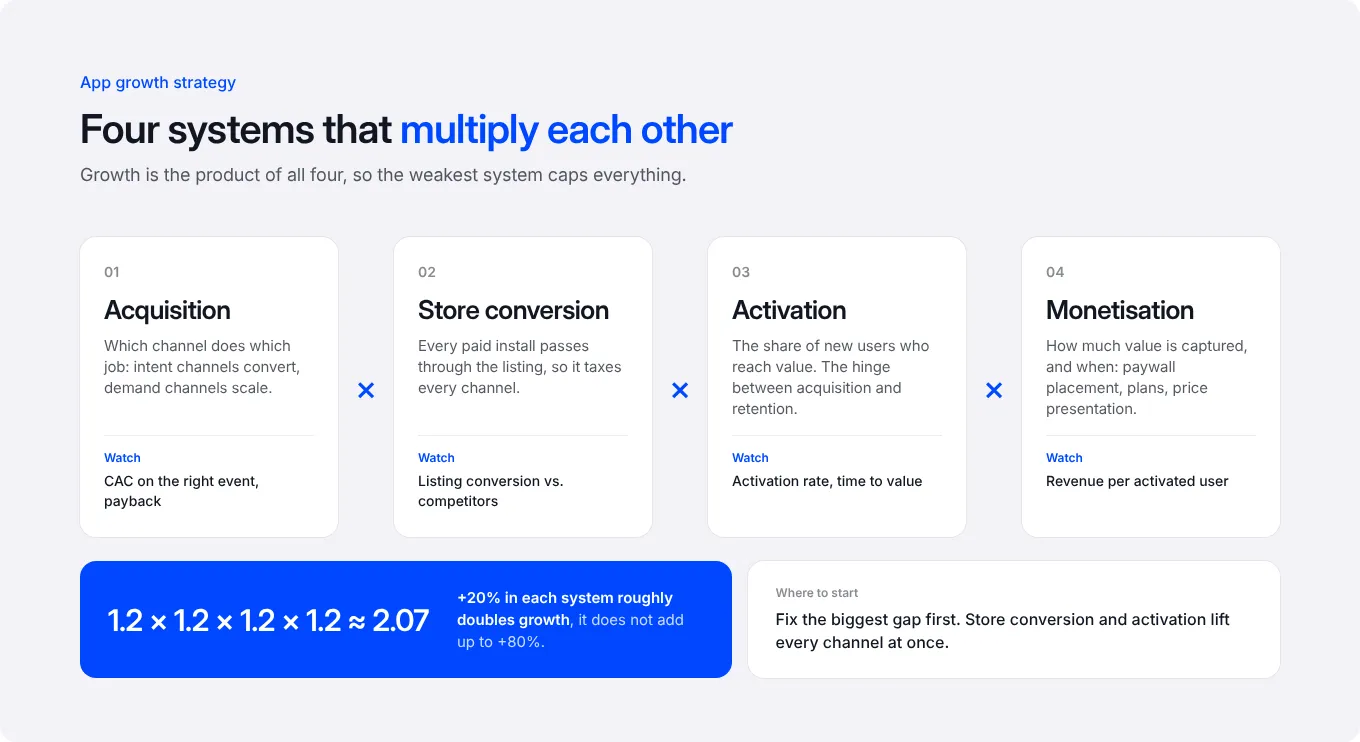
Which systems produce that number? Four, and they compound: acquisition, store conversion, activation and monetisation. Each multiplies the others, which is why the weakest one caps everything.
What do you fix first? The one with the largest gap between where you are and what good looks like. Almost never the one that is most fun to work on.
Why the old playbook stopped working
Measurement became probabilistic. After App Tracking Transparency, most iOS conversions arrive modelled rather than observed. Strategies that depend on precise channel attribution are now built on estimates, and the teams still treating those estimates as facts are making confident decisions on noise.
Targeting moved into the creative. Platforms model audiences better than manual targeting specifies them. The creative is what tells the algorithm who the ad is for, which turns a design function into a performance one.
Discovery stopped being only search. People ask AI assistants which app to use. That traffic does not appear in your rank tracker, and optimising for it is a different job from ranking for keywords.
Acquisition costs rose faster than conversion improved. Which means the growth available from buying more users is smaller than the growth available from making each one worth more. That is the single biggest shift in where effort should go.
The four systems
Every mobile app growth strategy, whatever the category, runs on the same four systems. App growth marketing usually covers only the first one, which is why marketing-led plans plateau.
Acquisition
Particularly: which channel for which job. Intent channels such as Apple Ads convert best and cap early. Demand-creation channels such as Meta scale but depend on creative volume. Most apps should prove the funnel where intent is highest, then scale where volume is.
The discipline that matters is the optimisation event. Optimise to installs and you will get installs. Full treatment in mobile user acquisition strategy.
Store conversion
Every paid install passes through your listing. A listing converting at 25% against a competitor's 40% taxes every channel at once. This is the highest-leverage and least-staffed system in most teams, usually because it sits between marketing and product and belongs to neither. On TouchRetouch, a feature-focused custom product page cut cost per trial by 32.6% against the default product page in US branded campaigns. See app store conversion optimization.
Activation
The share of new users who reach value. It is the hinge between acquisition and retention, and it is where acquisition spend either becomes a user or evaporates. See user activation in mobile.
Monetisation
How much of the value you capture, and when. Paywall placement, plan structure and pricing presentation decide revenue per activated user more than the price itself does. On Fabulous, a pricing experiment at the end of the web-to-app funnel added 40% to ARPU within four weeks. See mobile paywall design.
The compounding point. A 20% improvement in each of the four is not an 80% improvement. It is roughly a doubling, because they multiply. This is why sequencing beats intensity, and why most teams that plateau have three strong systems and one neglected one.
Grow lifetime value, not installs
The single most consequential choice in an app growth strategy is which number the organisation optimises toward, because everything else arranges itself behind it.
Optimise to installs and you will get cheaper installs, worse users, a falling conversion rate and a team that cannot explain why revenue is flat while the dashboard is green.
Optimise to lifetime value and the nominal cost per install rises, the cost per paying user falls, and the channels that looked expensive turn out to be the profitable ones.
The practical version: pick the deepest event you can measure reliably, usually trial start or first payment, and make every channel report against it. Expect this to be unpopular, because it makes several channels look worse than they did.
For the modeling side, see the LTV model your app deserves and the difference between average revenue per user (ARPU) and LTV. To check how fast your acquisition spend pays back, try the free payback calculator, which weighs LTV against customer acquisition cost (CAC).
This is where disciplined testing earns its keep: 7 Minute Workout grew annual recurring revenue (ARR) by 50% through structured A/B tests across onboarding, paywall and pricing.
Building the strategy
1. Establish measurement before anything else
A mobile measurement partner configured to your actual commercial events, a deliberate SKAdNetwork schema rather than the default one, and cohort reporting by channel. Without these the rest is guesswork with a budget.
2. Find the weakest system
Map the funnel end to end: impression to install, install to activation, activation to payment, payment to renewal. Compare each transition against your own history. The largest decline, not the lowest absolute number, is where to start.
3. Fix in order of multiplication
Store conversion and activation sit above acquisition in leverage, because they improve every channel at once. Acquisition work only improves acquisition.
4. Scale what survives payback
Add a channel when the current one saturates, not when it is merely working. Saturation is rising cost per paying user at flat spend, or flat volume at rising spend.
5. Set a review cadence that matches the cycle
Weekly for creative, monthly for channel mix, quarterly for the strategy itself. Reviewing a quarterly decision weekly produces thrash; reviewing a weekly decision quarterly produces waste.
Your App Growth Roadmap by Stage
The four systems stay the same as an app grows. What changes is which one deserves the next month of effort.
Before product-market fit. Growth spend is mostly research. Run small paid tests to learn which audience and message convert, fix activation, and keep acquisition budgets small until a cohort shows it retains. Scaling a leaky funnel only buys churn faster.
Early scale. Once one channel pays back, the work shifts to store conversion and the paywall, because each improvement there lowers the cost of every install you buy. This is the stage where most subscription apps find their biggest gains.
Growth stage. Spend is large enough that creative volume and measurement become the bottleneck. Add channels only as the current ones saturate, and move the optimisation event deeper, to trial or first payment.
Mature. New users get more expensive every quarter, so retention, pricing and expansion into new markets carry more of the growth. Localisation and win-back campaigns usually pay back faster than another acquisition channel at this point.
What to measure
- Payback period by cohort and channel. The number that governs how fast you can scale
- Cost per paying user, not cost per install
- Store conversion rate, split by traffic source
- Activation rate and time to value
- Net revenue retention for subscription apps
If you track one, track payback by channel. It answers more questions than the rest combined.
Common mistakes
- A channel plan presented as a growth strategy
- Measurement built after the campaigns rather than before
- Optimising cost per install for a subscription business
- Spreading effort evenly across four systems instead of fixing the weakest
- Adding channels for diversification before the first is saturated
- Judging a quarter's strategy on a fortnight's data
Conclusion
An app growth strategy is not a list of channels. It is a decision about which number matters, an honest assessment of which of the four systems is weakest, and the discipline to fix that one first.
The teams that compound are not the ones running the most channels. They are the ones whose four systems are roughly equally strong, because that is what multiplication rewards.
If you are weighing outside help, this comparison of leading mobile app marketing agencies is a useful place to start. If you want a growth plan built on your own funnel data rather than a list of generic tactics, talk to Applica, an app growth agency for subscription apps.
FAQ
What is an app growth strategy?
It is the plan for which number you optimise toward and how the four systems that produce it (acquisition, store conversion, activation and monetisation) will be improved and in what order. A channel list with a budget attached is a media plan, not a growth strategy, and the difference shows up when a channel underperforms and nobody can say what should change.
What is app growth marketing?
App growth marketing is the part of app growth that brings users in and keeps them coming back: paid acquisition, app store optimisation, creatives and lifecycle messaging. A full app growth strategy goes further and includes activation and monetisation, which are product decisions as much as marketing ones.
How much does an app growth strategy cost?
The strategy itself costs analysis time. What varies is execution, and the figure that matters more than any budget is payback period, since it determines how much spend you can sustain before the cohort pays for itself. An app with a three-month payback can support far more spend than one with a nine-month payback at the same budget.
How long does a growth strategy take to show results?
Store conversion changes show within weeks because they affect every visitor immediately. Activation changes show in the next cohort. Acquisition changes take a full payback cycle to judge honestly, which for most subscription apps is one to three months. Judging acquisition before a payback cycle completes is the most common cause of good channels being cut.
What is the difference between app growth and app marketing?
App marketing is usually acquisition and communication. App growth includes store conversion, activation and monetisation, which are product decisions as much as marketing ones. The distinction matters because the largest gains in most apps sit in the parts marketing does not own.